
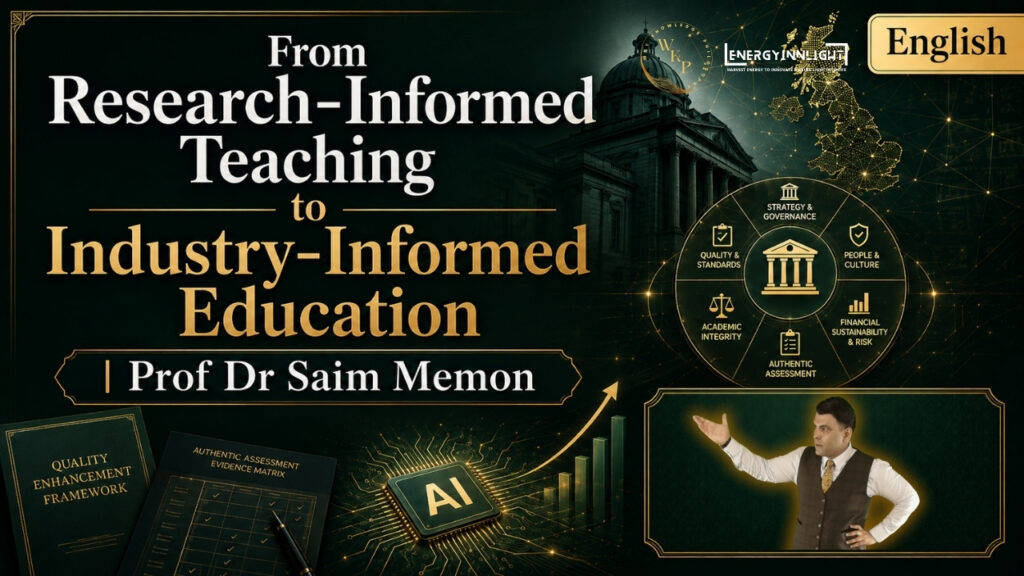
what does teaching mean now?
What does teaching mean when students carry artificial intelligence, student debt, professional ambition, personal anxiety and several virtual tutors in their pocket?
This is not a rhetorical question. It is now one of the most serious questions facing universities, academics, students, employers and policy leaders.
For many years, the answer appeared clear. We taught the approved curriculum. We taught the textbook. We taught the lecture notes. We taught the established methods of the discipline. In engineering, that meant that an electrical engineering student learned circuit theory, machines, power systems, control, electronics, mathematics and the language of the profession. In that sense, teaching was not merely the transfer of information. It was the transmission of a professional language.
I still believe that this matters. A student cannot become an electrical engineer if they cannot think in voltage, current, impedance, power factor, signal, noise, stability, uncertainty and safety. A student cannot become a mechanical engineer if they cannot think in force, stress, strain, energy, thermodynamics, heat transfer, fatigue and manufacturing limits. Fundamentals are not old-fashioned. They are the grammar of professional judgement.
But the deeper question is no longer only what we teach, or even how we teach. The deeper question is why this knowledge matters, where it is used, who benefits from it, who pays for it, what it does to society, and how it must change when evidence, technology, ethics and industry itself change.
That is where I believe universities now stand.
We moved from curriculum-informed teaching to research-informed teaching. Now we need industry-informed education, led by AI-informed teaching.
Not as a slogan. Not as a committee title. Not as another attractive diagram in a strategy document that everybody praises and nobody uses. We need it because the context around higher education has changed.
Students have changed. Industry has changed. Artificial intelligence has changed. The graduate labour market has changed. The economics of higher education have changed. If all of that changes while curriculum changes only through the slow ritual of annual module review, then we should not be surprised when students ask difficult questions. In fact, we should welcome those questions. They are often the beginning of truth.
The first model: curriculum-informed teaching
The first model was curriculum-informed teaching. It was based on a stable assumption: knowledge was scarce, books were authoritative, lecturers had privileged access to disciplinary expertise, and students came to university to enter that knowledge system.
There was nothing wrong with that model in its time. It built generations of engineers, scientists, teachers, doctors, lawyers, managers and public servants. It gave students structure. It protected academic standards. It introduced students to the intellectual heritage of a subject.
The hidden fact within that fact is this: curriculum-informed teaching worked well when the world outside the curriculum moved relatively slowly. A module could remain stable for years because the industrial systems connected to it changed at a manageable speed. A textbook could reasonably represent the centre of the discipline. A library was not merely a building. It was the gatekeeper of serious knowledge.
Today, the library should not be dismissed, but its role has changed. It is no longer only a warehouse of books and journals. It must become a navigation system for trusted knowledge, where students learn how to distinguish evidence from noise, peer review from performance, and real understanding from confident but unsupported content.
So the leadership question is not: should we keep the curriculum?
Of course we should.
The better question is this: which parts of the curriculum are intellectual foundations, and which parts are historical habits wearing academic clothing?
The second model: research-informed teaching
Then came the idea of research-informed teaching. This was a major improvement. It asked academics not simply to repeat established content, but to bring current research, inquiry, evidence and scholarship into the classroom.
That matters deeply. Universities should not become training factories. A university education must develop curiosity, critique, intellectual independence and the ability to work with incomplete evidence. Research-informed teaching helps students see that knowledge is not a finished object. It is a process, sometimes a beautiful process, sometimes a messy one, and occasionally a process involving reviewers who disagree with each other for reasons known only to themselves.
Research-informed teaching also helps academics connect their scholarship with student learning. That is valuable. But we must now be honest: research-informed teaching alone is no longer sufficient.
A research paper may be rigorous, but far from industrial readiness. A simulation may be elegant, but the product may fail in manufacturing. A laboratory prototype may impress a conference audience, but still be nowhere near deployment, cost control, certification, supply-chain integration, user adoption or customer value.
This is where my own experience across academic teaching, degree apprenticeships, industrial R&D and commercial translation has shaped my thinking. Moving an idea from early-stage research towards industrial validation and market application changes how one understands education. It makes you respect theory more, not less, because theory becomes accountable to reality. It also makes you more impatient with knowledge that is never tested against cost, standards, safety, users, regulation, production constraints and market behaviour.
A graduate who can quote a research paper is useful.
A graduate who can question the assumptions behind that paper is better.
A graduate who can connect that paper to a real industrial problem, test it ethically, communicate it clearly, and improve it under constraints is the kind of graduate universities should now aim to produce.
The third model: industry-informed education led by AI-informed teaching
We now enter the third transition: industry-informed education, led by AI-informed teaching.
I choose the word education deliberately. I am not only speaking about teaching technique. I am speaking about the design of a whole learning experience: curriculum, assessment, employer engagement, apprenticeships, enterprise, technical skills, professional ethics, student confidence and graduate outcomes.
The evidence is clear that knowledge production has accelerated. Global science and engineering publication output reached 3.3 million articles in 2022, based on Scopus-indexed science and engineering publications, and grew by 59 per cent between 2012 and 2022 [1]. Crossref statistics also show a very large and growing scholarly record, with more than 183 million records and more than 123 million journal DOIs in its database at the time of access [2].
The point is not to pretend that we know every book, paper, report and dataset ever produced. We do not. The point is simpler and more important: the volume of available knowledge is now beyond the capacity of any individual lecturer, student, library or curriculum committee to absorb and organise manually.
Then came generative AI.
By 2026, students do not simply have books, papers, recorded lectures and online resources. They have conversational systems that can explain concepts, generate code, summarise papers, critique drafts, solve equations, produce diagrams, translate language, generate revision plans and simulate a patient tutor at two o’clock in the morning.
Sometimes the system is brilliant. Sometimes it is confidently wrong.
That combination is exactly why universities matter more, not less.
The HEPI Student Generative Artificial Intelligence Survey 2026 reports that 95 per cent of students use AI in at least one way and 94 per cent use generative AI to help with assessed work [3]. Jisc’s 2025 student research also reports that some students are concerned about over-reliance on AI, anxiety about the pace of AI development, data use and the wider impact of deepfakes [4]. The Office for Students has noted that students use AI to break down complex information, visualise data, write code and prompt creativity, while also asking for clear, consistent and accessible guidance [5].
This means the teacher is no longer the only explainer in the room.
The teacher must become something more difficult and more valuable: a designer of judgement, a guardian of standards, a guide to evidence, a challenger of assumptions, and a builder of professional capability.
If AI can explain the what and the how, universities must become much better at teaching the why, the when, the where, the risk, the ethics, the evidence and the consequences.
That is why critical questioning matters. The future graduate will not be judged only by how much they know. They will be judged by the quality of questions they ask when knowledge is incomplete, data are uncertain, the model is biased, the budget is limited, the client is impatient and the ethical answer is inconvenient.
Student value and the employability covenant
There is another reason why this matters: students now carry a financial and emotional burden that universities must take seriously.
The graduate premium has not disappeared. Department for Education statistics show that, in 2024, 87.6 per cent of working-age graduates were in employment, compared with 68.0 per cent of non-graduates. The same statistics show that 67.9 per cent of working-age graduates were in high-skilled employment, compared with 23.7 per cent of non-graduates [6].
So we should not lazily say that degrees have no value. That would be wrong. Degrees still matter.
But value is not the same as automatic trust.
Students, families, employers, regulators and government now ask sharper questions. Does the course prepare students for work? Is the teaching current? Is assessment meaningful? Is support visible? Is the cost justified? Does the curriculum connect with the world students are entering?
The student loan figures are sobering. Student Loans Company data show that the total higher education loan balance in England increased from £54.4 billion in 2013–14 to £266.6 billion by 2024–25 [7]. The House of Commons Library reported that the average debt among borrowers who finished their course in 2024 was £53,000 when they first became liable to repay in April 2025 [8]. The Government has also confirmed that the Plan 5 repayment threshold for loans due to come into repayment from April 2026 is £25,000, with the Plan 5 interest rate for 1 September 2025 to 31 August 2026 linked to RPI at 3.2 per cent [9].
So when a student asks, “Where will I use this?” we should not respond with academic irritation.
We should hear the deeper question: How does this help me become capable, employable, ethical and economically resilient?
Office for Students research published in March 2026 found that securing employment was the primary goal for 76 per cent of recent graduates surveyed. Half reported feeling prepared for life after leaving university or college, while a third reported feeling unprepared [10]. The same research suggests that graduates who had work placements or opportunities to develop professional connections felt better prepared, and that universities and colleges should strengthen links with employers and industry professionals through placements, mentoring and speaker visits [10].
This is what I call the employability covenant.
If a university asks a student to invest money, time, hope and often family sacrifice, the university must do more than deliver content. It must create the conditions in which that student can understand the labour market, practise professional skills, build evidence of capability, meet employers, use AI responsibly and graduate with confidence rather than panic.
This is not about reducing education to job training. It is about refusing to separate intellectual development from life chances.
A good university should not say, “We have taught the module; good luck with the market.”
That is like handing someone a beautiful map and forgetting to mention that the bridge has collapsed.
Engineering example: from transistor teaching to AI factories
Let me use engineering as a practical example.
We still teach Laplace transforms, control theory, circuit analysis, semiconductors, bipolar junction transistors, filters and amplifier circuits. We should not simply remove them. That would be a mistake. These fundamentals still help students understand the behaviour of systems, signals, stability, frequency response, switching, amplification and abstraction.
But the question is how we frame them.
When I studied complex Laplace transforms and solved long algorithms by hand, I appreciated the discipline because I was being trained to think mathematically. Today, a student may reasonably ask: “Where will I use this in industry?”
That question is not ignorance. It is an opportunity to redesign teaching.
We can teach Laplace transforms through control of smart grids, power electronics, robotics, energy storage, EV battery thermal management and AI-assisted digital twins. We can teach transistors not as isolated museum objects, but as the conceptual gateway to modern semiconductor systems, GPU architectures, embedded electronics, sensors, automation and AI infrastructure.
Take NVIDIA Blackwell as an example. NVIDIA states that Blackwell-architecture GPUs pack 208 billion transistors, are manufactured using a custom-built TSMC 4NP process, and use two reticle-limited dies connected by a 10 terabytes per second chip-to-chip interconnect [11].
Now ask the critical question: what does a first-year transistor lecture have to do with 208 billion transistors in an AI superchip?
The answer is not that a student should design a Blackwell GPU after one lecture. That would be ambitious, even by university marketing standards.
The answer is that the student must understand the hierarchy: semiconductor physics, device behaviour, switching, logic, architecture, interconnect, memory, thermal management, power delivery, software ecosystems, data-centre infrastructure, energy demand, manufacturing constraints, supply chains and ethics.
This is where industry-informed education becomes powerful. The curriculum does not abandon fundamentals. It gives fundamentals a living address.
SCADA, smart grids and high-voltage transmission lines provide another example. These systems have existed for decades and will continue to matter. But they now interact with renewable energy, cyber security, distributed generation, grid-scale storage, AI-based forecasting, digital twins and national energy resilience.
An industry-informed module should not merely explain a protection relay or a transmission-line equation. It should ask: what does grid reliability mean in a decarbonised, digitised and cyber-threatened energy system? What data do we need? What can AI predict? What should AI never decide alone? What happens when a model is accurate but the ethics are weak?
That is the shift.
The subject remains engineering, but the educational experience becomes richer, more current, more employable and more honest.
A six-layer model for industry-informed education
I propose a practical six-layer model for industry-informed education.
1. The disciplinary language layer
Every programme must still teach its intellectual grammar: mathematics, scientific principles, design, analysis, evidence, communication and professional standards.
Without fundamentals, students become tool users without judgement.
This layer protects academic seriousness. It also protects students from becoming dependent on software outputs they cannot interpret.
2. The industry-problem layer
Each module should be linked to real systems, real sectors, real employers or real public needs.
In engineering, this may include clean energy, advanced manufacturing, construction, digital technologies, healthcare, automation, AI infrastructure, transport and climate resilience.
Skills England’s assessment of priority skills to 2030 describes future employment needs across ten critical sectors aligned with the UK Industrial Strategy and wider economic priorities [12]. This does not mean universities should abandon intellectual independence. It means they should understand the world into which graduates are moving.
3. The AI co-intelligence layer
Students should not be taught either to worship AI or fear it.
They should learn how to use AI for ideation, explanation, modelling, coding, literature navigation and feedback, while also testing its accuracy, bias, traceability and limitations.
AI literacy should include prompt design, verification, data ethics, academic integrity, model limitations and human accountability.
The point is not to catch students using AI. The point is to teach them how to use it responsibly, intelligently and transparently.
4. The work-integrated evidence layer
Students need evidence of capability.
This may include employer-linked projects, apprenticeships, placements, simulations, design briefs, portfolios, demonstrations, oral defences, reflective logs and assessment tasks that resemble authentic professional practice.
Degree apprenticeships are especially important because they force universities to connect learning with workplace performance. They also show that higher education can be both academically serious and professionally situated.
5. The ethics and public-value layer
Industry-informed education must not become industry-obedient education.
This distinction is vital.
The university must retain its critical independence. Students must be able to ask whether an industrial solution is safe, sustainable, fair, transparent, affordable and socially useful.
This is particularly important in AI, energy, construction, healthcare, data, cyber security, defence and environmental systems.
Industry can tell universities what problems matter. Universities must still teach students how to question those problems, test evidence and protect the public good.
6. The enterprise and productivity layer
Graduate employability is not only about getting a job.
It is about helping students create value.
That may mean joining an employer, improving a process, launching a venture, commercialising research, improving a public service, building a prototype, developing a policy, designing a safer system or translating knowledge into productivity.
Universities UK’s blueprint for change argues that universities should stabilise, mobilise and maximise their contribution to economic growth and widening opportunity [13]. That is a useful direction if it is handled with academic integrity and not reduced to slogans.
The university of the future should not only ask whether a student passed. It should ask what capability the student can evidence.
How should curriculum approval change?
Industry-informed education changes the function of curriculum approval.
Instead of asking only whether learning outcomes are mapped to assessments, universities should ask a richer set of questions.
What industry problem does this module help students understand?
Which professional capabilities does it build?
Which AI tools will students use, critique and evidence?
Which employer, sector or public-service context informs it?
Which ethical risks are discussed?
Which assessment produces credible evidence for a future employer?
Which fundamentals remain non-negotiable?
Which content is retained mainly because it is familiar?
These questions do not weaken academic standards. They strengthen them.
The Quality Assurance Agency’s UK Quality Code sets out principles for securing academic standards and assuring and enhancing quality in UK higher education [14]. Industry-informed education must sit inside that quality framework. It should not be a shortcut around academic standards. It should be a stronger method for making standards meaningful.
The critical-thinking method: what, how, why, where and what remains hidden
At the heart of this model is the method of critical questions.
I often say that we must move beyond what and how.
What is the theory? How is it calculated? These questions are necessary, but incomplete.
We must also ask why, where, under what assumptions, with what evidence, in whose interest, with which ethical constraint and with what hidden consequence.
This is also where semantics and prompt engineering become educationally important.
Prompting is not merely a fashionable AI trick. At its best, it is disciplined questioning. It forces the student to define context, criteria, evidence, constraints, assumptions and desired output.
Good prompting is not magic. It is structured thinking in language.
I would like students to leave university with a professional habit of inquiry. When they face a problem, they should not rush to the first answer. They should ask:
What do we know?
What do we think we know?
What is missing?
Which data are reliable?
What is the model assuming?
Who is affected?
What can go wrong?
What would make this solution fail in the real world?
What would make it useful?
What is the fact inside the fact?
That last phrase matters to me: the fact inside the fact.
The fact may be that graduate employment is higher for graduates than non-graduates. The fact inside the fact is that many graduates still feel underprepared, face intense competition and may struggle to articulate their skills.
The fact may be that AI can explain a topic quickly. The fact inside the fact is that explanation without judgement can become dependence.
The fact may be that industry wants job-ready graduates. The fact inside the fact is that industry also needs graduates who can question industry when industry is wrong.
What should university leaders do?
If industry-informed education is to become real, university leaders must move beyond surface-level employer engagement.
First, redesign curriculum governance
Industry engagement should not be a decorative advisory board meeting once a year.
It must become a living curriculum intelligence system. Programme teams should review labour-market data, employer feedback, apprentice performance, accreditation requirements, student outcomes, AI developments and regional skills priorities together.
Second, build employer-integrated assessment
Not every assessment needs an external employer, but every programme should include authentic tasks where students produce evidence that makes sense beyond the university.
This could include technical design dossiers, consultancy reports, prototypes, digital portfolios, code repositories, simulations, product specifications, standards-based audits, industry presentations or problem-solving briefs.
Third, connect careers support with the curriculum
Careers support should not be a separate office that students discover in panic three weeks before graduation.
Employability must be embedded into modules, academic advising, projects, employer engagement, alumni mentoring, apprenticeships and assessment.
Fourth, make AI literacy a core graduate capability
AI literacy should not be optional or hidden inside one digital-skills session.
It should include prompt design, verification, data ethics, academic integrity, domain-specific AI use, explainability, limitations and human accountability.
Students should know when AI is useful, when it is risky, when it must be declared, when it should not be used, and when human judgement must remain central.
Fifth, support staff properly
Academic staff have endured Brexit, the pandemic, financial pressure, workload growth, changing student expectations, regulatory burden and now AI.
Universities cannot simply tell academics to redesign everything while also producing research, winning grants, supervising projects, supporting students, managing quality processes and replying to endless emails.
That is not leadership. It is wishful thinking with a calendar invitation.
Leaders must create time, incentives, training, industry links, shared resources, AI support, workload recognition and cross-school collaboration.
A good teacher must also be a good learner. In the AI era, that becomes an institutional duty, not just a personal virtue.
Sixth, build stronger bridges across the education and skills ecosystem
Universities cannot solve employability alone.
They must work with schools, colleges, further education, apprenticeships, employers, professional bodies, regional skills organisations, alumni and civic partners.
The future of higher education should not be a fight between academic learning and vocational relevance. It should be an intelligent design of both.
What should students expect from an industry-informed university?
A student should not graduate saying, “I passed the module, but I do not know what I can do.”
A student should be able to say:
I understand the fundamentals of my discipline.
I can learn fast.
I can use evidence.
I can work with AI responsibly.
I can explain my judgement.
I can solve problems with others.
I can connect theory to real systems.
I can recognise ethical risk.
I can show evidence of capability.
I know how to keep asking better questions.
That is not a small ambition. But universities should not be small in their ambition. If universities cannot be ambitious about the future of knowledge, capability and human judgement, then who should be?
Final reflection: redesign as a serious act of optimism
Industry-informed education led by AI-informed teaching is not a rejection of research. It is the next serious expression of it.
It says that research must inform teaching, but teaching must also prepare students to enter a world where evidence, technology, work, ethics and productivity are deeply connected.
It also says something important about leadership.
A university leader in 2026 cannot only defend the old system. Nor can they chase every new technology with breathless excitement. The leader must ask disciplined questions, protect what is intellectually valuable, remove what is merely habitual, and build partnerships that give students a stronger future.
I believe the university of the future should be a place where students learn fundamentals, question evidence, work with AI, engage industry, understand ethics, build confidence and produce value.
The strongest university is not the one that merely explains knowledge.
It is the one that transforms knowledge into judgement, capability and social value.
That is the real work ahead.
References
[1] National Science Board, National Science Foundation. Publications Output: U.S. Trends and International Comparisons. Published 11 December 2023. The report states that global science and engineering publication output reached 3.3 million articles in 2022 and grew by 59 per cent between 2012 and 2022.
[2] Crossref. Crossref Stats Page. The Crossref statistics page reports more than 183 million total records and more than 123 million journal DOIs in the database at the time accessed.
[3] Higher Education Policy Institute. Student Generative Artificial Intelligence Survey 2026. Published 12 March 2026. HEPI reports that 95 per cent of students use AI in at least one way and 94 per cent use generative AI to help with assessed work.
[4] Jisc. Student perceptions of AI 2025. Published 22 May 2025. The report identifies student concerns about over-reliance on AI, anxiety about rapid AI development, data use and the impact of deepfakes.
[5] Office for Students. Embracing innovation in higher education: our approach to artificial intelligence. Published 5 June 2025. The OfS notes that students are using AI to support learning, including to break down complex information, visualise data and write computer code, while asking for clear and accessible guidance.
[6] Department for Education. Graduate labour market statistics: 2024. Published 5 June 2025. The statistics report that 87.6 per cent of working-age graduates were in employment in 2024 and 67.9 per cent were in high-skilled employment.
[7] Student Loans Company and GOV.UK. Student Loans in England: Financial Year 2024–25. Published 19 June 2025. The report states that the total higher education loan balance increased from £54.4 billion in 2013–14 to £266.6 billion by 2024–25.
[8] House of Commons Library. Student loan statistics. Updated 10 December 2025. The briefing reports that the average debt among borrowers who finished their course in 2024 was £53,000 when they first became liable to repay in April 2025.
[9] GOV.UK. Student Loans Interest Rates and Repayment Threshold Announcement. Published 19 August 2025. The announcement states that the Plan 5 repayment threshold for loans due to come into repayment from April 2026 is £25,000 and the applicable RPI rate for 1 September 2025 to 31 August 2026 is 3.2 per cent.
[10] Office for Students. Preparing for the next steps after higher education: Student insight report. Published 25 March 2026. The report states that securing employment was the primary goal for 76 per cent of respondents, half felt prepared for life after graduation, and a third felt unprepared; it also highlights the value of placements, industry guest sessions and alumni mentoring.
[11] NVIDIA. Blackwell Architecture. NVIDIA states that Blackwell-architecture GPUs contain 208 billion transistors, use a custom-built TSMC 4NP process and connect two reticle-limited dies through a 10 terabytes per second chip-to-chip interconnect.
[12] Skills England and GOV.UK. Assessment of priority skills to 2030. Published 12 August 2025, updated 5 November 2025. The report analyses future employment needs across ten critical sectors aligned with the Government’s Industrial Strategy and Plan for Change.
[13] Universities UK. Opportunity, growth and partnership: a blueprint for change. Updated 17 January 2025. The blueprint sets out reform proposals to stabilise, mobilise and maximise the contribution of UK universities to economic growth and widening opportunity.
[14] Quality Assurance Agency. UK Quality Code for Higher Education 2024. Published 27 June 2024. The Quality Code articulates principles for securing academic standards and assuring and enhancing quality in UK higher education.
SHARE