

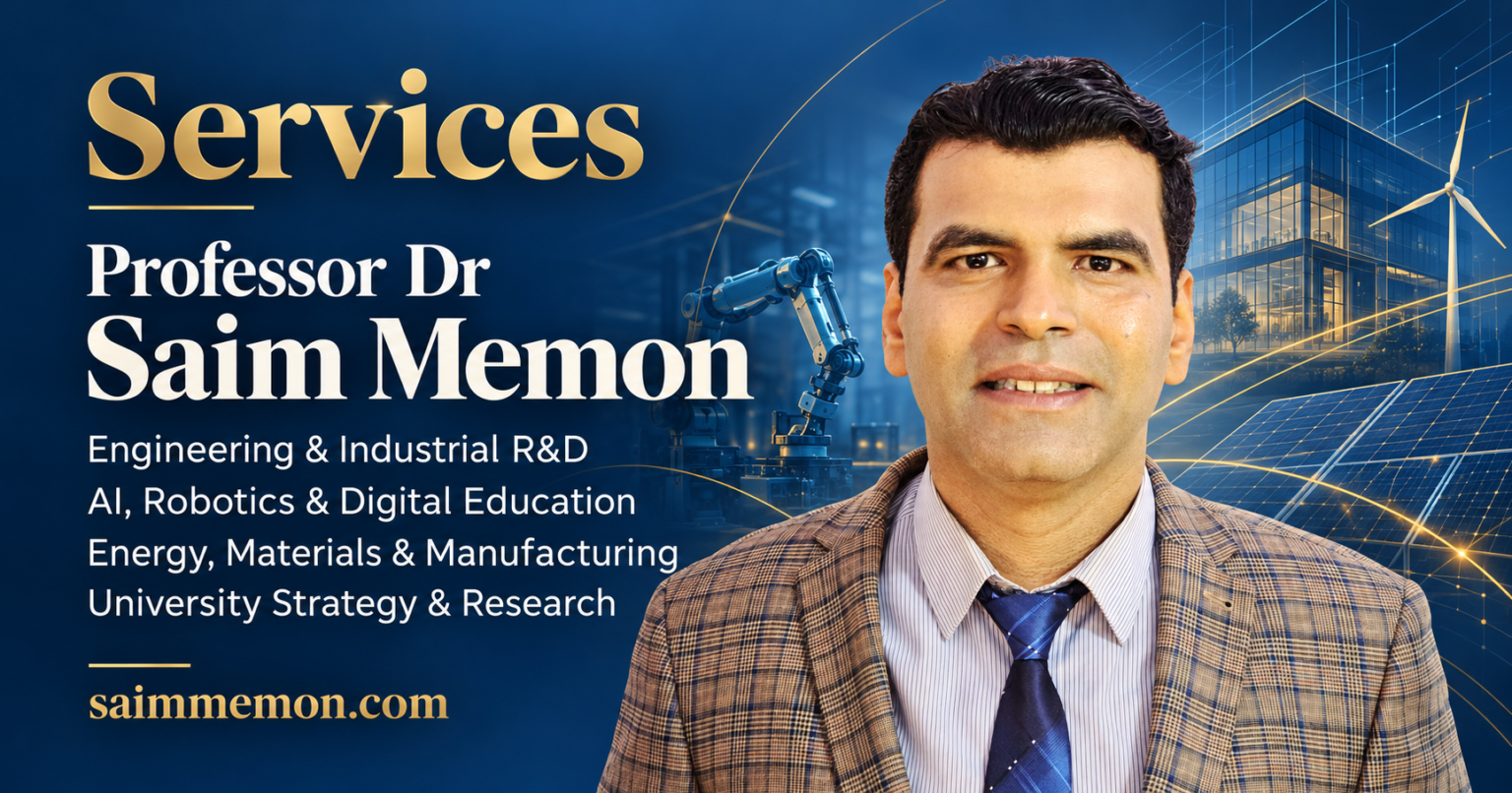
Services by Professor Dr Saim Memon
Professor Dr Saim Memon alongside his engineering, industrial R&D, AI, energy and university consultancy services.
Skip to services

Consultancy · Academia · Industry

Engineering, R&D,
AI and academic
consultancy

Professor Dr Saim Memon

Industrial Professor · Chartered Engineer
Founder and CEO of Sanyou London · Fellow of the Higher Education Academy

I help companies, universities and research organisations assess technology, develop engineering solutions, strengthen academic provision and make informed decisions about research, innovation and commercial development.

For universities and skills partners: academic transformation, assessment reform, degree apprenticeships and laboratory development for the AI era.

Explore university strategy and future skills Explore embodied AI and humanoid professor R&D

UK based · International · Remote, hybrid and on site by agreement

My work combines mechanical, electrical and manufacturing engineering, postgraduate training in mechatronics, senior academic leadership and industrial product development. I contribute through focused technical consultations, project consultancy, continuing advisory roles, visiting professorships and specialist teaching.

Whether you need to evaluate an emerging technology, resolve a development problem, prepare a manufacturing programme or strengthen your institution’s research and teaching, I can help define the work and the evidence needed to move forward.

Services and deliverables

Expertise you can commission

Each engagement starts with the problem, the intended result and the decisions the work must support. Scope, responsibilities and deliverables are agreed before work begins.

Explore a service for its scope and relevant experience.

01Research and development

Industrial R&D Consultancy and Product Development

I help organisations turn an engineering idea or unresolved technical problem into a structured development programme.

Typical outputs

A feasibility report, technical development plan, experimental programme, prototype evaluation or R&D roadmap with milestones and decision points.

Scope and experience — Industrial R&D Consultancy and Product Development

My experience includes progressing vacuum-insulation technologies from research and experimental development through prototype refinement, manufacturing and commercial application. I bring this experience to projects that require scientific analysis alongside practical consideration of materials, performance, production and cost.

Support can include

  • Defining the technical problem, user requirements and measurable performance criteria.
  • Reviewing existing research, competing approaches and technology readiness.
  • Developing modelling, experimental and prototype-validation programmes.
  • Investigating performance limitations and prioritising design improvements.
  • Planning the progression from research to demonstration, production and application.
02Technical decisions

Technical Due Diligence and Engineering Review

I provide technical assessment for organisations deciding whether to develop, procure, pilot or support an engineering technology.

Typical outputs

A technical due-diligence report, comparative assessment, evidence-gap review or recommendation on whether and how to proceed.

Scope and experience — Technical Due Diligence and Engineering Review

The work examines the strength of the evidence, the assumptions behind performance claims and the practical conditions needed for successful implementation. It can support manufacturers, innovation teams, research organisations, technology developers and investors seeking an engineering assessment.

Support can include

  • Reviewing technical proposals, test results and product-performance claims.
  • Assessing the quality of modelling, measurement and validation.
  • Identifying gaps in evidence, engineering risks and development dependencies.
  • Comparing technologies, suppliers and build-or-partner options.
  • Examining manufacturing readiness and the assumptions behind projected costs.
03Intelligent manufacturing

Robotics, Automation and AI-Enabled Manufacturing

I support robotics and automation projects where technical integration, reliable performance and commercial feasibility need to be considered together.

Typical outputs

An automation feasibility study, system requirements, supplier comparison, pilot specification or phased implementation plan.

Scope and experience — Robotics, Automation and AI-Enabled Manufacturing

My background includes an MSc in Mechatronics, a robot self-charging research project, university teaching in Robotics and Mechatronics, and earlier industrial work involving automated machine vision for fruit and vegetable quality assessment.

Support can include

  • Defining suitable automation tasks and measurable operational requirements.
  • Reviewing sensing, machine vision, control and electromechanical integration.
  • Assessing automated inspection and agri-tech applications.
  • Comparing proposed systems, suppliers and integration approaches.
  • Planning pilots, acceptance criteria, engineering training and implementation stages.
  • Assessing how AI could support production knowledge, inspection and engineering decisions.

AI-enabled factories and smart manufacturing. I help connect proposed digital tools with actual production needs, available data, workforce capability and process constraints.

Humanoid robotics. Engagements can focus on task suitability, feasibility, technology assessment and pilot planning, with specialist development and integration requirements identified within the scope.

04Buildings and construction

Buildings, Construction and Thermal Engineering

I provide specialist consultancy on building-envelope performance, advanced insulation, vacuum glazing and thermal technologies for new construction and retrofit.

Typical outputs

A thermal assessment, material-selection report, modelling study, product-development brief or testing and validation plan.

Scope and experience — Buildings, Construction and Thermal Engineering

My experience includes doctoral research within the EPSRC-funded CALEBRE building-retrofit programme, thermal modelling, experimental vacuum-glazing development and industrialisation of vacuum-insulation products. I work with manufacturers, developers, contractors, architects, engineering teams and research partners on questions such as material suitability, insulation thickness, installation constraints and expected thermal performance.

Support can include

  • Heat-loss, thermal-resistance, U-value and thermal-bridge analysis.
  • Comparison of insulation and glazing options for a defined application.
  • Assessment of thin insulation for space-constrained or heritage retrofit.
  • Review of durability, moisture behaviour, interfaces and installation details.
  • Development and evaluation of construction materials and integrated products.
  • Planning the tests and technical evidence needed for the intended application.
05Energy and electrification

Renewable Energy, Electrification and Thermal Management

I help organisations evaluate energy technologies against their operating requirements, performance objectives and economic assumptions.

Typical outputs

A technical feasibility study, technology comparison, performance model, engineering-led cost-benefit assessment or validation programme.

Scope and experience — Renewable Energy, Electrification and Thermal Management

My research, teaching and industrial work span renewable-energy engineering, electrical power systems, solar technologies, electric vehicles, energy efficiency and thermal management.

Support can include

  • Solar photovoltaics, solar thermal systems and photovoltaic–thermal integration.
  • Building-integrated renewable energy and advanced insulation.
  • Electric-vehicle charging, renewable integration and battery thermal-management research.
  • Smart-grid and electrical-energy system studies.
  • Thermoelectric generation, waste-heat recovery and energy harvesting.
  • Thermal-performance assessment for storage, refrigeration and temperature-sensitive transport.

Specialist thermal projects may also involve early feasibility and test planning for aviation, hydrogen or cryogenic applications, with the required evidence and specialist contributions defined at the outset.

06Production and commercialisation

Manufacturing Development and Technology Commercialisation

I help organisations address the practical work between a promising prototype and a repeatable, commercially useful product.

Typical outputs

A manufacturing-readiness review, scale-up plan, quality and testing framework, commercialisation roadmap or partnership brief.

Scope and experience — Manufacturing Development and Technology Commercialisation

My experience includes manufacturing-process development, engineering training, product testing, quality procedures, technical documentation and UK–China industrial collaboration.

Support can include

  • Reviewing manufacturing readiness and production constraints.
  • Developing process requirements, quality checks and validation plans.
  • Identifying equipment, supplier and engineering capability needs.
  • Preparing technical documentation and coordinating evidence for market readiness.
  • Assessing product positioning, applications, pricing assumptions and routes to market.
  • Developing manufacturing partnerships and evaluating international sourcing options.

Commercial planning can include the operational implications of manufacturing location, supply arrangements, distribution and entry into a new market.

07Applied AI and digital education

AI, LLM and Digital Education Consultancy

I help universities and organisations identify useful applications of artificial intelligence and develop them around a defined purpose, suitable information and appropriate human oversight.

Typical outputs

An AI opportunity assessment, use-case specification, pilot application, evaluation framework, teaching demonstration or staff-development programme.

Scope and experience — AI, LLM and Digital Education Consultancy

My work includes AISaim, an AI Digital Professor, multilingual LLM-based teaching models and digital teaching demonstrations that combine academic expertise with AI-generated presentation and educational content.

Support can include

  • Identifying practical AI and large language model applications.
  • Designing assistants that use approved educational or organisational knowledge.
  • Structuring content, prompts, workflows and response evaluation.
  • Developing and assessing supervised proof-of-concept applications.
  • Creating digital-professor, educational-avatar and multilingual teaching formats.
  • Supporting staff development, assessment design and responsible AI use.

For universities, the work can address teaching quality, student engagement, access to learning, staff capability and the role of subject expertise in AI-supported education.

For engineering and industrial organisations, it can address technical knowledge access, training, documentation and selected administrative or analytical workflows.

I also offer advanced AI and AGI strategy briefings, examining emerging capabilities, research directions, uncertainty and their implications for education and industry.

08Professorial appointments

Visiting Professorships, Teaching and Research Supervision

I welcome enquiries for Visiting Professor, Professor of Practice, Industrial Professor, adjunct and other appropriately scoped academic appointments.

Typical outputs

An agreed teaching programme, lecture series, module contribution, supervision plan, research workshop or visiting-professorial programme.

Scope and experience — Visiting Professorships, Teaching and Research Supervision

Engagements can combine specialist teaching, research development, postgraduate supervision, curriculum contribution and industrial collaboration. They may take the form of an intensive teaching visit, a semester contribution or a continuing institutional relationship.

Support can include

  • Undergraduate and postgraduate teaching in engineering and energy subjects.
  • Specialist lectures in robotics, mechatronics, electrical engineering, renewable energy and thermal technologies.
  • Teaching on industrial R&D, manufacturing and technology commercialisation.
  • AI education demonstrations and digital teaching development.
  • PhD and Master’s research supervision, co-supervision and mentoring.
  • Research-methods workshops, project development and academic examination.

My approach connects engineering fundamentals with research evidence, practical examples and the questions students will encounter in professional work.

Appointments, supervision and examination arrangements are agreed with the host institution.

09Academic leadership and quality

Higher Education Strategy, Academic Quality and Curriculum Development

I advise universities and education providers on engineering provision, academic development and the relationship between institutional strategy and day-to-day delivery.

Typical outputs

A programme or school review, curriculum framework, academic improvement plan, accreditation-readiness assessment or staff-development programme.

Scope and experience — Higher Education Strategy, Academic Quality and Curriculum Development

My experience includes Deputy Head of School and acting headship responsibilities, course direction, degree-apprenticeship leadership, research-group leadership and external academic assessment.

Support can include

  • Reviewing school, department and programme priorities.
  • Designing or revising engineering curricula and assessment strategies.
  • Preparing evidence and mapping learning outcomes for accreditation readiness.
  • Reviewing academic standards, programme quality and student experience.
  • Developing practical, virtual and blended laboratory provision.
  • Planning academic staffing, staff development and employer engagement.
  • Integrating AI into education with attention to learning quality and academic integrity.

I can also contribute through external examining, programme review and appropriately appointed independent academic assessment.

10Research and partnerships

Research Development, Funding Proposals and International Partnerships

I help universities, researchers and companies develop technically credible research projects with clear responsibilities and a practical route to application.

Typical outputs

A concept note, proposal review, technical work-package plan, consortium brief or university–industry collaboration programme.

Scope and experience — Research Development, Funding Proposals and International Partnerships

My experience includes research proposal development, funded collaboration, expert review and the translation of academic research into industrial work.

Support can include

  • Defining the research question, originality and intended contribution.
  • Assessing the fit between an opportunity, the proposed work and partner capabilities.
  • Developing methodology, work packages, milestones and resource requirements.
  • Reviewing feasibility, risk, impact and implementation plans.
  • Establishing useful roles for academic and industrial partners.
  • Planning knowledge exchange, demonstration, commercialisation and dissemination.

International collaboration can combine research, teaching, doctoral development and industrial application within one agreed programme.

11Executive and technical leadership

Executive Advisory and Continuing Technical Leadership

I provide senior advice to boards, founders, university leaders and engineering organisations that need experienced judgement across technology, research, people and commercial priorities.

Typical outputs

A strategic review, prioritised action plan, leadership briefing or continuing programme of technical oversight.

Scope and experience — Executive Advisory and Continuing Technical Leadership

Engagements can include a defined strategic review, continuing advisory support or an agreed interim or part-time leadership assignment.

Support can include

  • Prioritising R&D and innovation portfolios.
  • Reviewing technical direction, resource allocation and development progress.
  • Establishing clear responsibilities, milestones and review processes.
  • Assessing partnerships and commercialisation options.
  • Mentoring technical leaders, researchers and emerging engineering teams.
  • Supporting university–industry strategy and organisational development.

Relevant assignments may include Senior Technical Consultant, R&D Adviser, Interim R&D Lead, Technology Commercialisation Adviser or a suitably scoped academic leadership role.

Recruiters and executive-search teams are welcome to discuss assignments aligned with this expertise.

12Speaking and professional learning

Keynote Speaking, Executive Education and Technical Communication

I deliver specialist presentations and learning programmes for universities, companies, professional bodies and conferences.

Typical outputs

A tailored presentation, workshop, executive learning session, teaching resource or technical communication package.

Scope and experience — Keynote Speaking, Executive Education and Technical Communication

My portfolio includes more than 120 speaking and professional engagements, including keynote, plenary, invited academic and chairing contributions.

Topics can include

  • Developing engineering research into useful products.
  • Vacuum insulation, advanced glazing and energy-efficient buildings.
  • Renewable energy, thermal management and electrification.
  • Manufacturing development and technology commercialisation.
  • AI-supported education and the Digital Professor.
  • Engineering judgement, research methods and university–industry collaboration.

Formats include keynote addresses, executive briefings, technical masterclasses, staff workshops, postgraduate seminars and industry-focused teaching.

I also support technical communication through research-informed scripts, engineering review, instructional design and selected educational or product-demonstration content.

A project can span several areas. Start with the problem you need to solve.

University strategy · Assessment · Future skills

Build academic capability
for the AI era

I help institutions connect strategic change with the work of teaching teams, research groups, laboratories and employers. The emphasis is on sound academic judgement, demonstrable learning and changes that the institution can implement and evaluate.

For vice-chancellors, provosts, deans, heads of school, academic registrars, learning and teaching leaders, research directors and skills partners: commission a focused diagnostic or a defined transformation workstream, with clear responsibilities and evidence of progress.

Eight services for academic strategy, learning and future skills.

13University strategy and change

University Transformation, Restructuring and Change Management in the AI Era

I advise university and faculty leaders on how to reshape academic provision, operating arrangements and staff capability as AI, student expectations and financial pressures change higher education.

Typical outputs

An institutional or school diagnostic, restructuring options paper, AI-readiness assessment, change-management plan and prioritised implementation roadmap.

Scope and experience — University Transformation, Restructuring and Change Management in the AI Era

My experience as Deputy Head and Acting Head of a School of Engineering, alongside programme leadership and industrial entrepreneurship, informs a practical approach to institutional change. I can support a university-wide strategy or lead a defined school, curriculum, laboratory or implementation workstream with the institution’s leadership team.

Support can include

  • Reviewing the current academic operating model: how schools, programmes, academic teams and professional services work together.
  • Developing options for school and departmental structures, shared provision, interdisciplinary activity and academic decision-making.
  • Assessing AI readiness across teaching, assessment, research, student support and academic administration.
  • Planning organisational change through stakeholder consultation, staff capability development, communication and phased implementation.
  • Examining programme viability, resource requirements and the student implications of consolidation, new provision or planned closure.
  • Establishing accountable workstreams, a risk register, milestones and measures of educational benefit.

Strategic oversight. Assignments can combine a diagnostic review, options appraisal and implementation support, with attention to educational purpose, staff contribution, student protection and institutional sustainability. Longer-term scenario planning can examine the implications of more capable AI and possible AGI developments.

14Academic design and programme portfolios

Academic Structure Development, Programme Portfolio Review and Curriculum Architecture

I help universities design coherent schools, degree portfolios and progression pathways that connect academic standards, student demand, employer needs and the institution’s strategic direction.

Typical outputs

A programme-portfolio review, academic structure proposal, curriculum and assessment map, validation documentation or academic workforce-development plan.

Scope and experience — Academic Structure Development, Programme Portfolio Review and Curriculum Architecture

I have contributed to school strategy and planned engineering provision at Arden University, developed an Electrical Power Engineering degree at London South Bank University, and coordinated programme delivery, academic staffing and accreditation evidence. This experience supports both new programme development and review of established provision.

Support can include

  • Reviewing the positioning and relationship of undergraduate, postgraduate, foundation and professional programmes.
  • Designing programme specifications, module structures, credit arrangements, progression routes and graduate attributes.
  • Mapping learning outcomes to teaching, practical activity and assessment through constructive alignment.
  • Identifying opportunities in engineering, robotics, automation, AI, digital manufacturing, energy and interdisciplinary provision.
  • Preparing evidence for internal validation, periodic review and professional accreditation, using the applicable qualifications and subject frameworks.
  • Planning academic workforce capability, delivery responsibilities, induction and succession.

Provision can include short courses, continuing professional development, microcredentials and work-based pathways where these fit the institution’s approvals, resources and learner needs.

15Assessment, integrity and learning assurance

Authentic Assessment Framework Development for Generative AI and AGI Readiness

I help institutions redesign assessment so that students demonstrate knowledge, reasoning, practical competence and responsible AI use as generative AI becomes part of study and professional practice.

Typical outputs

An assessment and assurance-of-learning framework, programme assessment map, redesigned briefs and rubrics, AI-use guidance and a staff-development or pilot-evaluation plan.

Scope and experience — Authentic Assessment Framework Development for Generative AI and AGI Readiness

My contribution draws on engineering assessment, laboratory teaching, external examining, thesis and viva assessment, programme leadership and the development of AI teaching models. The work starts with the learning outcomes and the evidence needed to judge each student’s achievement, then considers assessment across the whole programme.

Support can include

  • Mapping where and how programme learning outcomes are demonstrated, including meaningful points for assurance of individual achievement.
  • Designing authentic projects, experiments, practical demonstrations, oral defences, design reviews and professional case studies.
  • Combining supervised assessment with appropriately permitted AI use, reflection, draft development and evidence of the learning process.
  • Developing assessment briefs, rubrics, moderation approaches and clear expectations for AI acknowledgement and academic integrity.
  • Reviewing accessibility, assessment workload, consistency and the support students and staff need.
  • Running staff workshops and evaluating pilots before wider adoption.

AGI readiness. Forward-looking scenarios can test whether an assessment framework remains credible as AI capabilities evolve. Current implementation is grounded in available tools and demonstrable learning; future capability assumptions are made explicit.

16Employer-integrated higher education

Degree Apprenticeship Development, Occupational Standards Mapping and Employer Co-design

I support universities, training providers and employers in matching degree curricula to occupational requirements and building coherent apprenticeship pathways with clear evidence of academic and professional development.

Typical outputs

An occupational-standard matching review, curriculum and competence mapping matrix, apprenticeship programme blueprint, employer-engagement model or assessment-readiness review.

Scope and experience — Degree Apprenticeship Development, Occupational Standards Mapping and Employer Co-design

My experience includes Degree Apprenticeship leadership, engineering curriculum mapping, apprentice-progress frameworks and external programme assessment. I have worked with electrical, electronic, embedded-systems and control engineering pathways, connecting academic study with workplace practice and professional competence.

Support can include

  • Matching proposed provision to the current occupational standard, learner level and employer role requirements.
  • Mapping modules, learning outcomes and work-based activity to knowledge, skills and behaviours, with coverage gaps identified.
  • Aligning academic assessment and workplace evidence with the applicable apprenticeship assessment plan and professional requirements.
  • Supporting initial assessment and recognition of prior learning, learning plans, workplace projects and progress reviews.
  • Co-designing delivery with employers and clarifying responsibilities between academic teams, employers and assessment organisations.
  • Developing progression, mentoring and learner-support arrangements, alongside evidence for validation and quality review.

For England, development takes account of the assessment plan, funding rules and transition arrangements that apply to the selected standard and cohort. This includes end-point assessment where it remains applicable and revised assessment arrangements where introduced. International work-based degrees are designed around the relevant local framework.

17Governance, quality and institutional assurance

UK Higher Education Guidance, Academic Quality and Regulatory Readiness

I help higher education teams translate academic quality expectations and applicable regulatory requirements into clear programme evidence, review processes and practical improvement actions.

Typical outputs

An academic quality diagnostic, standards-mapping matrix, evidence-gap review, accreditation-readiness dossier or prioritised quality-enhancement action plan.

Scope and experience — UK Higher Education Guidance, Academic Quality and Regulatory Readiness

My experience combines programme development, external examining and moderation, independent academic assessment and the preparation and scrutiny of engineering accreditation evidence. I can support institutional quality teams, school leaders and programme teams with a defined academic review and evidence-development remit.

Support can include

  • Reviewing academic governance, approval and monitoring processes, assessment practice and the use of external expertise.
  • Mapping provision to the relevant UK qualifications framework, subject benchmark statements and institutional academic regulations.
  • Reviewing evidence relevant to applicable OfS quality and standards conditions in England, including academic experience, resources, student outcomes, assessment and awards.
  • Using the QAA UK Quality Code as a sector reference point, with attention to its different role across the UK nations.
  • Supporting engineering accreditation readiness through applicable AHEP, UK-SPEC and professional-body requirements.
  • Identifying gaps in course information, student support, practical provision and assessment evidence, and agreeing an improvement plan.

Jurisdiction and institutional remit. The review is scoped to the country, provider type, awarding arrangements and current framework. UK-wide academic reference points, England’s regulatory conditions and professional accreditation are treated according to their respective roles. Institutional leaders and the relevant bodies retain formal approval and regulatory decisions.

18Government, employers and future skills

Future Skills Strategy, Government Advisory and University–Industry Workforce Development

I welcome opportunities to work with UK government bodies, skills agencies, public-sector organisations, universities and employers on the capabilities future generations need for an economy increasingly shaped by AI and advanced engineering.

Typical outputs

A skills-needs review, policy or consultation briefing, competency framework, employer-engagement workshop or roadmap for education and workforce-development pilots.

Scope and experience — Future Skills Strategy, Government Advisory and University–Industry Workforce Development

My perspective connects senior academic leadership, teaching of employer-sponsored engineers and apprentices, industrial R&D, manufacturing and entrepreneurship. I can contribute through commissioned evidence reviews, expert workshops, consultation responses, curriculum workstreams and university–industry partnerships.

Support can include

  • Reviewing labour-market and sector-skills evidence alongside employer requirements and regional development priorities.
  • Developing skills pathways for robotics, automation, AI, advanced manufacturing, energy systems, construction and thermal engineering.
  • Connecting technical capability with critical thinking, experimentation, problem-solving, communication and professional judgement.
  • Designing employer-informed degrees, apprenticeship pathways, short courses and professional upskilling or reskilling programmes.
  • Supporting AI literacy, ethical use and staff capability development with clear educational objectives.
  • Convening university–industry dialogue and defining pilots, responsibilities and measures of workforce relevance.

I would be pleased to contribute to future-skills commissions involving government departments, Skills England, devolved skills bodies, local and regional authorities, professional bodies and employer partnerships. Each engagement would have an agreed remit, evidence base and intended policy or delivery contribution.

19Research infrastructure and experimental learning

R&D Laboratory Development, Experimental Facilities and Engineering Teaching Laboratories

I help universities and research organisations plan laboratories that connect advanced experimentation, practical learning, research capability and industrial collaboration.

Typical outputs

A laboratory strategy, facility and equipment specification, experimental programme, investment roadmap, practical-learning design or commissioning and staff-training plan.

Scope and experience — R&D Laboratory Development, Experimental Facilities and Engineering Teaching Laboratories

My experience includes establishing specialist vacuum-glazing experimental facilities, developing industrial thermal-testing and prototype capability, and leading a blended engineering laboratory roadmap combining virtual, remote and physical experimentation. I connect laboratory investment with what students and researchers need to investigate, build, measure and demonstrate.

Support can include

  • Auditing existing facilities and defining research questions, practical learning outcomes and equipment priorities.
  • Developing laboratory concepts for thermal engineering, vacuum insulation, renewable energy, electrical systems, mechatronics, robotics and sensing.
  • Planning instrumentation, data acquisition, experimental protocols, measurement quality and prototype-validation activity.
  • Integrating physical facilities with simulation, virtual or remote laboratories and suitable practical kits.
  • Developing equipment specifications, procurement priorities, staffing and training plans, maintenance needs and staged investment cases.
  • Embedding student projects, industry briefs, interdisciplinary challenges and research-led experiments into the curriculum.
  • Working with the institution’s facilities and safety specialists on operating arrangements, access and safe experimental practice.

From laboratory investment to student experience. Facilities can support open-day demonstrations, school outreach, student project showcases and employer collaboration. Evaluation can track participation, practical competence, student feedback, project quality and recruitment-enquiry engagement, using evidence agreed with the institution.

20Student experience, outreach and recruitment

Student Engagement, University Recruitment and Employability Development

I help academic teams make their programmes more compelling through purposeful practical learning, research participation, employer connections and an accurate, engaging account of what students will experience.

Typical outputs

A student-engagement and outreach plan, laboratory recruitment-demonstration programme, employer-project model, programme showcase brief or evaluation framework.

Scope and experience — Student Engagement, University Recruitment and Employability Development

My experience includes module and programme leadership, hands-on laboratory teaching, student-society development, engineering outreach, open days and recruitment activity. This informs an approach that connects the prospective-student experience with the quality of learning and opportunities offered after enrolment.

Support can include

  • Designing accessible laboratory taster sessions, open-day demonstrations and school or college outreach.
  • Developing student project showcases and programme narratives grounded in real facilities, teaching and progression opportunities.
  • Strengthening belonging and participation through student societies, peer collaboration and interdisciplinary design challenges.
  • Connecting research projects, industrial briefs and professional-body activity with graduate capability and employability.
  • Reviewing student feedback, engagement evidence and progression patterns to prioritise practical improvements.
  • Agreeing measures for outreach participation, enquiry engagement, continuation and student experience, then evaluating activity against them.

The aim is a credible student experience that supports informed recruitment, sustained engagement and progression. Improvement priorities are based on the institution’s evidence and delivery capacity.

Senior academic and research assignments

Available remits include Higher Education Strategy Consultant, University Transformation Adviser, Academic Portfolio Consultant, Assessment and Academic Integrity Adviser, Degree Apprenticeship Development Consultant and Research Infrastructure Adviser. Consultancy, fractional leadership and interim assignments can be agreed around the institution’s needs.

Discuss an institutional or skills brief
Academic frameworks informing the work

Reference points are selected for the institution’s jurisdiction, provider type and commissioning brief. The framework review forms part of the scope.

Industrial R&D · Academic–industrial collaboration

Embodied AI Professor and Humanoid Robotics R&D Consultancy

From a Digital Twin AI Professor to an Embodied Humanoid Professor—and a proposed Global AGI-Enabled University Network.

I offer specialist consultancy and collaborative industrial R&D for humanoid robotics companies, AI developers, universities and corporate training organisations seeking to develop professor-grounded AI teaching and research systems. I welcome commissioned projects and academic–industrial partnerships in the United States, China and internationally.

My vision connects a human professor’s knowledge and academic judgement with multilingual AI, digital teaching and a humanoid robotic interface. The intended result is an Embodied Humanoid Professor that can support lectures, structured questioning, laboratory orientation and industry-linked learning within an agreed academic and technical remit.

As Professor Dr Saim Memon, PhD, CEng, FHEA, and Founder and CEO of Sanyou London, I bring engineering education, academic leadership, mechatronics, industrial R&D and technology commercialisation to this programme. I can lead its academic architecture, teaching design, research questions, evaluation and commercial development, working alongside specialist AI and robotics engineering teams.

  1. 01 · Existing foundationDigital Twin AI ProfessorMultilingual lecture materials and a Chinese-language presentation.
  2. 02 · Proposed R&DEmbodied Humanoid ProfessorKnowledge architecture, platform integration and a controlled teaching pilot.
  3. 03 · Long-term visionGlobal university networkValidated academic content, shared infrastructure and institutional licensing.

Services you can commission

Back to service directory

Six workstreams for a defined academic and technical programme.

21Requirements and architecture

Embodied AI feasibility and system architecture

I help define the educational problem, suitable use cases, system requirements and contribution expected from physical embodiment.

Typical outputs

A feasibility study, requirements specification, system architecture and phased R&D plan.

Scope and collaboration — Embodied AI feasibility and system architecture

Work can cover the professor knowledge layer, classroom infrastructure, robot interfaces, supervision arrangements and evaluation criteria.

22Academic knowledge and AI

Professor-grounded academic AI models and teaching agents

I lead the design of academic AI systems using approved lecture materials, research, worked examples and defined learning outcomes.

Typical outputs

A knowledge-corpus specification, academic AI workflow, evaluation questions, multilingual terminology framework and content-review process.

Scope and collaboration — Professor-grounded academic AI models and teaching agents

Collaborative development can include large language model orchestration, retrieval-augmented generation (RAG), multimodal teaching interfaces, specialist academic agents, source attribution, content updating and referral to a human expert when the system reaches its knowledge boundaries.

A multi-professor architecture can connect distinct subject specialists through an agreed academic review process.

23Platform integration and interaction

Humanoid teaching integration and human–robot interaction

Working with the robotics partner’s engineering team, I help translate teaching activities into speech, gesture, pointing, presentation control and selected supervised interactions.

Typical outputs

A classroom interaction specification, integration work packages, demonstrator scenarios and a supervised pilot protocol.

Scope and collaboration — Humanoid teaching integration and human–robot interaction

The integration plan connects the academic AI layer with the platform’s supported interfaces, perception and action capabilities, while defining which activities require local academic or technical supervision.

24Learning and professional capability

Curriculum, authentic assessment and workforce learning

I design teaching and assessment around what learners must understand and demonstrate.

Typical outputs

A pilot teaching package, assessment rubrics, instructor guidance and a framework for industry-relevant skills development.

Scope and collaboration — Curriculum, authentic assessment and workforce learning

Applications can include bilingual engineering lectures, laboratory preparation, design reviews, research-presentation rehearsal and industrial problem-solving workshops.

Assessment can combine practical demonstrations, oral defence and evidence of individual reasoning, with human academics retaining formal judgement.

Curriculum priorities can include AI literacy, critical thinking, practical engineering and human–robot collaboration, with employer input to support employability.

25Evidence and pilot evaluation

Pilot evaluation and university–industry research

I help partners test whether the proposed system delivers educational and operational value.

Typical outputs

An evaluation protocol, expert-review framework, pilot analysis and recommendations on refinement or further deployment.

Scope and collaboration — Pilot evaluation and university–industry research

A pilot can compare digital presentation with humanoid delivery where appropriate, examining academic correctness, terminology, learner understanding, interaction reliability, staff workload and cost per learning session.

Physical embodiment is evaluated for the tasks in which it may help. Learner consent and data-use responsibilities are agreed with the host institution.

26Partnerships and commercial development

Joint laboratories, commercialisation and institutional licensing

I support the development of joint university–industry programmes and laboratories combining educational robotics, applied AI, experimental engineering and workforce training.

Typical outputs

A joint-laboratory concept, partnership brief, commercial feasibility assessment and licensing or scale-up roadmap.

Scope and collaboration — Joint laboratories, commercialisation and institutional licensing

Commercial planning can address professor-content licensing, authorised use of voice and digital likeness, partner contributions, deployment support, shared infrastructure and expansion to further courses or institutions.

A practical first commission

A focused first project in China or the United States

My proposal identifies China as the first intended pilot location, while welcoming US-led projects and international partnerships. A practical starting point is one humanoid platform, one university or corporate training partner, one course or defined learning task, and an accountable academic lead.

For a robotics company

For a robotics company, the project offers an education and professional-training use case with defined tasks and structured evaluation.

For a university

For a university, it offers a route to an industry-linked teaching and research pilot, student projects and staff development.

For an employer

For an employer, it offers a way to investigate multilingual technical training grounded in real operational needs.

An initial commission can establish feasibility, partner responsibilities, resources and milestones before prototype development and a controlled learner pilot. Hardware access, developer interfaces, academic approval and the agreed budget determine the delivery schedule.

Discuss a pilot project

Longer-term research and licensing vision

The longer-term vision: a Global AGI-Enabled University Network

My longer-term ambition is a licensed international network connecting participating professors, universities, laboratories and industry learning centres. Validated academic content and shared AI infrastructure could be combined with local teaching staff, mentoring, practical facilities and selected humanoid interfaces.

The proposed “AGI university franchise” model would develop through successive pilots and partnership agreements. Participating institutions would retain responsibility for their academic governance, admissions, student support and formal awards within the relevant jurisdiction.

The economic objective is to improve access to rigorous, industry-relevant education through multilingual reuse of expert teaching and shared infrastructure. Learning quality, total delivery cost and graduate capability would be evaluated as the model develops. Courses would include a defined process for updating technical content and reviewing its relevance to employers.

“AGI-enabled” describes the long-term research direction. Present development would use available LLMs, multimodal AI and robotics platforms, with capabilities demonstrated and evaluated at each stage.

Work with me

Engagements can include technical and academic advisory, commissioned feasibility studies, joint R&D pilots, visiting or industrial professorships linked to a defined programme, joint laboratory development and institutional licensing strategy.

If your organisation has a humanoid platform, an AI development team or an academic environment suitable for a pilot, please send a short brief describing the proposed use case, available resources, partner roles and intended timescale.

Email: · WeChat: profsaimmemon · WhatsApp username: profsaimmemon

Discuss an R&D partnership

Experience and professional foundations

Experience behind the services

Engineering research, industrial development and academic leadership inform the advice I provide.

Industrial development and commercialisation

I led the development of Vacuum Insulated Wallpaper, Vacuum Insulated Curtain and Vacuum Insulated Heatable Curtain through research, testing, prototype refinement and commercialisation. This work connects engineering decisions with manufacturing, documentation and customer applications.

Robotics, mechatronics and sensing

My experience combines postgraduate mechatronics research, Robotics and Mechatronics teaching, and an earlier contribution to automated machine-vision systems for non-destructive fruit and vegetable quality assessment.

Academic leadership and teaching

I have held school and programme leadership responsibilities, contributed to teaching across 41 engineering modules and project units, supervised doctoral and Master’s research, and undertaken external examining and academic assessment.

Applied AI education

I developed AISaim and multilingual AI teaching models. International demonstrations include a Chinese-language Digital Professor presented alongside my in-person teaching in Changzhou in May 2026.

International academic and industrial engagement

My experience includes visiting teaching at Hokkaido University in Japan, academic engagements in China and the UAE, UK–China manufacturing collaboration and international research partnerships.

Professional foundations

I hold a PhD in Mechanical, Electrical and Manufacturing Engineering, an MSc in Mechatronics and a first-class BEng in Electrical Engineering. I am a Chartered Engineer, a Fellow of the Higher Education Academy and a qualified teacher.

School strategy and leadership continuity

At Arden University I served as Deputy Head of the School of Engineering and for approximately three months as Acting Head. My responsibilities included school development, programme planning, academic workforce capability and continuity of leadership during transition.

Programme creation and accreditation evidence

At London South Bank University I developed Electrical Power Engineering provision, led engineering programmes and contributed to IET accreditation evidence, curriculum mapping and employer integration. My experience also includes Degree Apprenticeship leadership and external programme assessment.

Physical, virtual and remote laboratory development

I developed specialist experimental facilities for vacuum-glazing research and industrial thermal and prototype work. At Arden University I led development of a blended laboratory roadmap combining digital engineering tools, virtual reality, practical kits and physical experimentation.

External judgement, outreach and student development

My experience includes external examining and moderation, MSc thesis and viva assessment, programme review and independent assessment of a professorial promotion case. I have also led student-society activity and practical engineering outreach, and contributed to university open days and recruitment events.

Digital professor teaching foundation

My existing multilingual digital teaching and Chinese-language presentation provide a foundation for the proposed embodied AI programme. The next stage is a commissioned humanoid integration and evaluated pilot.

View the digital teaching presentation

Defined scope · Agreed outputs

Ways to work together

From a focused expert consultation to a continuing technical or academic contribution.

  1. 01

    Focused expert consultation

    A paid consultation on a defined technical, academic or commercial question. Suitable when you need informed scrutiny of an idea, evidence or proposed course of action.

    Preparation, document review and any written follow-up are agreed within the scope.

  2. 02

    Technical review or feasibility assignment

    A defined piece of work examining a technology, product, process, programme or proposal.

    Suitable when you need a written assessment, comparison of options or clear recommendations before committing further resources.

  3. 03

    R&D or implementation planning

    A structured project to define requirements, development stages, testing, resources and milestones.

    Suitable when an idea needs a credible programme for development, validation or industrial application.

  4. 04

    Continuing advisory or interim leadership

    Regular support for an organisation, leadership team or development programme.

    The engagement can include scheduled reviews, technical challenge, mentoring and agreed responsibility for particular workstreams.

  5. 05

    Academic, teaching or speaking engagement

    A visiting appointment, teaching programme, research contribution, executive workshop or conference engagement with agreed objectives and preparation.

  6. 06

    Institutional review and transformation workstream

    A defined review of academic structures, programme portfolios, assessment practice, laboratory provision or institutional AI readiness.

    Deliverables may include a diagnostic, options appraisal, evidence map, facilitated workshop and phased implementation plan.

  7. 07

    Fractional academic or R&D leadership

    A recurring contribution with an agreed time commitment and responsibility for selected academic, research or laboratory-development priorities.

    Suitable assignments can include a Fractional Academic Director, Interim Academic Programme Lead or Interim R&D Lead remit, subject to the institution’s appointment and governance arrangements.

  8. 08

    Government, skills and employer commission

    A commissioned evidence review, expert contribution, consultation briefing or collaborative future-skills development programme.

    The scope defines the intended policy or delivery contribution, stakeholders, evidence requirements and evaluation approach.

  9. 09

    Joint embodied AI R&D programme

    A commissioned feasibility study or collaborative pilot connecting a humanoid robotics partner, an AI team and an academic or industrial training environment.

    Partner responsibilities, academic content, platform access, evaluation, intellectual property and resources are agreed within a defined programme.

Fees and scope

Consultation fees, project fees, day rates and retainers are agreed according to preparation, complexity, responsibilities and required outputs. Travel and on-site arrangements are agreed where applicable.

UK based · International collaboration

Work across
borders and disciplines

I welcome enquiries from organisations across these regions. Work can be delivered remotely, through a combination of online and on-site activity, or through an agreed international visit or institutional appointment.

Scope takes account of the organisation’s operating environment, local partners, project requirements and intended application.

Middle East
United Arab Emirates, Saudi Arabia, Qatar, Kuwait and Bahrain
United Kingdom and Europe
Including all European Union member states
North America
United States and Canada
Australia
Academic, industrial and research enquiries
China and Japan
Teaching, industrial R&D and international collaboration

Practical questions

Working together

How engagements are scoped, delivered and agreed.

What if our project does not fit one service category?

Many projects involve several disciplines. Send a short description of the problem and the decision you need to make. I can help identify a suitable starting scope.

Can we begin with a small assignment?

Yes. A focused consultation, document review or feasibility assessment can establish the priorities and evidence needed for a larger programme.

Can you work with our existing team?

Yes. I can contribute alongside internal engineers, academic staff, specialist consultants, laboratories and delivery partners. Responsibilities and interfaces are agreed within the project scope.

Can you support both advice and practical development?

Yes, where the work matches my expertise and the available resources. An engagement may involve analysis, modelling, experimental planning, prototype evaluation, teaching or development oversight. Specialist facilities and additional contributors are identified where needed.

Can you provide products or arrange manufacturing?

Relevant product development, supply or manufacturing enquiries can be discussed through Sanyou London. Any company involvement or commercial interest is made clear when the engagement is scoped.

How are fees agreed?

Fees reflect the scope, preparation, complexity, responsibility, duration and required outputs. Travel and on-site requirements are agreed where applicable. Engagements may use a consultation fee, fixed project fee, day rate or continuing retainer. Academic appointments and speaking engagements are agreed according to their responsibilities and preparation.

Can we discuss confidential work?

Yes. Confidentiality requirements can be agreed before detailed technical or commercially sensitive information is shared.

Can you support university restructuring and AI-related change?

Yes. I can provide a scoped academic diagnostic, review structural and programme options, support consultation and help plan implementation. The work draws on my school and programme leadership and can focus on an institution-wide strategy or a defined academic, assessment, laboratory or workforce workstream.

Can you develop an assessment framework for more capable AI?

Yes. The work can combine authentic assessment, evidence of individual achievement, clear AI-use expectations and programme-level assurance of learning. Planning for possible AGI developments is treated as scenario work, with assumptions documented and current assessment grounded in tools and capabilities available now.

Can your UK academic experience support international institutions?

Yes. Programme design, experimental learning, academic quality and university–industry collaboration can be adapted to the institution’s local context. The relevant national regulator, qualifications framework, professional body and awarding arrangements are identified when the engagement is scoped.

Can we commission an embodied AI or humanoid professor pilot?

Yes. A starting commission can define the use case, academic AI architecture, platform interfaces, partner contributions and evaluation protocol. My proposal identifies China as the first intended pilot location and welcomes US-led and international projects.

What is already developed, and what would the R&D project create?

The existing foundation is digital teaching: multilingual AI-enabled lecture materials and a Chinese-language Digital Twin AI Professor presentation. A physical humanoid prototype, interactive knowledge architecture and measured educational outcomes are proposed development and evaluation work.

What does the AGI university network mean?

It is a longer-term research and institutional licensing vision. Current projects would use available LLMs, multimodal AI and robotics platforms. Partner institutions would retain academic governance and responsibility for formal awards; capability, learning quality and cost would be evaluated as the model develops.

Start a conversation

Discuss your project
or appointment

If you need senior engineering judgement, a structured R&D programme, an academic contribution or a review of a proposed technology, I would be pleased to consider your enquiry.

WeChat profsaimmemonWhatsApp username: profsaimmemon

Open the enquiry form

Professor Dr Saim Memon · Consultancy, research and academic engagement

Back to top