
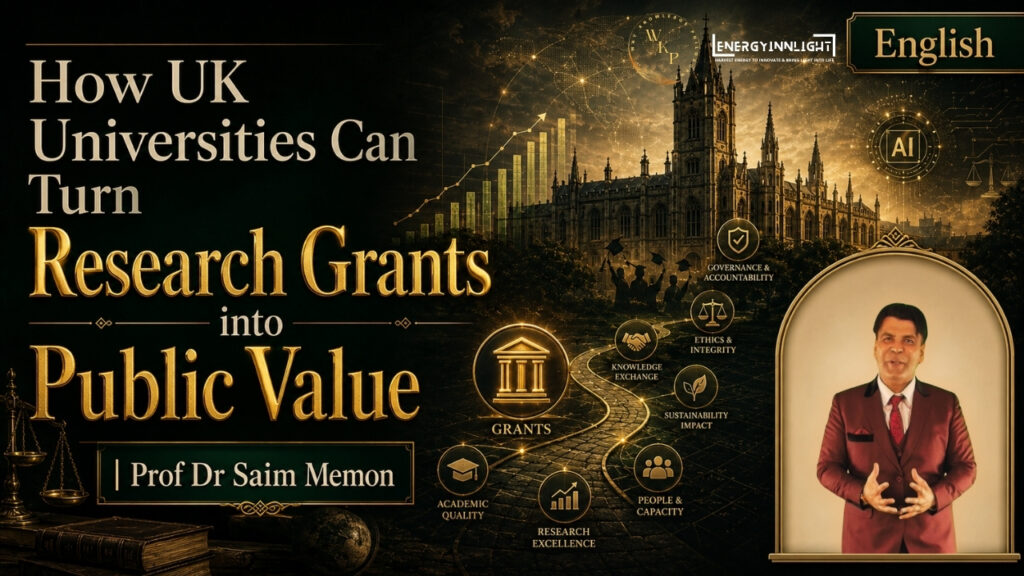
Why must the future Dean redesign value, not merely manage pressure?
The university remains one of the most powerful inventions of civilisation. It creates knowledge, trains minds, tests evidence, protects difficult questions and helps society think before it acts.
That is the ideal.
The practical reality is more uncomfortable. Many universities are now trying to protect that ideal inside a financial model that is under real pressure.
The future Dean cannot simply say: we need more grants, more papers, more citations, more students, more impact case studies, and please could everyone do it with fewer staff and less time. That is not a strategy. That is an email with a spreadsheet attached, and many academics have received enough of those to last a lifetime.
The deeper responsibility of the future Dean is different.
A future Dean must not be merely a manager of grants, workloads, rankings and savings. A future Dean must become a designer of institutional value.
That means protecting research excellence, asking what public investment returns to society and the economy, building industrial confidence, strengthening doctoral quality, reforming academic integrity for the AI age, and creating a financially literate research culture before crisis forces crude decisions.
My argument is simple: research must remain intellectually free, but it must also become financially literate. Knowledge must remain open, but it must also become useful enough to build trust with industry, government, students and the public.
The central question is no longer only: how do we win more research grants?
The better question is this: what is the true return on those grants, for knowledge, people, the economy, society, students and the university itself?
When a research grant ends, what exactly has changed in the world, apart from a final report, a publication list and a few impressive slides?
What does the current evidence tell us about research funding and university pressure?
Any serious leadership argument must begin with evidence.
The UK Government allocated £20.4 billion of public R&D investment across government for 2025–26. The Department for Science, Innovation and Technology’s R&D budget was set at £13.9 billion, including funding for UK Research and Innovation [1]. This matters because the problem is not a simple story that public research funding has disappeared. Public investment exists. The deeper problem is that the institutional economics of delivering research are fragile.
UKRI’s policy is normally to pay 80 per cent of eligible full economic costs on a successful standard research grant application [2]. In simple terms, this means that the university usually has to carry the remaining cost, either directly or indirectly. UKRI has also stated that, from autumn 2025, its funding opportunities will not usually require institutional matched funding beyond the standard 20 per cent full economic cost gap [3]. That is useful, but it does not remove the underlying cost-recovery issue.
The Office for Students describes TRAC, the Transparent Approach to Costing, as a system that records the full economic costs of university activities, including direct costs, support costs and the margin needed for sustainability and investment [4]. The OfS annual TRAC 2023–24 analysis reported a sector aggregate deficit of £2,003 million for higher education institutions in England and Northern Ireland [5].
This should change how research leaders think about grants.
A grant is not automatically pure income. A grant is a contract to deliver knowledge under financial conditions. Sometimes it strengthens the university. Sometimes it quietly increases the deficit, particularly when indirect costs, estate use, technicians, doctoral supervision, equipment, compliance, data management and academic time are undercounted.
HESA reported that there were 244,755 academic staff employed at UK higher education providers in 2024–25, excluding atypical staff, a one per cent fall from the previous year [6]. One annual data point should not be overdramatised, but the signal matters. Many early-career academics now feel a harsh message: work harder, publish more, apply for grants, teach more, comply more, and then hope the institution can afford to keep you.
If the research university depends on brilliant people, but makes their future feel unstable, what kind of talent pipeline is it really building?
Is the grant, paper, citation and ranking model enough?
Let us describe the academic currency model honestly.
A university wins a research grant. The money supports staff time, research staff, PhD researchers, equipment, consumables, travel, estates, administration and sometimes laboratory infrastructure. The project produces experiments, models, datasets, reports, presentations and, if all goes well, peer-reviewed papers.
Those papers generate citations.
Citations strengthen academic profiles.
Those profiles support promotions, REF narratives, rankings, recruitment campaigns and international reputation.
Rankings then become part of the student recruitment story. Students and parents see the brand, the league tables, the research intensity, the star performers, the glossy buildings and the promise of employability. The university receives tuition income. The cycle continues.
There is nothing inherently wrong with this cycle. It has produced remarkable science. It has trained generations of scholars. It has given universities a visible way to signal quality.
The problem begins when the signal becomes the goal, and the goal quietly replaces the purpose.
A citation is useful. It tells us that a piece of work has entered the scholarly conversation. But a citation is not the same as implementation. A highly cited paper may change a discipline. It may also be cited because it is controversial, convenient, review-like, fashionable or located in a field with high citation density.
Equally, a lower-cited industrial prototype may save energy, reduce waste, improve a product, protect patients, support a supply chain or create jobs.
The world is more complex than one number. That is inconvenient, but reality usually is.
So I would not abolish citation metrics. That would be theatrical rather than intelligent. I would demote them from verdict to evidence.
A citation should be one witness in the court, not the judge, jury and executioner.
Why can useful metrics become poor masters?
The h-index is a useful example.
Jorge Hirsch proposed the h-index in 2005 as a way to combine scientific productivity and citation impact [7]. It became globally influential. Yet later commentary from Hirsch himself warned that the h-index can have unintended consequences and may discourage more innovative thinking when used uncritically [8].
This should make universities pause.
Academic life now contains a strange moral theatre. We say we value originality, rigour, collegiality, teaching, mentoring, public service, industrial impact and long-term scholarship. Then, at the point of judgement, we often reach for a few numbers because numbers are neat, portable and easier to defend in committees.
A number reduces argument. It does not necessarily improve truth.
The result is a citation dilemma. Metrics help us see patterns, but they also tempt us to mistake visibility for value. They reward some fields more than others. They favour older careers. They may penalise practical, confidential, industrial, regional, interdisciplinary, policy-facing or standards-based work. They may reward volume over depth.
A future Dean therefore needs a more mature research value system.
Citations should remain part of the evidence base, but they should sit inside a balanced research value scorecard. That scorecard should include research quality, reproducibility, doctoral training value, industrial relevance, knowledge exchange, policy influence, product or process development, open data where appropriate, intellectual property potential, cost recovery, ethical risk and contribution to institutional strategy.
If a metric becomes the destination, who is still brave enough to pursue the difficult work that cannot be measured quickly?
What should the taxpayer and society receive from research investment?
This is an uncomfortable but necessary question: when public money funds research, what does the public receive in return?
The question must be handled carefully. I am not arguing that every publicly funded project must become a product, patent, company or factory within three years. That would be naïve and damaging. Fundamental research matters. Discovery science often creates value in unpredictable ways. Some of the greatest breakthroughs looked useless before they became essential.
But the opposite argument is also weak.
Universities cannot keep writing that every project will transform sustainability, net zero, climate change, green growth, resilience and social impact, and then treat the final publication as the main return.
If the proposal promised real-world value, the completion report should not quietly retreat into academic currency only.
The UK economy needs growth. The Office for National Statistics estimated that real UK GDP increased by 1.4 per cent in 2025, following growth of 1.1 per cent in 2024 [9]. The UK’s Modern Industrial Strategy is presented as a 10-year plan to increase business investment and grow the industries of the future [10]. Universities are not outside that productivity conversation. They are part of it.
This does not mean universities serve the economy only. They do not. They also serve truth, culture, democracy, health, public reasoning, environment, ethics and human development.
But if universities receive public and student investment, they must be able to explain their value in language that citizens, industry and government recognise.
“Trust us, we are clever” is not enough. It may have worked once. It will not work now. Frankly, it was always a bit cheeky.
What are the five returns on research investment?
I propose a simple research value model built around five forms of return.
1. Scientific return
What new knowledge has been created?
This includes theory, method, data, models, evidence, peer-reviewed outputs, reproducibility and contribution to the field.
2. Capability return
What skills, people, equipment, techniques, laboratories and doctoral capacity have been built?
A grant should leave capability behind. It should not leave only exhaustion and a closing report.
3. Economic return
What firms, products, processes, productivity gains, standards, supply chains or industrial capabilities may benefit?
This does not require every project to become commercial. It does require applied research to be honest about its route to use.
4. Social return
What public benefit is plausible and evidenced?
This may include climate benefit, health improvement, inclusion, civic engagement, education, public policy, safety or social trust.
5. Institutional return
Does the work strengthen or weaken the university?
This includes cost recovery, strategic fit, REF and KEF evidence, recruitment value, curriculum impact, partnership development and reputational risk.
If a research portfolio cannot describe its return in these five forms, is it being led strategically, or merely administered politely?
Why must research regain its route to reality?
Technology readiness levels are useful because they remind universities that research has different stages of maturity.
TRL 1 begins with basic principles. TRL 9 refers to a real system proven in operational use.
Many universities are excellent at TRL 1 to TRL 3: ideas, theory, early modelling, proof of concept and early laboratory investigation. Some are strong at TRL 4 to TRL 6: validated technology, prototypes and relevant environments. Far fewer have the culture, capital, patience, industrial trust and manufacturing discipline to reach TRL 7 to TRL 9 consistently.
In my own work, this question has never been theoretical. I established Sanyou London because I wanted to test whether research ideas in vacuum insulation could move from early concept and laboratory reasoning into real products. That journey led to practical technologies such as Vacuum Insulated Wallpaper and Vacuum Insulated Heatable Curtain, designed to address real energy-use problems in buildings and homes.
The point is not to turn this article into a company discussion. The point is to show that research leadership changes when an idea is carried through technical risk, manufacturing constraints, supply-chain realities, user acceptance, certification, cost, durability, sales conversations and customer scepticism.
A phrase such as “this will disrupt the market” no longer feels impressive by itself. A serious Dean asks: which market, which customer, what price, what standard, what production route, what warranty, what failure mode, and who will buy it on a wet Tuesday afternoon when budgets are tight?
This is not anti-academic. It is deeply academic because it asks for evidence, mechanisms, boundary conditions and the facts within the facts.
At what point does research stop describing the problem and start changing the system that keeps reproducing the problem?
Why is industrial R&D intellectually serious?
Industrial R&D is sometimes misunderstood in universities.
It is treated as lower-status than blue-sky research, as consultancy, or as something that belongs in a business development office rather than in the academic heart of the institution.
That is a serious mistake.
Good industrial R&D is intellectually demanding. It requires theory, experimentation, modelling, standards, data, manufacturing knowledge, failure analysis, customer insight, regulation, environmental judgement and ethical reasoning.
It also requires a different kind of humility.
A journal reviewer may ask whether the method is sound. A customer asks whether the technology works, whether it can be supplied, whether it fails safely, whether it fits the building, whether it survives use, and whether the price makes sense.
Both questions matter. The second one is usually less forgiving.
Universities UK has argued that universities are critical to industrial strategy through skills, research, innovation, place-making and industrial collaboration [11]. The UK’s Modern Industrial Strategy identifies future-facing sectors including advanced manufacturing, clean energy, defence, digital and technologies, life sciences, and professional and business services [10].
A research university that does not connect its research and curriculum to such sectors risks becoming impressive but detached.
Not every academic must commercialise. That would be absurd.
But every school should know which research groups are discovery-led, which are policy-led, which are industry-facing, which are translational, and which can carry technology towards adoption.
Ambiguity is expensive. Clarity is liberating.
What should a Dean’s grant gateway ask?
A future Dean should introduce a grant gateway that is supportive, not bureaucratic.
The aim should not be to stop ambition. The aim should be to make ambition sustainable.
Before major bids are submitted, the gateway should ask seven questions.
1. What is the true full economic cost?
This includes estates, technical support, data management, equipment use, supervision, compliance, consumables and academic time.
2. What is the cost-recovery position?
If a gap exists, how will it be funded, and why is the gap strategically justified?
3. Does the proposal strengthen a strategic research theme?
Or is it only opportunistic income?
4. What is the pathway to five forms of ROI?
Scientific, capability, economic, social and institutional returns should be visible from the beginning.
5. Are industrial or civic partners involved early enough?
Partnership should not be added at the end when the project suddenly remembers it promised impact.
6. What are the ethical, data, IP and reputational risks?
This includes export control, safeguarding, academic integrity, data protection, AI use and partner governance.
7. What remains in the university when the grant ends?
A grant should leave trained people, stronger methods, reusable data where appropriate, equipment capability, industrial confidence, curriculum enhancement, doctoral quality, or a pathway to the next level of development.
This is not about turning academics into accountants. It is about preventing financial accountability from arriving too late, usually wearing a dark suit and carrying the phrase “difficult decisions”.
A future Dean should make difficult decisions earlier, intelligently and transparently, so later decisions are less brutal.
How should REF and KEF be connected?
The Research Excellence Framework remains central because it assesses the excellence of research in UK higher education providers. REF outcomes are used to inform the allocation of around £2 billion per year in public funding for universities’ research [12].
A serious Dean cannot ignore REF. It shapes behaviour, resources and institutional standing.
But REF alone is not enough.
The Knowledge Exchange Framework provides information about how English higher education providers work with external partners, from businesses to community groups, for the benefit of the economy and society [13]. Research England published KEF5 in September 2025, describing it as a tool for understanding how higher education drives economic growth and societal benefit across England [14].
The future Dean must stop treating REF and KEF as separate administrative rituals.
They should be read together.
REF asks: is the research excellent, significant and rigorous?
KEF asks: does the institution exchange knowledge effectively with the wider world?
The future research university needs both.
Excellence without exchange can become isolated.
Exchange without excellence can become shallow.
The correct ambition is rigorous knowledge that travels responsibly.
Why must research leadership include quality assurance and academic integrity?
A Dean of the future cannot separate research leadership from education leadership.
The Office for Students states that providers must ensure students are assessed effectively, each assessment is valid and reliable, and relevant awards are credible [15]. The QAA UK Quality Code provides a UK-wide reference point for academic standards and quality [16]. QAA’s Academic Integrity Charter states that institutions should ensure every student’s qualification is genuine, verifiable and respected [17].
Generative AI makes this urgent.
The challenge is not only that some students may misuse AI. The deeper challenge is that AI exposes weaknesses in assessment design that were already there.
HEPI argued in 2026 that generative AI has not created assessment problems as much as exposed them, particularly where assessment is misaligned with critical thinking, synthesis and ethical judgement [18]. The HEPI Student Generative AI Survey 2026 also reported that nearly two-thirds of students said assessment had changed significantly in response to AI [19].
The response should not be panic, prohibition or theatrical detection.
Students need transparent rules. Staff need development. Programmes need assessment designs that test judgement, process, experimentation, oral defence, laboratory skill, portfolio evidence, design choices, ethics and reflective reasoning.
In other words, universities must assess the human capability that AI should augment, not replace.
This is where research and teaching meet. If students learn inside laboratories linked to real industrial problems, defend design decisions, work with data provenance, understand uncertainty and practise responsible AI use, then academic integrity becomes a lived practice, not a paragraph in a handbook.
What is the AI Research Factory?
I propose a practical concept: the AI Research Factory.
I do not mean a soulless machine that turns academics into data-entry clerks. I mean an institutional intelligence system that helps a university remember, learn, cost, connect and improve.
The UK’s AI Opportunities Action Plan is intended to support growth, living standards, public services and the creation of future AI companies [20]. Its one-year update reports progress across foundations for AI, adoption and homegrown AI capability [21]. Universities should not respond to this by adding a few AI modules and calling it transformation. They need an operating model.
An AI Research Factory would do six things.
First, it would map research strengths to funding calls and industrial strategy sectors.
Second, it would model full economic cost and cost recovery before bids are submitted.
Third, it would maintain evidence repositories for REF, KEF, impact, ethics, data management and industrial engagement.
Fourth, it would identify duplication, underused equipment and collaboration opportunities across departments.
Fifth, it would support responsible grant writing without inventing evidence or exaggerating impact.
Sixth, it would monitor post-award delivery, outputs and promised benefits.
Alongside this, I would build a University Assessment Factory.
This would not standardise all assessment into dull uniformity. It would provide a validated design environment where modules can be stress-tested for AI misuse, learning outcomes, authenticity, accessibility, workload, feedback quality, marking reliability and professional relevance.
We do COSHH assessment before laboratory work because harm matters. In the AI age, universities need a comparable risk discipline for assessment validity and academic integrity.
I am careful with the word AGI. Genuine artificial general intelligence remains uncertain and contested. But universities do not need to wait for AGI to act. Current AI systems are already strong enough to improve institutional intelligence, reduce avoidable duplication, surface risk and help staff focus on higher-value academic judgement.
The technology is not the strategy. The strategy is what the university chooses to make visible, accountable and improvable.
Why do laboratories need to become industrial learning platforms?
Students increasingly recognise the difference between a university that talks about the future and a university that lets them touch it.
This matters for recruitment, retention, satisfaction and employability.
The IET’s 2025 UK Engineering and Technology Skills Survey states that employers are navigating automation, AI, decarbonisation and diversity while facing continuing challenges in recruiting and retaining the expertise needed for innovation and long-term goals [22]. The IET also reported that automation and cyber security were the top digital skills needed for growth, followed by data engineering and software engineering [23].
Therefore, laboratories cannot be museum pieces.
A future research university should build laboratories that are partly teaching spaces, partly industrial testbeds, partly digital twin environments and partly knowledge exchange platforms.
Students should not only read about CUDA, digital twins, accelerated computing, AI-enabled design, energy systems, robotics or advanced manufacturing. They should use relevant tools, test assumptions, compare models with experiments and understand why real equipment refuses to behave like a perfect simulation.
Equipment has a sense of humour. Any experimental engineer knows this.
This is also a recruitment strategy. A student, parent, employer or international partner can understand the value of a laboratory where students solve real industrial problems with modern tools.
That is more convincing than a brochure saying “world-class” fifteen times.
World-class is not a font size. It is a capability that people can see.
Why must PhD quality matter more than volume?
A university is not a building, a ranking position or a dashboard. It is a community of students, researchers, academics, technicians, professional staff, alumni, partners and civic trust.
When the sector repeatedly discusses redundancies, course closures and restructuring, students notice. Early-career researchers notice. Families notice. Future academics notice.
If academic life becomes associated with chronic insecurity, talented young people will think twice before choosing it.
The answer is not to promise false comfort. Universities face real constraints. But a future Dean can make the academic career feel purposeful again by connecting research to real problems, protecting quality, reducing pointless bureaucracy, supporting grant discipline, strengthening industrial partnerships, improving doctoral supervision and ensuring that PhDs are developed as high-capability professionals rather than produced as numbers.
A high-quality PhD should produce more than a thesis.
It should produce a person who can reason, design, test, write, teach, collaborate, handle uncertainty, understand ethics, use AI responsibly and contribute to academia, industry or society.
That is a real return.
What is the Future Dean operating model?
A future Dean should turn this argument into an operating model.
1. Map the research portfolio honestly
The school or faculty should map research by cost recovery, research quality, industrial relevance, doctoral load, equipment use, REF readiness, KEF activity and strategic risk.
This should not be punitive. It should be an institutional truth exercise.
You cannot lead what you refuse to see.
2. Create a research value board
This board should bring together academic leads, finance, research services, technicians, doctoral training, business development, quality assurance and, where appropriate, student representation.
Its purpose should be to support better decisions earlier.
It should examine major bids, industrial partnership opportunities, laboratory investment, doctoral numbers, ethics-sensitive AI use and research sustainability.
3. Launch industrial R&D challenge programmes
A school or faculty should launch three to five industrial R&D challenge programmes linked to institutional strengths and national growth sectors.
Each programme should have academic leadership, industry partners, student involvement, defined TRL ambition, IP principles, funding strategy, skills outcomes and knowledge exchange measures.
The aim is to convert scattered activity into visible capability.
4. Pilot the AI Research Factory and Assessment Factory
This should include grant intelligence, cost-recovery dashboards, REF and KEF evidence capture, equipment utilisation, assessment stress-testing, academic integrity risk review and staff development.
The early success measure should not be perfection. It should be whether the university makes better decisions with less noise.
5. Ask five questions at school or faculty level
Every school or faculty should be able to answer:
What are we excellent at?
What costs us more than we admit?
Which partnerships are real?
What can students do because of our research environment?
What will still matter five years from now?
If the Dean’s office becomes a design studio for institutional value, rather than a control room for institutional pressure, the research university starts to rebuild itself with purpose.
What is the Research Value Compass?
The following framework translates the argument into a leadership tool.
Scientific ROI
Core question: What new knowledge is created?
Evidence to examine: Outputs, datasets, methods, reproducibility, peer review and field contribution.
Leadership action: Protect excellence and depth. Avoid volume-only incentives.
Capability ROI
Core question: What capacity remains after the grant?
Evidence to examine: People trained, equipment, techniques, laboratories, doctoral development and staff expertise.
Leadership action: Make every grant leave institutional capability.
Economic ROI
Core question: What value can industry or the economy use?
Evidence to examine: TRL progress, IP, standards, manufacturing pathway, spin-outs, licensing, productivity and partner adoption.
Leadership action: Build early industrial co-design and TRL roadmaps.
Social ROI
Core question: What public benefit is plausible and evidenced?
Evidence to examine: Policy influence, climate benefit, health, inclusion, civic engagement and public trust.
Leadership action: Distinguish evidence, interpretation and aspiration.
Institutional ROI
Core question: Does the work strengthen or weaken the university?
Evidence to examine: Cost recovery, strategic fit, REF and KEF evidence, recruitment value, curriculum impact and reputational risk.
Leadership action: Use a grant gateway and research value board.
Final reflection: rebuilding confidence in the research university
The future research university does not need less ambition. It needs better-directed ambition.
It needs grants that are costed honestly, research that is excellent and purposeful, industrial partnerships that begin with real problems, knowledge exchange that builds trust, assessment that remains credible in the AI age, and leadership that protects people by designing better systems before crisis arrives.
The future Dean should not be a professional pessimist. Universities already have enough bad news, and British higher education has never needed more dramatic sighing.
The future Dean must be positively dissatisfied: dissatisfied with weak logic, vague impact claims, poor cost recovery, performative innovation and metrics without meaning, but positive about what universities can still become.
I believe the next stage of academic leadership is not managed decline. It is disciplined renewal.
It is the courage to ask why, not only what and how.
It is the ability to see facts within facts: the visible publication and the hidden cost; the citation and the absent implementation; the grant award and the unfunded support structure; the student experience and the assessment risk; the industrial strategy and the missing laboratory capability.
If universities bring those facts together with evidence, ethics, financial discipline, industrial confidence and human purpose, the research university can still be one of the strongest engines of national renewal.
Not because it says it is world-class.
Because it produces knowledge, people, technologies and judgement that the world can actually use.
That, for me, is the future of the Dean.
References
[1] Department for Science, Innovation and Technology. DSIT research and development allocations for 2025/2026. Published 4 April 2025. The allocation states that £20.4 billion was allocated for public R&D investment across government in 2025–26, with DSIT’s R&D budget set at £13.9 billion.
[2] UK Research and Innovation. Research financial sustainability: insights paper 2025. Published 21 March 2025. UKRI states that its policy is normally to pay 80 per cent of eligible costs on successful standard research grant applications.
[3] UK Research and Innovation. Research financial sustainability. UKRI states that, from autumn 2025, funding opportunities will by default have no requirement for institutional matched funding beyond the standard 20 per cent full economic cost gap.
[4] Office for Students. Latest TRAC data 2023–24. OfS describes TRAC as a costing system analysing costs and income across teaching, research and other activity categories.
[5] Office for Students. Annual TRAC 2023–24: Sector summary and analysis by TRAC peer group. Published 10 June 2025. The OfS summary reports a sector aggregate deficit of £2,003 million for higher education institutions in England and Northern Ireland.
[6] Higher Education Statistics Agency. Higher Education Staff Statistics: UK, 2024/25. Published 19 February 2026. HESA reports 244,755 academic staff, excluding atypical staff, employed in the higher education sector.
[7] Hirsch, J. E. An index to quantify an individual’s scientific research output. Proceedings of the National Academy of Sciences, 2005. Hirsch proposed the h-index as a way to characterise scientific output.
[8] Nature Index. What’s wrong with the h-index, according to its inventor. Published 24 March 2020. The article reports concerns about unintended consequences of the h-index when used beyond its proper context.
[9] Office for National Statistics. GDP quarterly national accounts, UK: October to December 2025. Published 31 March 2026. ONS estimated that real GDP increased by 1.4 per cent in 2025.
[10] UK Government. The UK’s Modern Industrial Strategy 2025. The strategy is described as a 10-year plan to increase business investment and grow future industries in the UK.
[11] Universities UK. Why universities are critical to an industrial strategy. Universities UK sets out the role of universities in skills, research, innovation, place-making and industrial collaboration.
[12] Research Excellence Framework. REF 2029. REF outcomes are used to inform the allocation of around £2 billion per year of public funding for university research.
[13] Knowledge Exchange Framework. Research England KEF. KEF provides information on knowledge exchange activities undertaken by English higher education providers with external partners for the benefit of the economy and society.
[14] UK Research and Innovation. KEF5: powering economic growth through smarter knowledge exchange. Published 23 September 2025. Research England describes KEF5 as a tool for understanding how higher education drives economic growth and societal benefit across England.
[15] Office for Students. How we regulate quality and standards. OfS states that Condition B4 requires effective assessment, valid and reliable assessment, and credible awards.
[16] Quality Assurance Agency. UK Quality Code for Higher Education. The Quality Code provides a sector reference point for standards and quality in UK higher education.
[17] Quality Assurance Agency. Academic Integrity Charter. QAA states that the Charter supports policies and practices to ensure every student’s qualification is genuine, verifiable and respected.
[18] Higher Education Policy Institute. What generative AI reveals about assessment reform in higher education. Published 6 February 2026. HEPI argues that generative AI has exposed long-standing assessment problems and misalignment between assessment design and learning purpose.
[19] Higher Education Policy Institute. Student Generative Artificial Intelligence Survey 2026. Published 12 March 2026. The survey reports that nearly two-thirds of students say assessment has changed significantly in response to AI.
[20] Department for Science, Innovation and Technology. AI Opportunities Action Plan: One Year On. Published 29 January 2026. The update reports progress on foundations for AI, AI adoption and homegrown AI capability.
[21] UK Government. AI Opportunities Action Plan: One Year On. The update states that the Government has met commitments on 38 of the plan’s 50 actions.
[22] Institution of Engineering and Technology. 2025 UK Engineering and Technology Skills Survey. Published 30 September 2025. The IET states that automation, AI, decarbonisation and diversity are shaping future engineering skills needs.
[23] Institution of Engineering and Technology. Latest UK engineering and technology skills stats 2025. Published 6 October 2025. The IET reports that automation and cyber security are top digital skills needed for growth, followed by data engineering and software engineering.
SHARE