
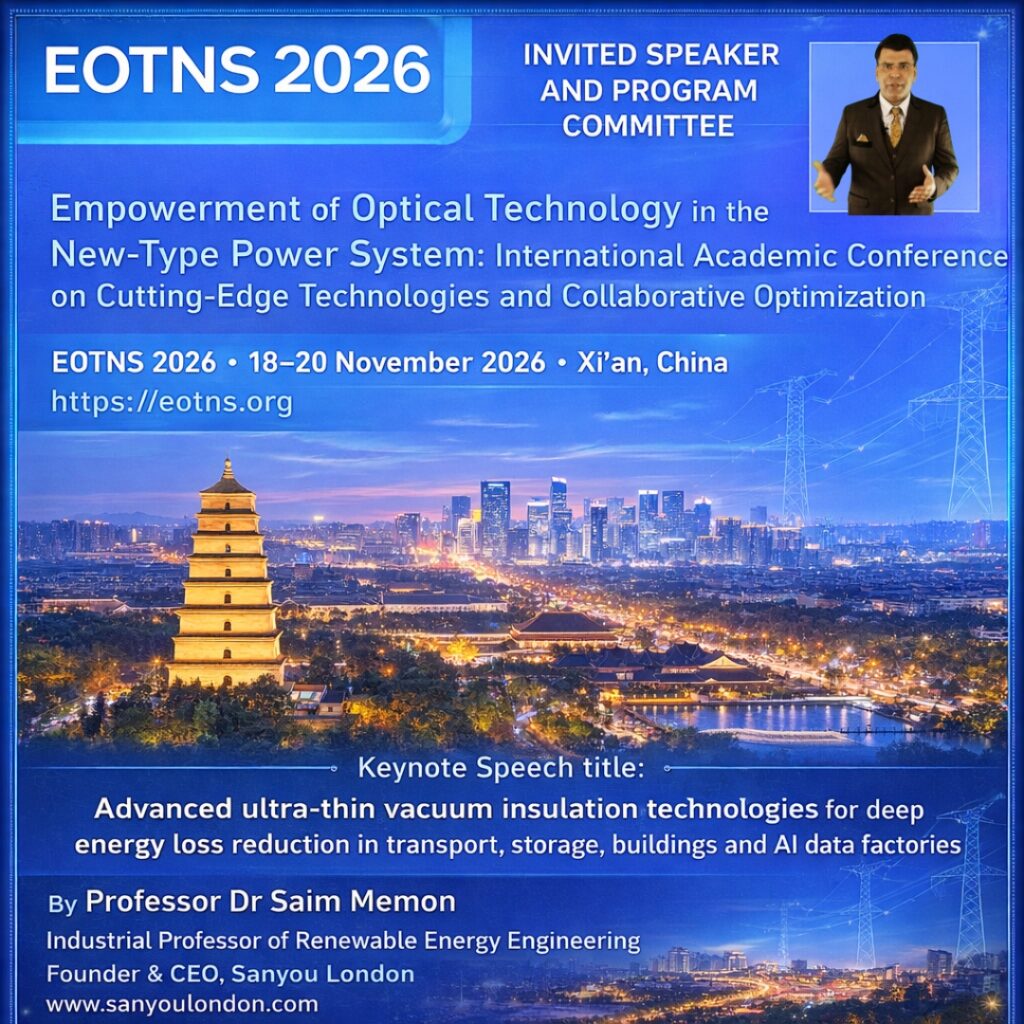
Invited Speaker and Programme Committee Member
Empowerment of Optical Technology in the New-Type Power System: International Academic Conference on Cutting-Edge Technologies and Collaborative Optimization, EOTNS 2026
18–20 November 2026, Xi’an, China
Conference link: EOTNS 2026
I am pleased to share this News & Events update on my participation in EOTNS 2026 in Xi’an, China, from 18 to 20 November 2026, where I am contributing as an invited speaker and as part of the programme committee. The official conference site presents EOTNS 2026 as a high-level academic platform focused on optical technology in the new-type power system, with keynote speeches, oral presentations, and poster sessions designed to encourage technical exchange and interdisciplinary discussion.
The official conference scope makes this a particularly interesting setting for my invited keynote. EOTNS 2026 is built around four broad directions: optical communication and power intelligent computing, optical sensing and intelligent operation and maintenance of power equipment, optical energy conversion and multi-energy-flow synergy, and system-level interdisciplinary integration and cutting-edge challenges. The organisers listed on the official site are College of Science and Technology Changchun, Jilin Society of Intelligent Science and Technology, Beijing Zhonghuan Institute of Electric Power and Energy Big Data, and the International Association for Energy and Environmental Research.
My keynote speech is titled:
Advanced ultra-thin vacuum insulation technologies for deep energy loss reduction in transport, storage, buildings and AI data factories
Why is EOTNS 2026 a meaningful platform for this topic?
Because the conference is not really about optics in isolation; it is about how advanced optical technologies strengthen future power systems through sensing, communication, intelligent computing, and coordinated energy management. In my view, that wider systems framing matters greatly, because smarter sensing and stronger computation still sit on top of real physical infrastructure, and that infrastructure continues to waste large amounts of energy through heat loss and heat gain. If the system is thermally inefficient, then even an intelligent system remains burdened by avoidable losses.
Why bring vacuum insulation to a conference on optical technology and new-type power systems?
That is a fair question, and it is exactly the kind of question I welcome at a conference like this. My answer is simple. Optical technologies help new-type power systems become faster, smarter, and more connected; vacuum insulation helps them become physically more efficient. When we talk about AI data factories, power-data centres, cold-chain control, thermal stability of equipment environments, or energy-efficient buildings supporting digital infrastructure, we are really talking about how to reduce unnecessary energy burden at source. The official EOTNS themes even include optical support for AI large-model training and inference, power-data-centre interconnection, and wide-area energy management under high renewable penetration, which makes the thermal side of the discussion even more relevant.
What is genuinely new in this keynote?
The keynote does not present one isolated product. It presents a TRL 7–9 platform of ultra-thin Vacuum Insulation Technologies designed for millimetre-scale deployment under real project constraints. The platform includes Vacuum Insulation Panels, VIP, Decorative Vacuum Insulation Panels, DVIP, 4 mm Vacuum Insulated Wallpaper, VIW, 7 mm Vacuum Insulated Curtains, VIC, the low-wattage Vacuum Insulated Heatable Curtain, VIHC, and Vacuum Insulated Bag-or-Box systems, VIBB. The consistent engineering logic is to evacuate tailored cores to 10 Pa or below, suppressing gas conduction and convection while managing radiative transfer through layered barrier design, so that high thermal resistance becomes possible in very slim forms. That matters because slim, modular solutions are often the difference between a project that can proceed and a project that stalls.
Why does millimetre-scale insulation matter in real projects?
Because real projects are full of practical constraints that theory often ignores. A warehouse operator does not want to lose internal volume. A building owner does not want thick layers stealing usable space. A retrofit team does not want every reveal, junction, and service route redesigned. A cold-chain operator does not want more bulk than payload. An AI hall does not want thermal-control improvements that complicate access and layout. This is why thin thermal resistance matters. Sanyou London’s published material presents 15 mm fibreglass VIPs at ≤ 2.5 mW/(mK), DVIP around ≤ 7 mW/(mK) in façade form, and a wider design philosophy aimed at keeping performance high while thickness stays low.
Where does the practical evidence already point?
The evidence presented in the wider published material is application-led rather than purely abstract. In the cited programme results, VIW is presented as reducing solid-brick wall U-values by up to 71% and lowering heating demand in London dwellings by around 30%. VIC is presented with effective whole-curtain conductivity around 13 mW·m⁻¹·K⁻¹ and cooling-load reduction of about 23% in the cited Riyadh single-glazed office scenario. VIHC adds targeted low-wattage warmth at roughly 1 kWh per three-hour cycle, while VIBB systems are presented as maintaining 2–8 °C for about 120 hours at 40 °C ambient exposure, with strong reduction in reliance on dry ice or active cooling.
Why do AI data factories make this more urgent?
Because AI data factories intensify three things at once: electricity demand, cooling demand, and reliability pressure. Once that happens, thermal inefficiency becomes more expensive, not less. A rack hall that wastes cooling through preventable heat ingress is, in principle, not so different from a poorly insulated room that loses warmth through a weak window edge: both force the wider system to compensate for avoidable leakage. Sanyou London’s published material specifically frames thin VIP systems as a route for thermal control in AI factories and data centres, including racks, pods, control boxes, and other compact thermal environments where space and uptime matter.
Why does collaborative optimisation matter here?
Because no single material solves an energy system on its own. The real value comes when materials, sensing, controls, digital twins, power management, and operational strategy begin to work together. That is why I find the wording of EOTNS 2026 especially useful: the conference does not stop at technology novelty; it explicitly points toward collaborative optimisation, interdisciplinary integration, and system-level challenges. My contribution sits naturally in that space. Vacuum insulation reduces the thermal burden; sensing and analytics tell us what is happening; optimisation helps tune the system around real constraints; and together they create a more serious route to demand-side efficiency.
What kind of collaboration does this conference open?
For me, the value of an event like this goes beyond presenting a paper. It opens serious conversations with universities, research groups, system designers, industrial institutions, logistics operators, and infrastructure stakeholders who are looking not for slogans, but for deployable solutions. Readers who want the wider context behind my work may visit my Worldwide Speaking Engagements, Research Publications, Research & Development Laboratory, and Biography. Those interested in the product and deployment side may also explore Sanyou London, the Department of Products and Sales, the VIP page, the VIW page, the VIC page, the VIHC page, the VIBB page, and the article on VIPs for AI factories and data centres.
Final reflection
I value my participation at EOTNS 2026 because it creates room for a deeper and more evidence-led conversation about where energy is actually being lost, and how advanced engineering can reduce that loss without waiting for some distant perfect system. In my view, credible progress in net-zero infrastructure depends not only on better generation or better algorithms, but also on whether we remove waste from the physical system itself. Ultra-thin vacuum insulation is now mature enough to be discussed not as a laboratory curiosity, but as an optimisation-ready industrial lever across buildings, storage, transport, cold chain, and AI-linked thermal environments. The official conference site also notes that accepted full papers are to be published by SPIE Press and then submitted to EI Compendex and Scopus, which adds a useful academic dissemination route to the event.
I welcome future dialogue with researchers, conference participants, industrial partners, logistics stakeholders, data-centre professionals, architects, contractors, and institutions interested in collaboration, consultancy, invited talks, industrial R&D, or practical deployment of advanced vacuum-insulation solutions. For professional contact, please visit my Contact page.
SHARE