
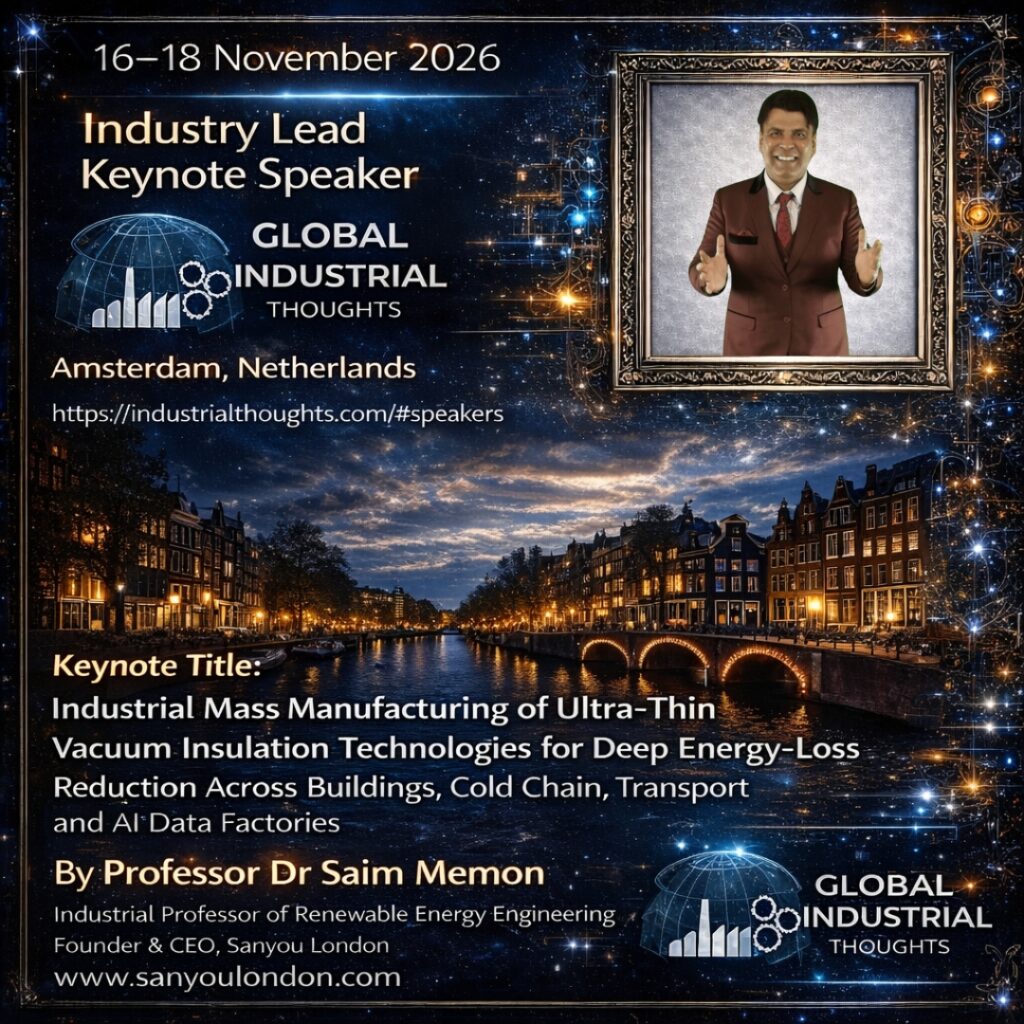
Industry Lead Keynote Speaker, Global Industrial Thoughts 2026
16–18 November 2026, Amsterdam, Netherlands
Conference link: https://industrialthoughts.com/#speakers
I am pleased to share this News & Events update on my participation as Industry Lead Keynote Speaker at Global Industrial Thoughts 2026, held in Amsterdam, Netherlands, from 16 to 18 November 2026. The event brings together professionals, researchers, and industry leaders to exchange practical ideas, technical advances, and industrial solutions across manufacturing, logistics, energy, operations, automation, and sustainability.
My keynote speech is titled:
Industrial Mass Manufacturing of Ultra-Thin Vacuum Insulation Technologies for Deep Energy-Loss Reduction Across Buildings, Cold Chain, Transport and AI Data Factories
This is an important keynote for me because the central issue is not simply whether better insulation physics exists; it does. The more serious question is whether that physics can be translated into repeatable industrial production, quality-controlled performance, and commercially credible deployment at scale. In my view, net-zero progress is increasingly constrained not by the absence of ideas, but by the failure to manufacture and deliver practical energy-saving solutions with the consistency, speed, and quality assurance that real projects require.
Why this keynote fits Global Industrial Thoughts
The official scope of Global Industrial Thoughts is especially relevant to this message. The organisers describe the event as a platform for discussion on production systems, operations management, quality engineering, supply chain optimisation, automation, and sustainability, with wider topic areas that also include energy systems and green engineering, smart manufacturing, Industrial Internet of Things, vehicle routing and transportation systems, logistics, and process optimisation. That makes it a suitable setting for a keynote that is not only about materials, but about industrial execution.
What the keynote argues
My keynote treats deep energy-loss reduction as an industrial problem that must be solved in the factory as much as in the laboratory. The talk presents an industrialised TRL 7–9 portfolio of ultra-thin Vacuum Insulation Technologies, designed for mass manufacturing rather than one-off prototype performance. The underlying engineering principle is to evacuate designed cores to 10 Pa or below, thereby suppressing gas conduction and convection, while layered barrier structures and surface treatments help control radiative transfer. That approach enables high thermal resistance in thin, modular forms that can be integrated into real products and projects without forcing complete redesign of the wider system.
The portfolio spans Vacuum Insulation Panels, VIP; Decorative Vacuum Insulation Panels, DVIP; 4 mm Vacuum Insulated Wallpaper, VIW; 7 mm Vacuum Insulated Curtains, VIC; the low-wattage Vacuum Insulated Heatable Curtain, VIHC; and Vacuum Insulated Bag-or-Box systems, VIBB. What matters here is not only that these technologies exist, but that they are framed around design for manufacture, scalable lamination and sealing routes, in-line vacuum and leak screening, batch traceability, and standards-led qualification, so that performance becomes a controlled production outcome rather than a fragile laboratory artefact.
From research to industrial production
The industrial value of this platform becomes clearer when one looks at its published performance direction. Sanyou London’s VIP material describes 15 mm fibreglass VIPs with thermal conductivity of ≤ 2.5 mW/(mK), while the company’s wider product and FAQ material also cites fumed-silica VIPs around 4.5 mW/(mK). That level of performance matters because it shows what becomes possible when meaningful insulation is achieved in millimetres rather than centimetres.
For internal retrofit, the VIW route is especially important because it addresses one of the biggest barriers to adoption: thickness. Sanyou London’s published VIW article presents the product as a 4 mm system with conductivity around 0.005 W/m·K, and reports major composite improvement on real walls, including up to 71% reduction in effective thermal conductivity for a single solid-brick wall case.
At the glazing line, the VIC platform shows the same industrial logic in a familiar curtain format. Sanyou London’s published technical article describes VIC as a 7 mm assembly with thermal conductivity of about 13.08 mW·m⁻¹·K⁻¹ and a U-value around 1.87 W/m²·K, alongside hot-climate savings in Riyadh ranging from about 33% down to 23% depending on the glazing and comparison case.
The VIHC extends that same platform by combining vacuum insulation with gentle local heating. Sanyou London’s published VIHC material describes it as a DIY-installable system that provides soft radiant warmth at around 1 kWh for 3 hours, while still using the vacuum-insulated curtain logic to reduce window-side losses. This is important because it turns the product into a dual solution: not only loss reduction, but also practical comfort improvement where the occupant actually sits or works.
For cold-chain operations, the VIBB systems show that the same industrial platform extends well beyond buildings. Published Sanyou London material reports 2–8 °C retention for about 120 hours at 40 °C ambient, while reducing dependence on dry ice or active cooling by about 80% in the cited case. That makes the industrial argument stronger, because the platform is not tied to one niche use; it reaches into buildings, logistics, transport, and storage.
Why AI data factories matter here
A particularly important part of this keynote is the inclusion of AI data factories. Industrial Thoughts explicitly includes themes such as artificial intelligence in autonomous systems and manufacturing, smart manufacturing, and energy systems. That matters because AI-linked industrial facilities intensify heat, power, and cooling demand at the same time. In such environments, thin thermal control becomes strategically valuable, especially where traditional bulky insulation is difficult to integrate. Sanyou London’s published article index presents flexible VIPs for AI factories and data centres as a route to taming hot spots, stabilising rack environments, and cutting cooling energy in thin, retrofit-ready forms.
Wider academic and industrial context
Readers who would like to explore the broader context behind this keynote may visit my Worldwide Speaking Engagements, Research Publications, Research & Development Laboratory, Industry Articles, and Biography. Those interested in the practical deployment side may also explore Sanyou London, the Department of Products and Sales, the VIP page, the VIW page, the VIC page, the VIHC page, and the VIBB page.
Final reflection
I value this keynote at Global Industrial Thoughts 2026 because it places the discussion exactly where it belongs: at the point where industrial engineering, manufacturing discipline, supply-chain readiness, and sustainability begin to meet. The official event describes itself as a place where academia and industry come together around operational excellence and sustainable development. In my view, ultra-thin vacuum insulation now deserves that kind of industrial conversation, because it is no longer merely a laboratory curiosity; it is becoming a manufacturable, quality-controlled, optimisation-ready lever for cutting energy waste across buildings, cold chain, transport, and AI-linked thermal infrastructure.
I welcome future dialogue with universities, manufacturers, logistics organisations, smart-manufacturing teams, building and retrofit stakeholders, AI infrastructure developers, suppliers, distributors, and industrial partners who are interested in collaboration, consultancy, industrial R&D, or deployment of advanced vacuum-insulation technologies. For professional contact, please visit my Contact page.
SHARE