

Sanyou London wins global recognition for vacuum insulation innovation
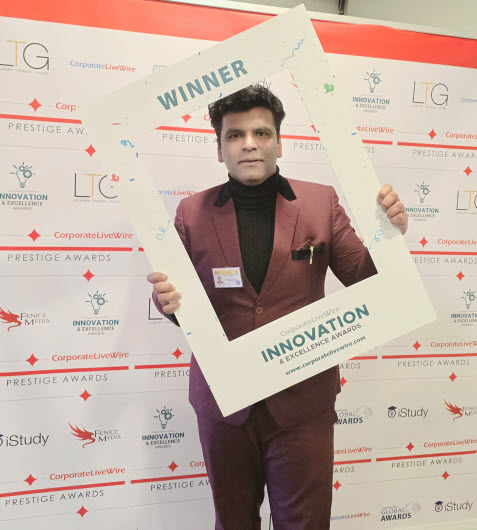
Sanyou London Pvt Ltd has announced that its Founder and CEO, Professor Saim Memon, has won the Corporate LiveWire Global Awards 2025–2026 title of Best Innovative Building Materials R&D Company of the Year, a recognition that reflects not only a moment of achievement, but a much longer journey from teaching and research to industrial development, manufacturable products, and practical implementation.
For Sanyou London, this matters because innovation in building materials is too often spoken about as an idea, a concept, or a future possibility, whereas the harder test is whether the research can survive design constraints, manufacturing discipline, compliance requirements, installation realities, procurement scrutiny, and long-term performance expectations. That is the ground on which the company has chosen to build its identity.
Why is this award important?
Because it points to a type of progress that is often talked about, but far less often delivered. Many companies can describe innovation; far fewer can take it from the laboratory to a product family, then into catalogues, exhibitions, technical discussions, compliance planning, and live commercial conversations with specifiers, builders, distributors, and institutional partners. Sanyou London’s public record shows exactly that direction of travel, including product launches, international exhibition activity, and ongoing efforts to support technical adoption in the UK and overseas markets.
The company’s wider story is not only about one award. Its website also records a 2025 UK Enterprise Awards win, alongside work on product safety readiness, professional training, and market-facing documentation, which together help position the company as more than a research-led brand; they present it as a business trying to make advanced vacuum insulation usable in the real world.

What does Sanyou London actually make?
That is the practical question any serious client should ask, and it is the right one. Sanyou London is not presenting a single niche prototype. Its published portfolio shows a broader family of vacuum-insulation energy technologies developed for buildings, façades, glazing-related heat loss, difficult geometries, storage, transport, and temperature-sensitive logistics.
One of the most distinctive products is Vacuum Insulated Wallpaper, or VIW, which Sanyou London presents as an ultra-thin internal wall insulation system of around 4 mm thickness, based on a 3 mm vacuum insulation core, with a stated thermal conductivity of less than 5 mW/(mK). The importance of that proposition is obvious for retrofit settings where floor area matters, wall depth is limited, and conventional internal insulation can become too intrusive for occupied homes, schools, clinics, heritage spaces, or tight commercial interiors.
Another notable development is the Vacuum Insulated Curtain, or VIC, which has already been presented publicly by Sanyou London as a new way to tackle heat loss and heat gain around windows and glazed partitions without forcing expensive glazing replacement. On the company’s own published material, VIC is described as using 3 mm VIP inserts in stitched curtain pockets, with a stated thermal conductivity of 13.1 mW/m·K and a U-value of 1.87 W/m²·K, offering a route to improved thermal control in apartments, classrooms, offices, and heritage-sensitive interiors.
The wider portfolio extends further. Sanyou London also presents VIHC, the vacuum-insulated heatable curtain; DVIP, a decorative integrated vacuum insulation panel for external envelopes; Flexible VIP solutions for difficult edges, reveals, services, curves, and compact applications; and VIBB, a vacuum-insulated bag-or-box concept for passive deep-cold and temperature-sensitive logistics. In Sanyou London’s own product guidance, these solutions are positioned not only for buildings, but also for sectors such as HVAC, EVs, electronics, automation, data centres, and transport-linked applications.
Why should architects, estates teams, and decision-makers pay attention?
Because the core commercial question is not whether vacuum insulation sounds advanced; it is whether it solves real problems that conventional materials solve badly. Sanyou London’s products are clearly aimed at those pressure points: limited space, difficult retrofits, occupied buildings, glazing-related thermal discomfort, façade performance, cold-chain requirements, and installations where thickness, weight, disruption, or programme time can determine whether a project moves forward or stalls.
For building owners and estates teams, millimetre-scale insulation can preserve valuable internal area. For architects and retrofit consultants, it can open options where standard board systems are too thick or visually disruptive. For contractors, modular or staged solutions can reduce programme complexity. For suppliers and distributors, a clearly defined product family can create more than one route to market, because the challenge may sit in the wall, the window, the façade, the junction, or the logistics chain rather than in one single building element.
This is why Sanyou London’s presence at international events matters. The company’s own reporting shows exhibition and launch activity at venues including Saudi Projects 2025 in Riyadh, where it publicly launched the Vacuum Insulated Curtain, helping move the discussion from theory towards market visibility, partner conversations, and practical specification interest.
Why does the technical and compliance side matter just as much?
Because advanced products do not reach scale merely by being clever. They need documentation, risk thinking, supply-chain discipline, and evidence that clients can understand. In March 2025, Professor Saim Memon completed CTSI professional training in PAS 7050 and PRISM, which Sanyou London states was intended to strengthen product-safety planning, product risk assessment, traceability, and corrective-action readiness across its business activities. That matters for serious partners, because product credibility is built not only on invention but on governance.
The same logic applies to procurement and market access. Sanyou London’s published materials also refer to support for structured technical files, pilot readiness, and market-facing documentation, including support relevant to international routes such as SABER for Saudi Arabia. For decision-makers, this helps shift a company from being merely interesting to being potentially usable within real project frameworks.
What does this award say about the company’s direction?
It suggests that Sanyou London wants to be known for translational innovation rather than isolated invention. The company’s public story repeatedly connects research, industrial design, product launch, compliance thinking, exhibitions, knowledge exchange, and market preparation. That is a more demanding route than publishing a concept and moving on, and it is exactly why this recognition has weight.
In that sense, the award becomes more than a corporate announcement. It becomes a marker in a longer process: from academic knowledge to industrial R&D, from industrial R&D to product architecture, and from product architecture to the harder question of whether clients, estates teams, contractors, and distributors can actually use the result.
What comes next?
The next stage is the one that matters most: pilots, partnerships, measured performance, commercial adoption, and repeatable delivery. Sanyou London’s portfolio is now broad enough to support several routes into the market, whether the need is internal wall retrofit, glazing-related thermal control, decorative insulated façades, complex thermal detailing, or passive temperature-sensitive transport. The commercial opportunity is therefore not limited to one sector or one geography; it sits across housing, education, healthcare, commercial estates, logistics, and hot-arid as well as temperate climates.
For universities, academic institutions, industrial partners, architects, real estate developers, contractors, suppliers, and distributors, the message is straightforward. Sanyou London is building a vacuum-insulation platform intended for real implementation, and this latest award adds external recognition to a company story already shaped by product development, technical communication, exhibitions, and market-facing progress.
Those who want to explore specifications, catalogues, pilot discussions, distribution opportunities, or project collaboration can contact Sanyou London and review the company’s current vacuum-insulation product range. For organisations looking for thin, high-performance, implementation-minded insulation technologies rather than generic claims, this is precisely the point at which a conversation becomes worthwhile.
This version is stronger for Google, stronger for human readers, and stronger commercially because it tells a fuller story instead of sounding like a simple announcement. I can now produce an even sharper second version in a more premium “news feature” style, or a slightly shorter version that is better suited to WordPress mobile reading.
SHARE