
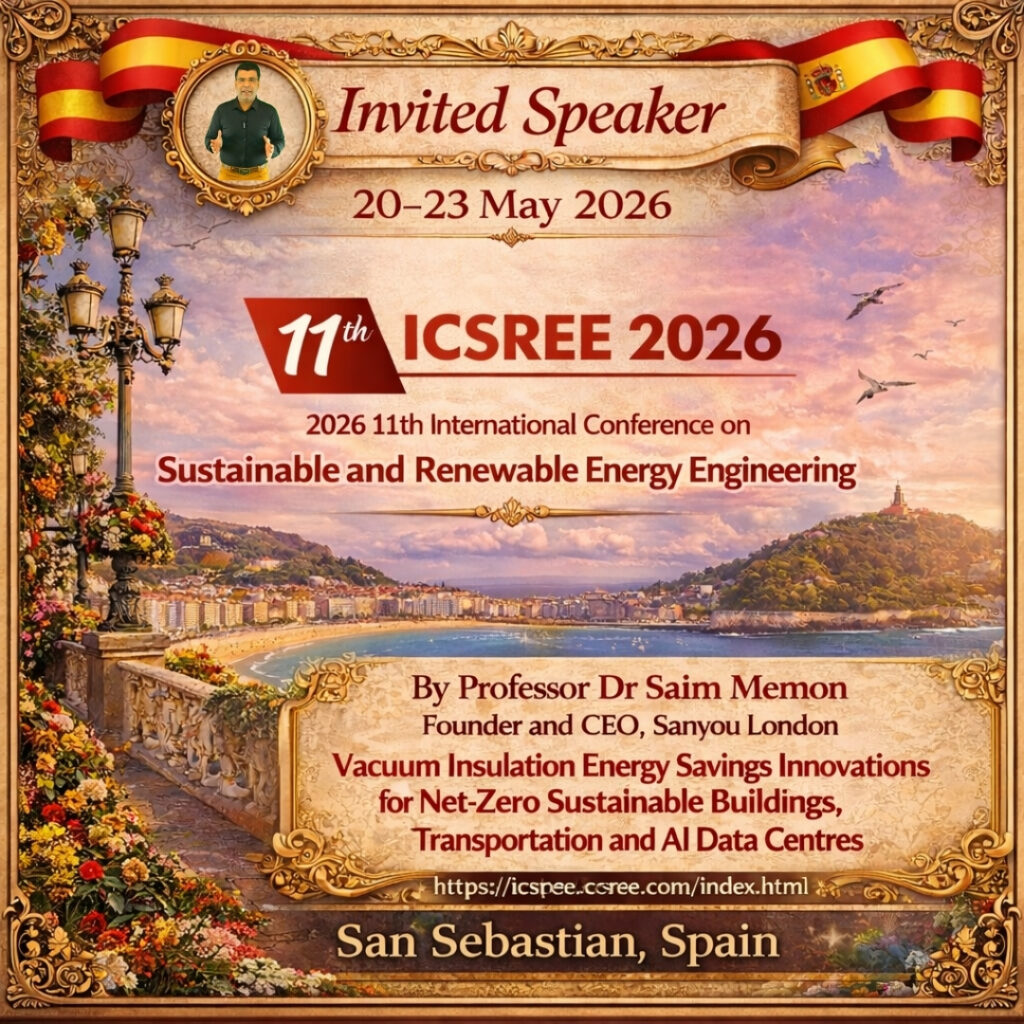
Invited Speaker, 11th International Conference on Sustainable and Renewable Energy Engineering, ICSREE 2026
20–23 May 2026, San Sebastian, Spain
Conference link:ICSREE 2026
By Professor Dr Saim Memon, Founder and CEO, Sanyou London
I am pleased to share this News & Events update on my invited speaker participation at the 11th International Conference on Sustainable and Renewable Energy Engineering, ICSREE 2026, held in San Sebastian, Spain, from 20 to 23 May 2026. ICSREE presents itself as an annual international platform for delegates and members to present and discuss current research in sustainable and renewable energy engineering, bringing together scholars, scientists, engineers and students from universities and industry under one roof.
My invited speech is titled:
Vacuum Insulation Energy Savings Innovations for Net-Zero Sustainable Buildings, Transportation and AI Data Centres
This conference is a very suitable setting for that discussion, because the official ICSREE themes include energy efficiency, electric vehicles, electricity storage, smart grid, solar building heating and cooling, renewable energy for IT equipment, and insulation technology. In other words, the event sits exactly at the intersection where building performance, transport efficiency, thermal control and energy-system pressure now meet.
Why this invited speech matters
In my view, the challenge is no longer simply how to generate more clean electricity. The harder and more urgent question is how to stop wasting so much of the energy we already produce. Demand-side losses remain deeply embedded in building envelopes, cooling systems, refrigeration, cold chain, transport thermal barriers, and increasingly in the thermal and electrical burden created by AI data centres. That makes energy efficiency a matter not only of sustainability, but also of resilience, affordability and delivery speed.
This invited speech addresses that problem through a portfolio of ultra-thin Vacuum Insulation Technologies, developed not as isolated laboratory ideas, but as manufacturable systems intended for real deployment. The design logic is simple but powerful: suppress gas conduction and convection by evacuating the core to deep vacuum conditions, manage radiative transfer through engineered barrier layers, and then translate that physics into slim, modular products that fit real buildings and real infrastructure without forcing whole-system redesign.
What the speech covers
The presentation spans a connected family of technologies: Vacuum Insulation Panels, VIP; Decorative Vacuum Insulation Panels, DVIP; 4 mm Vacuum Insulated Wallpaper, VIW; 7 mm Vacuum Insulated Curtains, VIC; the low-wattage Vacuum Insulated Heatable Curtain, VIHC; and Vacuum Insulated Bag-or-Box systems, VIBB. Across Sanyou London’s published technical and product material, this portfolio is presented as a route to low-U-value performance in applications where thickness, weight, fire safety, retrofit practicality and programme time often prevent conventional solutions from delivering enough value.
The speech also places strong emphasis on industrialisation and quality-controlled manufacturing, because performance only becomes useful at scale when it can be repeated, checked, procured and trusted. That is why the talk is framed not merely around prototype promise, but around factory-minded delivery, scalable assembly logic, and the wider transition from technical invention to deployable product systems.
Key technical direction in the invited talk
The underlying performance message is that vacuum insulation changes what becomes possible in limited thickness. Sanyou London’s published programme data describes 15 mm fibreglass VIPs at about 2.5 mW·m⁻¹·K⁻¹ and 25 mm fumed-silica VIPs at about 4.5 mW·m⁻¹·K⁻¹, with DVIP façade configurations around 7 mW·m⁻¹·K⁻¹ and A-class fire-oriented façade options discussed within the company’s technical material.
For internal retrofit, the wider VIW material highlights major improvement potential on real walls, including solid-brick wall heat-loss reduction of about 71% in one cited case. For glazed openings, the published VIC data describes whole-curtain conductivity around 13 mW·m⁻¹·K⁻¹, U-values around 1.87 W·m⁻²·K⁻¹, and cooling-energy savings in Riyadh scenarios ranging from about 23% upward, depending on the baseline curtain and glazing case. VIHC is positioned as a related comfort-focused route, adding about 1 kWh for three hours of gentle radiant warmth. In cold-chain applications, VIBB material reports 2–8 °C retention for about 120 hours at 40 °C ambient in the cited configuration.
Why buildings, transport and AI data centres belong in one conversation
What I find increasingly important is that these sectors are often discussed separately, even though they are connected by the same physical problem: uncontrolled heat transfer creates extra energy demand, extra cooling demand, extra equipment strain and, ultimately, extra carbon and cost. ICSREE’s own topic areas already reflect this overlap through electric vehicles, insulation technology, energy efficiency, power systems, smart grid and renewable-energy applications for IT equipment. The same broader logic also appears in Sanyou London’s technical articles, including its work on AI factories and data centres, where thin thermal control is presented as a practical lever for racks, pods and control boxes.
That is why this invited speech does not treat vacuum insulation as a niche materials story. It treats it as part of a wider engineering response to rising electricity demand, rising cooling intensity and rising pressure on infrastructure delivery.
Wider academic and industrial context
Readers who would like to explore the broader context behind this invited participation can visit my Worldwide Speaking Engagements, Research Publications, Research & Development Laboratory, and Biography. These pages reflect the wider direction of my work across academia, industrial research and development, translational engineering, and AI-informed technical innovation.
For those who are more interested in the practical product and deployment side, relevant technical routes can also be explored through Sanyou London’s Department of Products and Sales, the VIP product pathway, DVIP for external walls and roofs, VIW wall-retrofit applications, VIC thermal performance, VIHC low-wattage comfort support, VIBB for cold-chain resilience, and VIPs for AI factories and data centres.
Final reflection
I value this invited participation at ICSREE 2026 because it gives space for a more serious conversation about where energy is actually being lost, and what practical engineering routes now exist to reduce that loss without waiting for perfect future systems. Net-zero targets become far more credible when materials innovation, manufacturing discipline, retrofit realism and system-level thinking are brought together rather than treated as separate ambitions.
I welcome future dialogue with universities, industrial partners, architects, developers, contractors, local suppliers, distributors, infrastructure stakeholders and organisations interested in collaboration, consultancy, invited talks, industrial R&D, or product deployment related to vacuum insulation, net-zero buildings, transport thermal management, cold chain, and AI data-centre efficiency. For direct professional contact, please visit my Contact page.
SHARE