
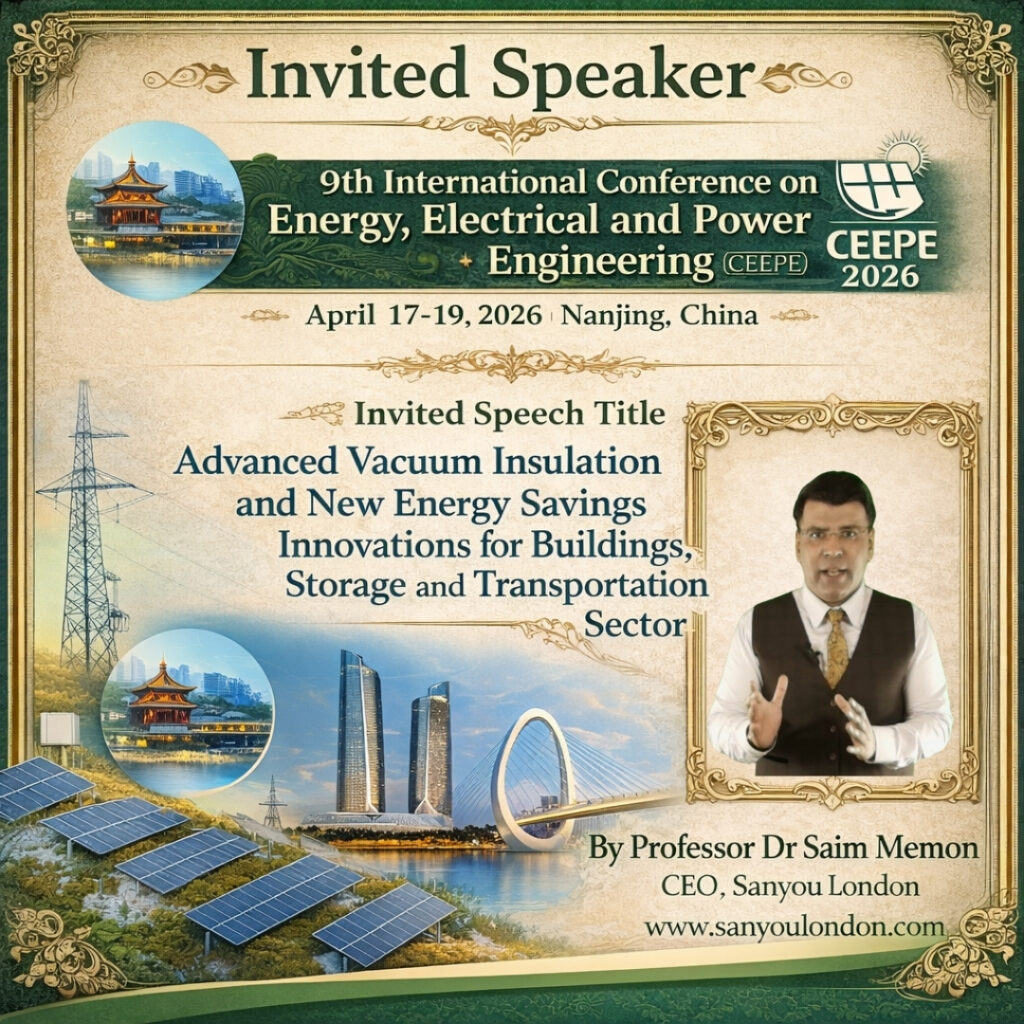
Invited Speaker, 9th International Conference on Energy, Electrical and Power Engineering, CEEPE 2026
17–19 April 2026, Nanjing, China
Conference link: https://www.ceepe.net/index.html
I am pleased to share this News & Events update on my invited speaker participation at the 9th International Conference on Energy, Electrical and Power Engineering, CEEPE 2026, held in Nanjing, China, on 17–19 April 2026. The conference brings together academic and industrial discussion on clean energy development, smart grid technologies, energy storage optimisation, and innovative power-system design, which makes it a very relevant platform for practical engineering solutions that reduce real energy waste rather than simply talking about it in abstract terms.
My invited speech is titled:
Advanced Vacuum Insulation and New Energy Savings Innovations for Buildings, Storage and Transportation Sector
This invited contribution reflects an issue that, in my view, still does not receive enough serious engineering attention: a large share of global energy is not merely consumed, but quietly lost through walls, roofs, glazing, pipework, storage systems, transport thermal barriers, and refrigeration envelopes before it delivers its full value. If climate targets are to mean anything in practice, then this demand-side loss must be reduced with solutions that are not only scientifically strong, but also manufacturable, deployable, and commercially realistic.
Why is this topic important?
The energy transition is often discussed in terms of generation, grids, storage, and electrification, all of which matter greatly, yet the conversation is still incomplete when avoidable heat loss and cooling loss remain built into so many buildings, logistics systems, and thermal-management applications. Traditional fibrous and polymeric insulation materials serve a purpose, but they often struggle when the required performance demands very low U-values without excessive thickness, awkward retrofit burden, space loss, or fire-safety compromise.
That is where advanced vacuum insulation becomes important.
What does my invited talk cover?
My talk presents a harmonised portfolio of ultra-thin vacuum insulation technologies developed to reduce energy loss across the built environment and associated storage and transportation sectors. These technologies work by evacuating the insulation core to 10 Pa or below, which sharply reduces gaseous conduction and internal convection, allowing strong thermal resistance within millimetre-scale thicknesses.
The portfolio includes:
- Vacuum Insulation Panels, VIP
- Decorative Vacuum Insulation Panels, DVIP
- Vacuum Insulated Wallpaper, VIW
- Vacuum Insulated Curtains, VIC
- Vacuum Insulated Heatable Curtains, VIHC
- Vacuum Insulated Bag or Box systems, VIBB
Together, these technologies show how one engineering principle can be translated into several application routes, from wall retrofit and façade upgrade to temperature-sensitive transport and cold-chain storage.
Readers who wish to explore the wider industrial background can visit Sanyou London, the Department of Products and Sales, my Industry Videos, and my Industry Articles.
Key technical highlights from the invited speech
The technical case I present is based on a portfolio that has already advanced to high technology-readiness levels in different forms.
A 15 mm fibreglass VIP reaches thermal conductivity as low as 2.5 mW·m⁻¹·K⁻¹, with an equivalent thermal transmittance of about 0.16 W·m⁻²·K⁻¹, while 25 mm fumed-silica systems achieve about 4.5 mW·m⁻¹·K⁻¹. When vacuum insulation is integrated into a 30 mm Decorative Vacuum Insulation Panel, the system reaches about 7 mW·m⁻¹·K⁻¹, while also addressing external-wall functionality such as durability and fire performance.
The 4 mm Vacuum Insulated Wallpaper route is especially important for retrofit, because it targets situations where traditional insulation thickness becomes a barrier to adoption. In the performance context presented in my work, VIW reduces solid-brick wall U-values by up to 71% and lowers space-heating demand in London homes by about 30%. Readers interested in this area may explore the Vacuum Insulated Wallpaper product page and the related article, Vacuum-Insulated Wallpaper (VIW): DIY True Energy Savings for Homes & Buildings.
For glazed openings, the 7 mm Vacuum Insulated Curtain approach offers another important route. With removable 3 mm VIP inserts, the whole-curtain system achieves thermal conductivity of about 13 mW·m⁻¹·K⁻¹ and, in the cited Riyadh office case, delivers around 23% cooling-load savings for single glazing. The related VIC product page and article, Vacuum Insulated Curtain: Thermal Performance & Energy Savings, give a fuller picture.
The Vacuum Insulated Heatable Curtain, VIHC adds a further layer of practical value by combining insulation with low-wattage heating. In the speech, I discuss a configuration that uses roughly 1 kWh over a three-hour cycle to provide local radiant warmth in colder climates, which points to a useful direction for energy-conscious comfort control. More on this appears on the VIHC page.
In storage and transport, the VIBB concept shows how vacuum insulation extends well beyond buildings. In the performance case presented in this talk, VIBB systems maintain 2–8 °C for 120 hours at 40 °C ambient conditions, while reducing dependence on dry ice or active cooling. This has relevance for medical logistics, cold chain, food transport, and off-grid delivery challenges. Relevant links include the VIBB product page and VIBB: Vacuum-Insulated Bag or Box for Medical, Food and Logistics.
Why does this matter beyond one conference?
What matters to me is not simply presenting another conference paper. What matters is demonstrating that advanced vacuum insulation is no longer a narrow laboratory curiosity, but a practical engineering pathway for buildings, façades, transport, packaging, cold chain, AI data-centre applications, and EV thermal protection where space, weight, and performance all matter at the same time.
In life-cycle terms, the argument is equally important. Across the application ranges discussed in this invited speech, the draft analysis indicates that deployment can prevent roughly 15–60 kg CO₂e per square metre over 25 years, which represents a meaningful reduction in avoidable end-use energy waste. That is why I continue to argue that serious climate mitigation must include stronger attention to deployable thermal-loss reduction, not just to energy generation on the supply side.
Academic and industrial relevance
This invited talk also reflects the wider direction of my academic and industrial work, which sits at the intersection of research, invention, industrial R&D, manufacturable design, and practical implementation. Those who wish to explore this wider context can visit my Worldwide Speaking Engagements, Research Publications, Research & Development Laboratory, and Biography pages.
For readers from universities, research groups, manufacturers, real-estate development, architecture, contracting, public-sector bodies, or logistics and storage sectors, this work is intended not just to inform, but to open the door to meaningful exchange. That may take the form of collaborative research, invited lectures, consultancy, product integration, feasibility studies, industrial trials, local manufacturing partnerships, or wider knowledge exchange.
Final note
I value my invited participation at CEEPE 2026 because it places advanced vacuum insulation within the wider international discussion on energy, power engineering, storage, and clean technology, where it belongs. The real challenge today is not the lack of ideas; it is the lack of sufficiently serious deployment of solutions that already show technical maturity and practical promise.
If your institution, company, or organisation has an interest in vacuum insulation for buildings, storage, transport, research collaboration, industrial consultancy, or commercial engagement, please visit my Contact page or explore the wider work through Sanyou London and the Department of Products and Sales
SHARE