
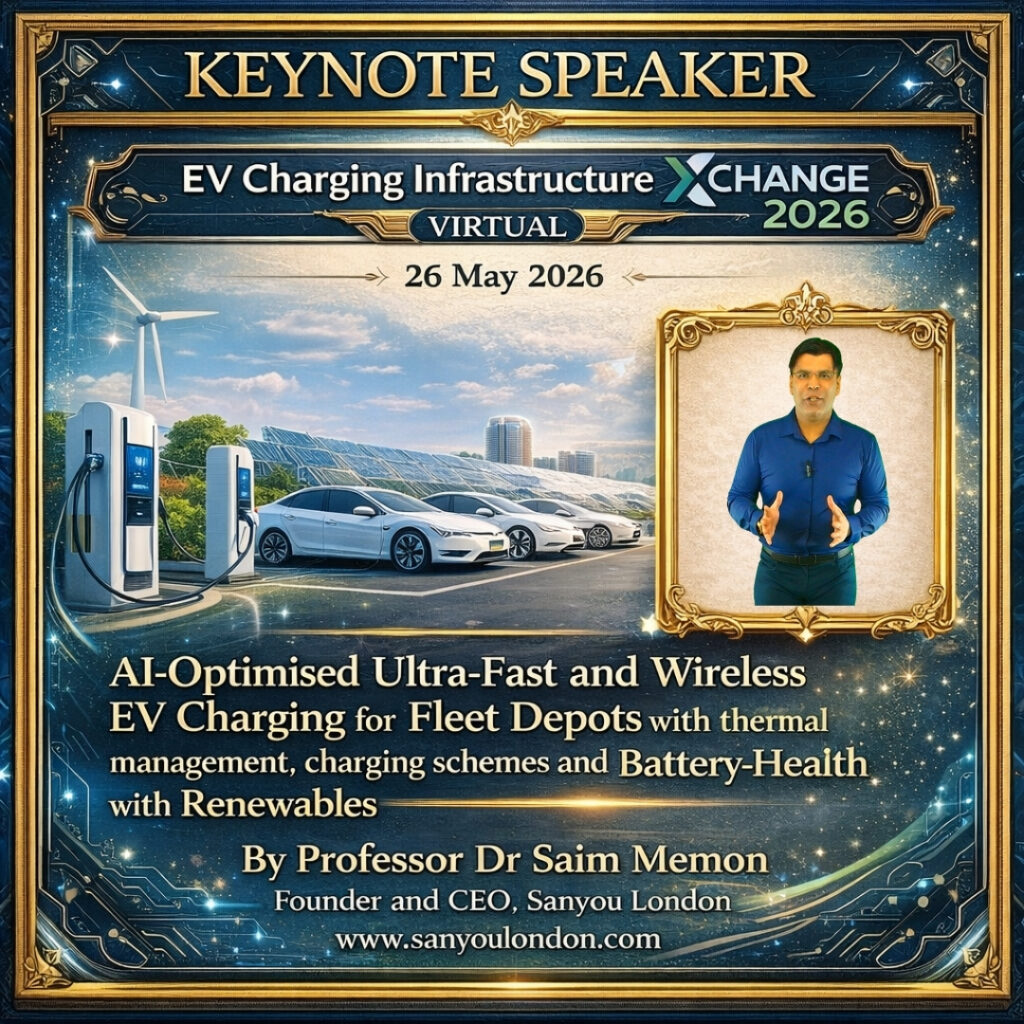
Keynote Speaker, EV Charging Infrastructure XCHANGE 2026
26 May 2026 | Virtual
Conference link: EV Charging Infrastructure XCHANGE 2026
I am pleased to share this News & Events update on my keynote speaker role at EV Charging Infrastructure XCHANGE 2026, the virtual event dated 26 May 2026. The event presents itself as a focused platform for the next phase of EV charging deployment, where the sector moves from simply installing chargers to managing a reliable utility, with particular attention to uptime, interoperability, grid integration, V2G commercialisation, and commercially viable charging models across residential, commercial, and highway settings.
My keynote speech is titled:
AI-Optimised Ultra-Fast and Wireless EV Charging for Fleet Depots with thermal management, charging schemes and Battery-Health with Renewables
This keynote reflects a research and engineering direction that I regard as increasingly important. The real challenge in EV charging is no longer only how to increase charger numbers; it is how to make charging infrastructure intelligent, thermally safe, grid-aware, operationally scalable, and economically credible under real fleet conditions. That means charging strategy, queue management, battery health, temperature control, wireless transfer performance, renewable integration, and power-quality governance all need to be treated as one connected system rather than as separate technical boxes. This keynote role is also listed on my Worldwide Speaking Engagements page, and the paper title appears within my Research Publications, which places the talk within the wider context of my academic and industrial work.
Why does this keynote matter?
EV charging infrastructure now sits at the centre of a much larger transition. Fleet operators, network developers, utilities, public authorities, and technology providers all face the same underlying question: how do we deliver faster and cleaner charging without undermining grid stability, battery life, commercial viability, or user confidence? The framing of XCHANGE 2026 is important precisely because it recognises that the sector is entering a more mature stage, one where technical performance and operational discipline matter just as much as hardware deployment itself.
What does my keynote focus on?
My presentation brings together applied research thinking on AI-led charging optimisation, ultra-fast charging, wireless charging, battery thermal management, renewable integration, and power-quality control for fleet depots and centralised charging stations. Rather than treating charging as a simple plug-in event, I frame it as a dynamic decision problem shaped by queue pressure, charger availability, charge-profile selection, battery-condition protection, ambient conditions, and the wider behaviour of the grid.
The keynote highlights include the following:
- a practical depot-charging architecture for centralised stations supplied by the utility grid together with PV and wind, designed for high throughput during peak periods;
- a queue-aware AI decision engine that jointly optimises charging time, charge-profile selection, charging capacity, and per-EV waiting delay;
- stochastic realism through Monte Carlo arrivals, so that attractive schedules also remain defensible under uncertain fleet behaviour;
- benchmark-backed optimisation performance, where WCOA shows a 13% reduction in total time versus MILP and 8.5% versus GA, especially under peak-hour conditions;
- thermal-management strategies that combine micro-channel cooling with temperature and humidity awareness to protect battery health during fast charging;
- waste-heat utilisation routes through PCM storage and magneto-thermoelectric conversion concepts to improve overall charging effectiveness;
- wireless charging implications, showing how temperature affects circular-coil WPT performance and what control strategies reduce performance risk;
- power-quality governance measures that reduce harmonic distortion and protect voltage quality when renewables and smart-grid inverters are integrated.
A wider research base behind this keynote
This keynote does not sit in isolation. It aligns with a broader body of my research on EV charging systems, charging control, battery behaviour, temperature effects, wireless power transfer, and grid interaction. Relevant examples include published work on smart techno-economic operation of electric vehicle charging stations, fast charging under dynamic temperature and humidity conditions, wireless power transfer performance under temperature effects, multi-stage fast-charging current control, and G2V and V2G grid-aggregator methodology. These themes are also visible through my Research Publications, where the conference paper and related journal contributions sit within a wider engineering portfolio.
Why is this useful for industry and decision-makers?
For me, the practical value of this keynote lies in its relevance to real deployment. Fleet depots do not operate in idealised conditions, and neither do utilities, infrastructure investors, or commercial charging operators. They deal with uncertain arrivals, peak congestion, thermal stress, return-on-investment pressure, power-quality limits, and increasingly complex expectations around renewable integration and grid responsiveness. That is why I focus on solutions that connect modelling with operational realism and why I continue to approach energy engineering through a combined academic and industrial lens.
Readers who wish to explore more of this work can visit my Biography, Research & Development Laboratory, Worldwide Speaking Engagements, and Research Publications. Those interested in the wider industrial context may also visit Sanyou London, particularly the Department of Industrial Research and Development, where research translation and practical innovation remain central to my work.
Final reflection
I value this keynote participation at EV Charging Infrastructure XCHANGE 2026 because it speaks to a problem that deserves more serious technical attention. EV charging is often discussed as infrastructure expansion, but the deeper engineering question is how to make that infrastructure intelligent, resilient, battery-conscious, grid-compatible, and commercially workable under real operating pressure. That is where good research, practical modelling, and sound system design begin to matter most.
I welcome future dialogue with universities, fleet operators, charging-network developers, utilities, technology companies, industrial institutions, and public-sector organisations that are interested in collaboration, consultancy, invited talks, applied research, or strategic project development in EV charging, thermal management, renewables, power engineering, and intelligent energy systems. For professional contact, please visit my Contact page
SHARE