
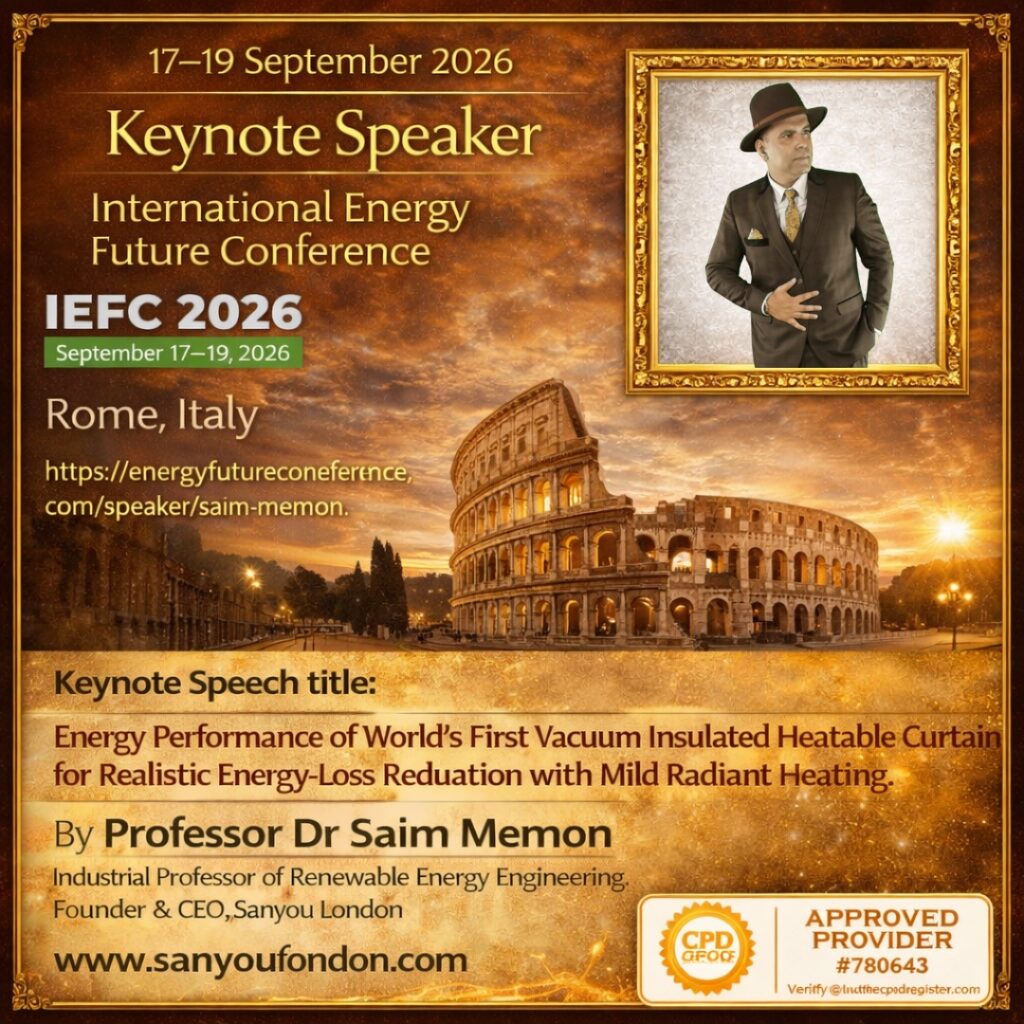
Keynote Speaker, International Energy Future Conference, IEFC 2026 17–19 September 2026, Rome, Italy
International Energy Future Conference, IEFC 2026
I am pleased to share this News & Events update on my keynote participation at the International Energy Future Conference, IEFC 2026, held in Rome, Italy, from 17 to 19 September 2026 as a hybrid event. The official conference site presents the event under the theme “Advancing the Energy Future: Reliability, Affordability, Sustainability”, and describes it as a forum that brings together researchers, renewable-energy specialists, policymakers, industrial practitioners, academics, and innovators to discuss transformative approaches to global energy challenges. The conference is organised by Magnus Group.
My keynote speech is titled:
Energy Performance of World’s First Vacuum Insulated Heatable Curtain for Realistic Energy-Loss Reduction with Mild Radiant Heating. The official speaker page lists this as an in-person keynote presentation, which makes the conference especially meaningful to me because it allows a direct discussion of a technology that sits at the intersection of energy efficiency, green buildings, thermal comfort, and practical retrofit engineering.
In my view, this keynote matters because one of the most common energy problems in buildings is also one of the least intelligently addressed. Windows continue to lose heat, cold downdraughts continue to reduce comfort near occupied zones, and the usual answer is still to run the central heating system harder than necessary. That is a familiar response, but it is not a very refined one. A better engineering question is whether we can reduce heat loss where it starts and improve local comfort at the same time, without forcing glazing replacement, structural work, or disruptive retrofit. That is the central logic of the Vacuum Insulated Heatable Curtain, VIHC.
The official conference programme themes make this keynote particularly well placed. IEFC 2026 explicitly includes Energy Efficiency & Green Buildings, Thermal Energy, Heating & Cooling Systems, AI, Machine Learning & Data Analytics in Energy, Smart Grids & Digital Power Systems, and Electric Vehicles & E-Mobility among its scientific sessions. That matters because the VIHC is not merely a curtain product; it is part of a broader argument about demand-side energy reduction, localised comfort control, and the practical value of thin thermal technologies in future energy systems.
The broader technical platform behind this keynote includes Vacuum Insulation Panels, VIP, Decorative Vacuum Insulation Panels, DVIP, 4 mm Vacuum Insulated Wallpaper, VIW, 7 mm Vacuum Insulated Curtains, VIC, and Vacuum Insulated Bag-or-Box systems, VIBB. Across this platform, the governing principle is to evacuate engineered cores to around 10 Pa or below, which suppresses gas conduction and convection, while barrier layers and surface treatments reduce radiative transfer. This makes it possible to achieve strong thermal resistance in very thin formats that are easier to integrate into real buildings and real logistics systems than conventional bulky insulation.
Within that wider family, the VIHC is, in my view, especially significant because it addresses both heat-loss reduction and mild localised radiant comfort in one system. Sanyou London’s published material describes it as the world’s first vacuum-insulated heatable curtain, designed to install like a normal curtain while adding gentle radiant warmth at low power, around 1 kWh for 3 hours, rather than depending entirely on high whole-room or whole-house heating demand. That distinction is important. The VIHC does not try to behave like a fan heater or a central-heating replacement. Instead, it supports a more targeted and realistic comfort strategy: reduce window-side losses, improve mean radiant conditions near the occupied zone, and allow the main heating system to work less aggressively.
This is why I see the VIHC as a particularly practical solution for heritage buildings, rental properties, hotels, schools, offices, and domestic environments where window replacement is restricted, financially unattractive, or simply undesirable. The published Sanyou London material consistently positions it as a portable, user-controlled technology that works with existing windows rather than demanding expensive glazing intervention. That makes it especially relevant to buildings where the energy problem is obvious, yet conventional retrofit options remain slow, intrusive, or hard to justify.
The keynote also sits within a much wider energy-performance narrative. Sanyou London’s published material describes VIC as achieving an effective thermal conductivity of about 13.1 mW/m·K and a U-value of about 1.87 W/m²·K, while VIW is presented as a 4 mm internal retrofit system with strong reported heat-loss reduction on common wall types. The same broader vacuum-insulation platform also extends into cold-chain logistics, refrigeration, and AI data-centre thermal management, which reinforces an important message: thin vacuum insulation is not only a building product idea; it is a wider energy-engineering strategy for reducing avoidable thermal losses across several sectors.
Readers who wish to explore the wider context behind this keynote may visit my Worldwide Speaking Engagements, Research Publications, Research & Development Laboratory, Industry Videos, and Industry Articles. Those interested in the industrial and deployment side may also explore Sanyou London, the Department of Products and Sales, the Vacuum Insulated Heatable Curtain page, the article Vacuum-Insulated Heatable Curtain (VIHC): DIY Warmth and Insulation for 1 kWh, and the article Which Vacuum-Insulated Solution Fits Your Project?.
I value this keynote at IEFC 2026 because it creates space for a more honest conversation about what realistic decarbonisation looks like in everyday buildings. Reliability, affordability, and sustainability are not abstract slogans if occupants are still forced to overheat rooms simply because the coldest part of the envelope remains underperforming. A solution such as the Vacuum Insulated Heatable Curtain is important precisely because it offers a more practical route: it reduces loss where it begins, improves comfort where it is needed, and does so in a form that people can actually use. That, to me, is where good research becomes meaningful engineering.
I welcome future dialogue with universities, researchers, retrofit specialists, housing providers, schools, hotels, architects, distributors, and industrial partners interested in window heat-loss reduction, mild radiant comfort, vacuum insulation, and practical demand-side energy solutions. For professional contact, please visit my Contact page.
SHARE