
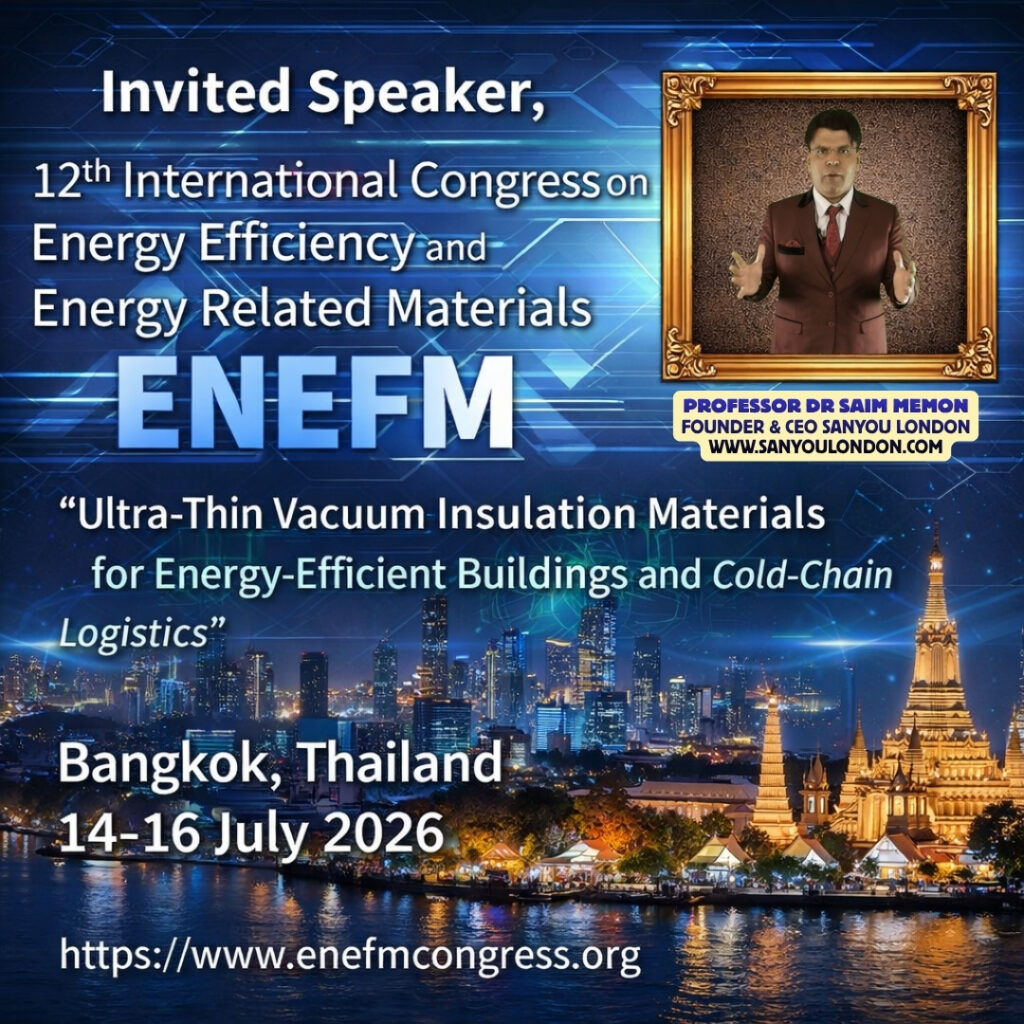
Invited Speaker, 12th International Congress on Energy Efficiency and Energy Related Materials, ENEFM 2026
14–16 July 2026, Bangkok, Thailand
Conference link: ENEFM 2026
I am pleased to share this News & Events update on my invited speaker participation at the 12th International Congress on Energy Efficiency and Energy Related Materials, ENEFM 2026, held in Bangkok, Thailand, from 14 to 16 July 2026. The official congress pages describe ENEFM 2026 as a global forum for researchers and engineers to present and discuss innovations in energy efficiency and energy-related materials, which makes it a strong fit for a talk focused on thermal-loss reduction through advanced vacuum-insulation materials.
My invited speech is titled:
Ultra-Thin Vacuum Insulation Materials for Energy-Efficient Buildings and Cold-Chain Logistics
This is an important topic because energy efficiency is still too often discussed as a matter of generation, control, or smart-system optimisation alone, while in real buildings, hospitals, warehouses, logistics fleets, and refrigerated spaces, one of the easiest resources to waste remains heat. Unwanted heat transfer through walls, glazing zones, curtains, packaging, and refrigerated enclosures quietly drives HVAC and refrigeration runtimes upward. In that sense, the real engineering challenge is not only how to manage energy better after losses occur, but how to remove those losses closer to their physical source.
Why this invited speech fits ENEFM 2026
The official ENEFM structure is especially relevant here because the congress includes tracks on energy efficient buildings, energy efficient products, and materials for energy saving, alongside its wider focus on energy-related materials. That makes this conference a suitable setting for a more serious discussion about insulation materials that do not merely support energy efficiency in theory, but directly improve it in application.
My invited speech addresses that problem through a connected platform of ultra-thin vacuum insulation innovations, presented not as isolated laboratory samples, but as practical energy-related materials with direct relevance to retrofit, logistics, cold chain, and space-constrained thermal control.
What the invited speech presents
The core argument is straightforward. Conventional fibrous and polymeric insulation remains useful, but it often struggles when deep heat-loss reduction is required without sacrificing too much space, causing excessive retrofit disruption, or introducing uncomfortable compromises around durability and fire performance. Vacuum insulation changes that equation by reducing heat transfer at the source. When the engineered core is evacuated to 10 Pa or below, gaseous conduction and convection are strongly suppressed, while barrier-layer design and surface treatment help reduce radiative transfer. That makes it possible to achieve very high thermal resistance in thin, modular forms. (sanyoulondon.com)
The invited speech brings together a coherent platform of technologies: Vacuum Insulation Panels, VIP; 4 mm Vacuum Insulated Wallpaper, VIW; 7 mm Vacuum Insulated Curtains, VIC; the low-wattage Vacuum Insulated Heatable Curtain, VIHC; and Vacuum Insulated Bag-or-Box systems, VIBB. What links them is a common purpose: reduce thermal leakage in forms that are practical for deployment across real buildings and real logistics operations.
Readers who wish to explore the wider industrial context can visit my Industry Articles, Industry Videos, and Sanyou London’s Department of Products and Sales.
Why buildings and cold-chain logistics belong in the same discussion
At first glance, buildings and cold-chain logistics may appear to be separate sectors, yet they are connected by the same underlying physical problem. In both cases, uncontrolled heat transfer raises operating energy demand, increases system burden, and weakens efficiency. In a building, that may appear as higher heating or cooling demand. In a cold-chain application, it may appear as temperature drift, shorter safe storage duration, more active cooling, or heavier dependence on dry ice and mechanical refrigeration. The same physics sits underneath both problems.
That is why I see this ENEFM speech as wider than a single product talk. It is really about energy-related materials as demand-side infrastructure. If the material layer is weak, the rest of the system must work harder. If the material layer is strong, the system becomes easier to optimise, cheaper to run, and more realistic to decarbonise.
Technical and applied value of the vacuum-insulation platform
Across Sanyou London’s wider technical and product material, 15 mm fibreglass VIPs are presented at effective thermal conductivity around 2.5 mW·m⁻¹·K⁻¹, while 25 mm fumed-silica VIPs reach about 4.5 mW·m⁻¹·K⁻¹. These figures matter because they show what becomes possible when very low heat flow is achieved in thin formats that conventional insulation would usually struggle to match without much greater thickness. (sanyoulondon.com)
For buildings, the VIW route is important because it targets internal retrofit with a very slim 4 mm system. Published application material reports up to 71% reduction in solid-brick wall U-value and about 30% reduction in space-heating demand in the London dwelling example cited in the product literature. Relevant background can be explored through the VIW product page and the article 4 mm VIW vs Bulk Insulation: Real Gains on SIPs, Concrete, Cob, Cavity and Brick Walls.
For glazing zones, the VIC system provides another practical route. The published material describes a 7 mm curtain architecture using removable 3 mm VIP inserts, with effective whole-curtain conductivity around 13.1 mW·m⁻¹·K⁻¹ and an overall U-value around 1.87 W·m⁻²·K⁻¹. In the cited Riyadh scenario, the system reduces cooling load by about 23%. Relevant links include the VIC product page and the article Vacuum Insulated Curtain: Thermal Performance & Energy Savings.
The VIHC route extends that same logic by combining insulation with low-wattage local heating. It is especially relevant where comfort needs to be improved at the occupied zone without forcing higher whole-room heating demand. The related background appears in the VIHC page and the article Vacuum-Insulated Heatable Curtain (VIHC): DIY Warmth and Insulation for ≈1 kWh.
For cold-chain logistics, the VIBB systems show the same vacuum-insulation principle in packaging and payload protection. The published performance case reports 2–8 °C retention for 120 hours under 40 °C ambient exposure, while reducing reliance on dry ice or active cooling by around 80% in the cited setup. That gives the speech a direct connection not only to buildings, but also to medical logistics, food delivery, warehouse handling, and passive cold-chain resilience. Useful reference links include the VIBB product page and the article VIBB: Vacuum-Insulated Bag or Box for Medical, Food and Logistics.
Wider academic and industrial context
This invited speech also reflects the broader direction of my work across materials innovation, building energy efficiency, industrial R&D, practical product development, and translational engineering. Readers who wish to explore the academic and professional context may visit my Worldwide Speaking Engagements, Research Publications, Research & Development Laboratory, and Biography.
What matters to me is that this work does not remain trapped in elegant theory. The real objective is to move from scientific reasoning to manufacturable and deployable materials that reduce demand-side waste in applications where space, cost, disruption, and operational pressure all matter.
Final reflection
I value this invited participation at ENEFM 2026 because the congress provides a relevant platform for discussing energy efficiency through the lens of materials that directly shape thermal performance. In my view, the transition to lower-carbon systems becomes far more credible when we reduce energy loss where it actually begins, rather than only trying to optimise the consequences later. Ultra-thin vacuum-insulation materials offer one of the more practical and technically mature routes for doing that across both energy-efficient buildings and cold-chain logistics.
I welcome future dialogue with universities, industrial institutions, hospitals, warehouse operators, logistics organisations, architects, contractors, local suppliers, distributors, and collaborators interested in vacuum insulation, building retrofit, cold-chain resilience, and demand-side energy reduction. For professional contact, please visit my Contact page.
SHARE