
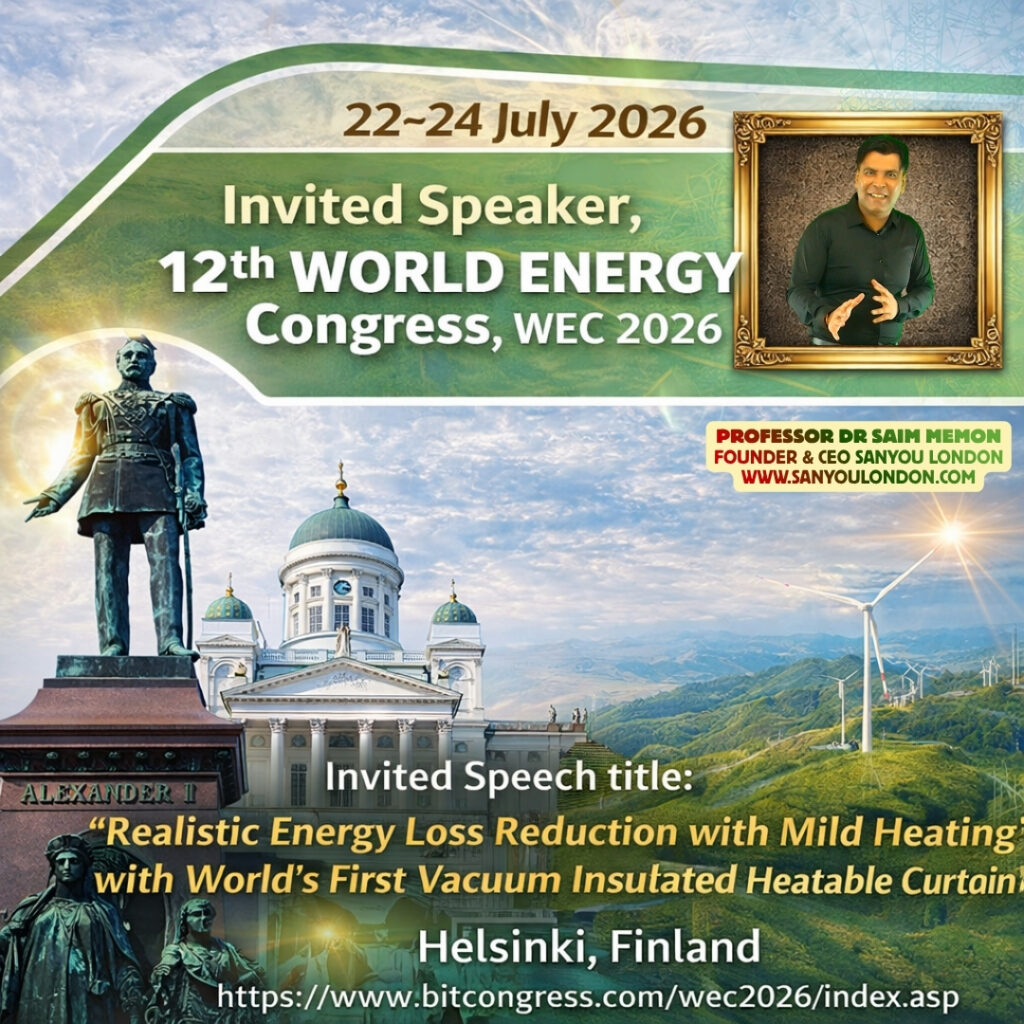
Invited Speaker, 12th World Energy Congress, WEC 2026
22–24 July 2026, Helsinki, Finland
Conference link: 12th World Energy Congress, WEC 2026
I am pleased to share this News & Events update on my invited speaker participation at the 12th World Energy Congress, WEC 2026, held in Helsinki, Finland, from 22 to 24 July 2026. The organisers present the congress as a major international forum for professionals, researchers, and industry experts to exchange knowledge on advanced energy technologies, energy storage, and renewable and sustainable energy solutions, while also exploring how research is translated into practical and scalable commercial outcomes.
My invited speech is titled:
Realistic Energy Loss Reduction with Mild Heating with World’s First Vacuum Insulated Heatable Curtain
This invited speech focuses on a problem that remains surprisingly ordinary, yet strategically important. In many homes, offices, hotels, public buildings, and retrofit settings, a very large share of discomfort and wasted energy still begins at the window line. The usual response is either to accept the loss, or to compensate for it by running the heating system harder. In my view, that is neither elegant nor sustainable. A better engineering question is this: can we reduce heat loss and improve local comfort at the same time, without forcing occupants into expensive renovation, full window replacement, or whole-building overheating?
At the centre of this talk is the Vacuum Insulated Heatable Curtain, VIHC, which I present as the world’s first curtain platform designed to combine ultra-thin vacuum insulation with gentle local heating in a single practical system. The wider technical idea is simple, though powerful in application. Instead of treating heat loss and comfort as two separate problems, VIHC addresses both together: the vacuum-insulated layer helps reduce heat flow through glazing, while the integrated low-power heating layer adds mild radiant warmth where people actually sit, work, or rest. That makes the system especially relevant to older buildings, rented properties, restricted heritage settings, and everyday retrofit situations where major façade or glazing intervention is unrealistic.
The published technical explanation of the VIHC concept describes it as an extension of the Vacuum Insulated Curtain, VIC, adding gentle radiant heat to the same vacuum-insulation platform. The article presents the product as about 7 mm thick, designed for straightforward curtain-style installation, and operating at roughly 1 kWh for 3 hours to provide targeted evening warmth. It also explains the wider comfort logic clearly: reduce heat loss at the window, improve local radiant conditions, and allow the main heating system to work less aggressively.
That matters because the standard heating approach in cold climates is often wasteful by design. We do not usually heat only the part of the room that needs comfort most; instead, we raise the temperature of the whole space and continue paying for losses through the coldest surface. The VIHC idea challenges that habit. It supports a more realistic model of comfort, one based on zoned warmth, lower thermostat pressure, and reduced window-side heat leakage, rather than brute-force heating of the entire room.
The invited speech also places VIHC within a wider portfolio of Vacuum Insulation Technologies, including Vacuum Insulation Panels, VIP, Decorative Vacuum Insulation Panels, DVIP, 4 mm Vacuum Insulated Wallpaper, VIW, Vacuum Insulated Curtains, VIC, and Vacuum Insulated Bag-or-Box systems, VIBB. Across Sanyou London’s published technical material, the purpose of this portfolio is consistent: make serious thermal performance possible in slim, practical, and more deployable formats where conventional thick insulation becomes disruptive, space-consuming, or difficult to implement.
The underlying case becomes stronger when viewed through real application examples. The published VIC material reports a whole-curtain thermal conductivity of about 13.08 mW·m⁻¹·K⁻¹ and a U-value around 1.87 W/m²·K, with cited energy savings in both hot and cold contexts. The VIW material presents a 4 mm retrofit approach with conductivity around 0.005 W/m·K, alongside reported composite improvement on common wall types, including up to 71% reduction for a single solid-brick wall case in the cited comparison. The wider VIBB family extends the same vacuum-insulation thinking into medical, food, and logistics applications, with published examples ranging from several hours of protection in delivery use to several days in medical-box conditions, depending on the system and ambient scenario.
For me, this is why the WEC 2026 invitation is important. The congress is not only about large-scale energy systems and emerging technologies; it is also about recognising that deep progress in sustainability depends on reducing waste at the point where it happens. The official WEC description stresses advanced energy technologies, storage breakthroughs, renewable energy development, and the sharing of practical success stories. That makes it an appropriate setting for a message I continue to emphasise: end-use energy loss reduction is not secondary to the energy transition; it is one of its most immediate and deployable levers.
Readers who wish to explore the broader context behind this invited speech may visit my Worldwide Speaking Engagements, Research Publications, Research & Development Laboratory, and Industry Articles. Those who are interested in the practical product direction can also explore Sanyou London, the Department of Products and Sales, the Vacuum Insulated Heatable Curtain article, the Vacuum Insulated Curtain performance article, and the Vacuum Insulated Wallpaper comparison article.
I value this invited participation at WEC 2026 because it gives space for a more honest engineering discussion. In a net-zero world, we cannot keep pretending that efficiency is achieved only through larger infrastructure, smarter software, or cleaner generation. Sometimes the more intelligent answer is far simpler: stop the loss where it begins, improve comfort where it matters, and do it in a way that people can realistically adopt.
I welcome future dialogue with universities, conference organisers, industrial institutions, architects, retrofit specialists, housing stakeholders, distributors, and collaborators interested in vacuum insulation, window-side heat-loss reduction, mild-heating strategies, low-energy retrofit, and real-world product deployment. For professional contact, please visit my Contact page.
SHARE