
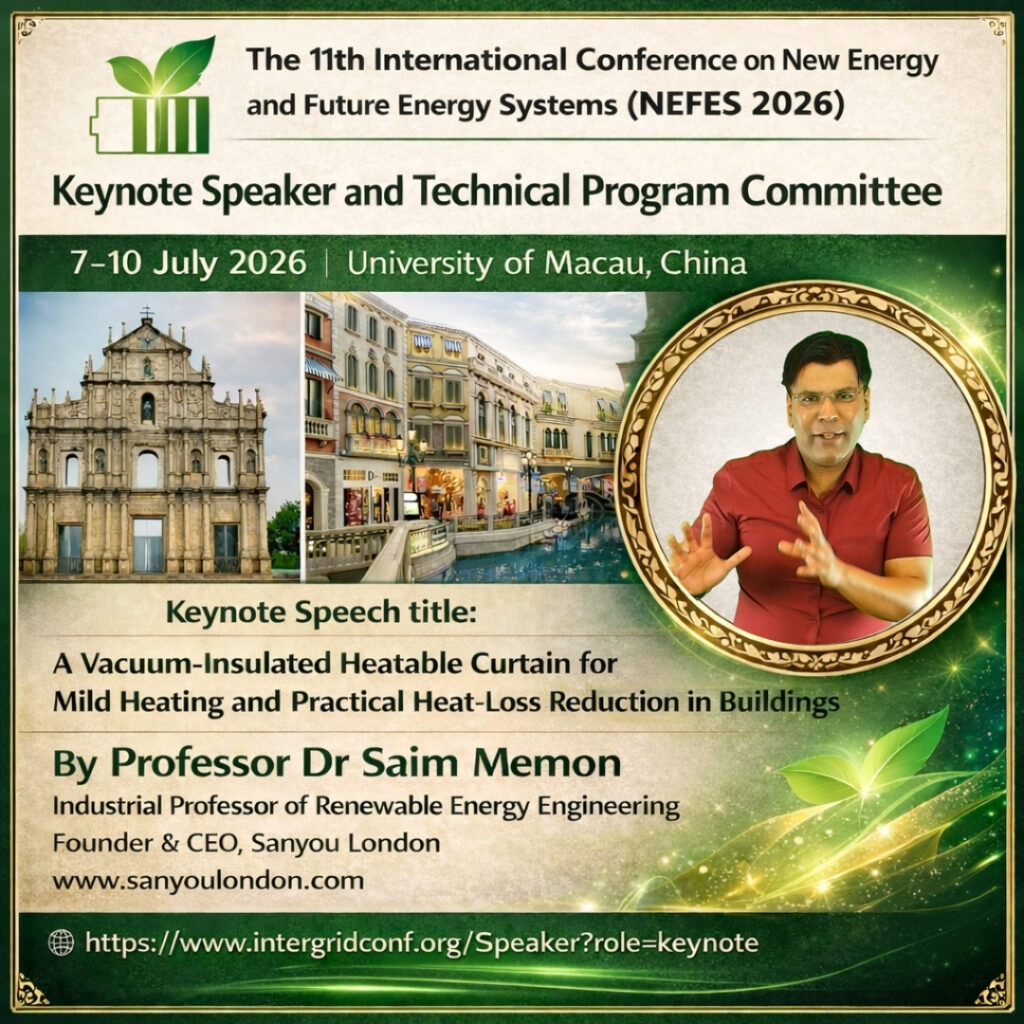
Keynote Speaker and Technical Program Committee Chair
11th International Conference on New Energy and Future Energy Systems, NEFES 2026
7–10 July 2026, City University of Macau, China
Conference link: NEFES 2026 Keynote Speakers
I am pleased to share this News & Events update on my participation in the 11th International Conference on New Energy and Future Energy Systems, NEFES 2026, held from 7 to 10 July 2026 at City University of Macau, China. The official conference pages list me among the keynote speakers and, separately, under the Technical Program Committee Chairs, which makes this a meaningful role both in academic contribution and in the wider technical direction of the conference. The conference also presents itself as a forum for researchers and practitioners working across new energy and future energy systems, with topics that include advanced energy technologies, green building, energy-saving technologies, energy management, and related system innovation.
My keynote speech is titled:
A Vacuum-Insulated Heatable Curtain for Mild Heating and Practical Heat-Loss Reduction in Buildings
What makes this keynote important, in my view, is that it addresses a problem that remains extremely common yet still under-treated in practical energy policy and building engineering. A great deal of heating demand is not created because people want excessive warmth; it is created because buildings, and especially glazing zones, continue to leak heat too easily. When that happens, the standard response is usually to raise whole-room or whole-building heating input. That works, but it is an expensive and blunt answer. A more intelligent approach is to reduce heat loss where it begins and improve comfort where it is actually needed. That is the engineering logic behind the Vacuum Insulated Heatable Curtain, VIHC.
The wider technical concept is simple, but strategically strong. VIHC combines the insulation logic of the Vacuum Insulated Curtain, VIC with a low-wattage heating layer, so the system can both reduce window-side heat loss and provide gentle local radiant warmth. Sanyou London’s published material describes VIHC as a world-first curtain platform that adds soft radiant heat to vacuum-insulated curtain technology, operating at roughly 1 kWh for 3 hours for targeted evening comfort, while avoiding the need for glazing replacement, structural changes, contractors, or disruptive installation work. In practical terms, this means comfort can be improved in the occupied zone while the main heating system is under less pressure to overheat the entire room.
That broader logic also sits within a more complete platform of Vacuum Insulation Technologies, including Vacuum Insulation Panels, VIP; Decorative Vacuum Insulation Panels, DVIP; 4 mm Vacuum Insulated Wallpaper, VIW; 7 mm Vacuum Insulated Curtains, VIC; VIHC; and Vacuum Insulated Bag-or-Box systems, VIBB. The official keynote abstract on the NEFES site presents this portfolio as a TRL 7–9 route for deep demand-side energy reduction across buildings, transport logistics, AI data centres, and thermal-management applications where conventional fibrous or polymeric insulation often struggles to deliver very low heat loss without space penalty, retrofit burden, or fire-performance compromise. The same official abstract reports 15 mm fibreglass VIPs at thermal conductivity as low as 2.5 mW·m⁻¹·K⁻¹, 25 mm fumed-silica cores at 4.5 mW·m⁻¹·K⁻¹, VIW retrofit reductions of up to 71% in solid-brick wall U-value with about 30% space-heating reduction in the cited London case, VIC cooling-load savings of about 23% in the Riyadh glazing scenario, and VIBB temperature retention of 2–8 °C for 120 hours at 40 °C ambient.
For this specific keynote, however, the focus is sharper. The speech places special attention on the value of a heatable curtain as a realistic retrofit response in buildings where window heat loss remains the dominant comfort problem but full window replacement is impractical, too expensive, restricted by regulation, or simply unnecessary. That is why this work matters in a real-world sense. It is not about chasing laboratory elegance for its own sake; it is about giving building users, landlords, housing providers, heritage properties, offices, hotels, and other constrained settings a more practical way to reduce heat loss and improve local comfort without major intervention.
NEFES 2026 is also significant because of its publication route. The official conference guidance states that accepted full papers are published in IET Conference Proceedings and indexed by Ei Compendex and Scopus, which gives the event a solid academic dissemination pathway in addition to its conference platform.
Readers who wish to explore the wider context behind this keynote may visit my Worldwide Speaking Engagements, Research Publications, Research & Development Laboratory, and Biography. Those interested in the practical product and industry side may also explore Sanyou London, the Department of Products and Sales, the Vacuum Insulated Heatable Curtain page, the Vacuum Insulated Curtain page, and the article Vacuum-Insulated Heatable Curtain (VIHC): DIY Warmth and Insulation for 1 kWh.
I value this participation at NEFES 2026 because it creates room for a more honest engineering discussion. In a serious net-zero transition, it is not enough to generate cleaner electricity if buildings continue to waste heat in ways that are ordinary, predictable, and technically avoidable. Mild heating, when combined with real heat-loss reduction at the glazing line, becomes a far more intelligent strategy than simply turning the whole heating system up. That is the central message of this keynote, and it is one I believe has immediate relevance to both academic research and real-world deployment.
I welcome future dialogue with universities, researchers, housing providers, retrofit specialists, architects, contractors, distributors, and industrial partners interested in vacuum insulation, low-energy comfort solutions, building heat-loss reduction, and practical retrofit pathways. For professional contact, please visit my Contact page
SHARE