
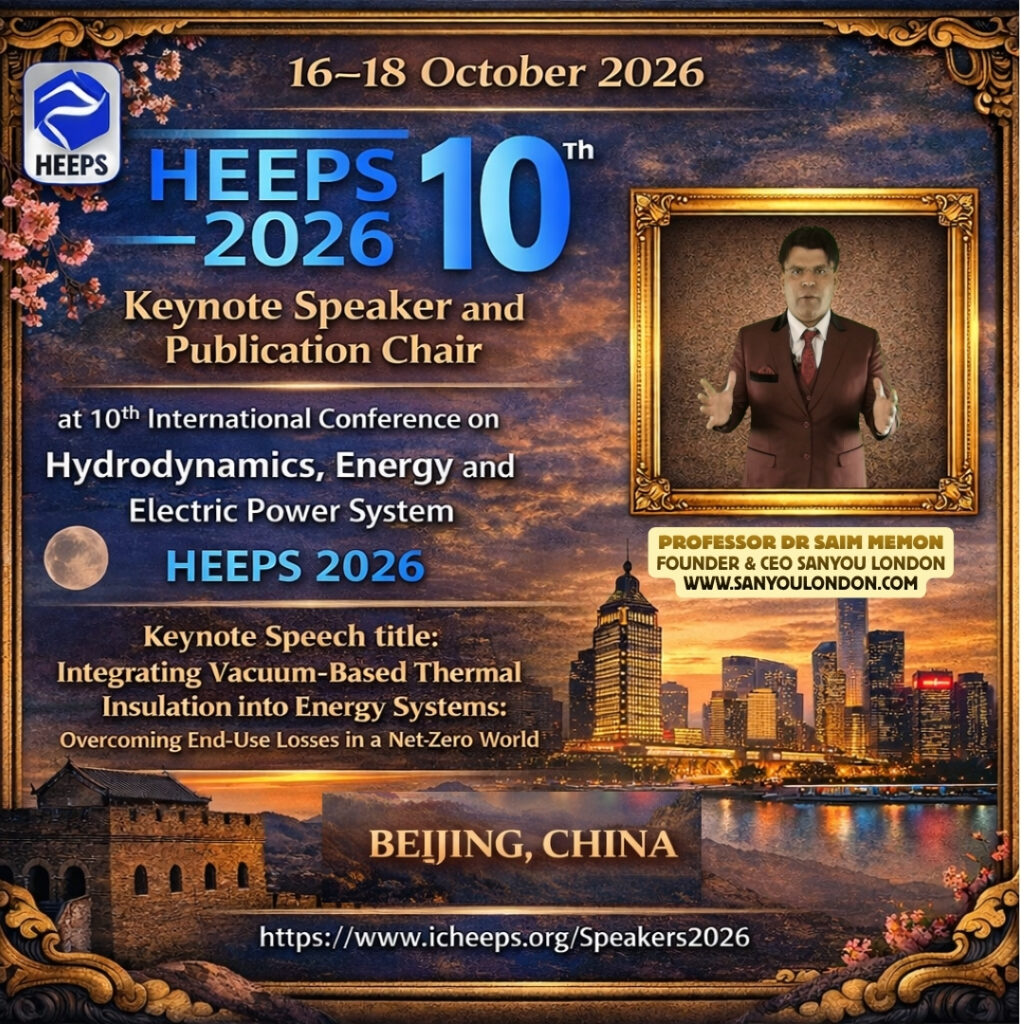
Keynote Speaker and Publication Chair
10th International Conference on Hydrodynamics, Energy and Electric Power System, HEEPS 2026
16–18 October 2026, Beijing, China
Conference link: https://www.icheeps.org/Speakers2026
I am pleased to share this News & Events update on my participation in the 10th International Conference on Hydrodynamics, Energy and Electric Power System, HEEPS 2026, in Beijing, China, on 16–18 October 2026, where the official conference pages list me as both a keynote speaker and publication chair. The event positions itself as an international forum focused on hydrodynamics, energy, and electric power systems, with emphasis on interdisciplinary integration and technological innovation across these fields.
My keynote speech is titled:
Integrating Vacuum-Based Thermal Insulation into Energy Systems: Overcoming End-Use Losses in a Net-Zero World
This role matters to me because the conference themes sit close to a question I consider increasingly urgent: in a world that talks constantly about net-zero targets, grid transition, and low-carbon growth, are we paying enough serious attention to the energy that is still being wasted at the point of use? In practice, a great deal of avoidable loss still sits in walls, roofs, glazing, refrigeration systems, chilled-water pipework, logistics packaging, transport envelopes, and temperature-sensitive infrastructure. When those losses remain embedded in the system, every extra unit of electricity generation, storage, cooling, and network reinforcement has to work harder than it should.
Why this keynote fits HEEPS 2026
The HEEPS 2026 conference describes its wider purpose as advancing hydrodynamics, numerical simulation technologies, and their applications in energy and electric power systems, while also bringing researchers and industry professionals together around renewable energy systems, energy storage, smart power, grid technologies, power quality, and energy-saving technology. That makes this keynote a very suitable contribution, because vacuum-based thermal insulation is not merely a materials topic; it is a systems topic, with direct relevance to energy efficiency, infrastructure resilience, operational cost, and the practical credibility of net-zero engineering.
What the keynote presents
My keynote presents a connected portfolio of ultra-thin Vacuum Insulation Technologies, developed to reduce end-use losses in buildings, transport, storage, and AI-linked thermal-management environments. The engineering principle is well established: by evacuating the core to 10 Pa or below, gaseous conduction and convection are sharply reduced, while barrier layers and reflective surfaces help manage radiative transfer. This makes it possible to achieve high thermal resistance in millimetre-scale forms that are far easier to integrate into constrained real-world projects than conventional thick insulation systems.
The platform discussed in this keynote includes Vacuum Insulation Panels, VIP; Decorative Vacuum Insulation Panels, DVIP; 4 mm Vacuum Insulated Wallpaper, VIW; 7 mm Vacuum Insulated Curtains, VIC; the low-wattage Vacuum Insulated Heatable Curtain, VIHC; and Vacuum Insulated Bag-or-Box systems, VIBB. Across Sanyou London’s published technical material, these systems are positioned not as isolated prototypes, but as a deployable family intended to make low U-values more achievable under real constraints of space, retrofit burden, fire performance, operational practicality, and commercial delivery.
Technical direction and application value
The technical case is strong because the portfolio covers both physics and application. Published company material describes 15 mm fibreglass VIPs at about 2.5 mW·m⁻¹·K⁻¹, with the internal vacuum maintained below 10 Pa and ageing life discussed in multi-decade terms. Related summaries also report that 4 mm VIW can reduce solid-brick wall U-values by up to 71% and lower heating demand in London dwellings by around 30%, while 7 mm VIC systems with removable vacuum inserts reach whole-curtain conductivity of about 13.08 mW·m⁻¹·K⁻¹, with cited cooling-load savings of at least 23% in a Riyadh office scenario. VIHC is presented as a comfort-oriented extension of that curtain platform, adding low-wattage radiant support of about 1 kWh for three hours.
The wider portfolio also extends into storage, transport, and temperature-sensitive logistics, which is important because end-use loss is not only a building problem. Sanyou London’s published summaries describe VIBB solutions maintaining 2–8 °C for about 120 hours at 40 °C ambient conditions, while reducing dependence on dry ice or active cooling by about 80% in the cited application context. The same body of material also positions flexible VIP systems as relevant to AI factories and data centres, where compact thermal control, reduced hot spots, and lower cooling demand become strategically important.
Publication route and academic relevance
Another reason this conference is important is the publication pathway. The official HEEPS publication page states that all accepted full papers are published in the Journal of Physics: Conference Series, JPCS, and are submitted to EI Compendex and Scopus for indexing. That gives the event a useful academic and dissemination route for authors whose work sits at the intersection of energy systems, modelling, applied engineering, and sustainable technology.
Wider context of my work
This keynote also reflects the broader direction of my academic and industrial work, where I continue to focus on the transition from invention and scientific evidence to industrial research and development, manufacturable product platforms, and real-world energy-saving applications. Readers who want the wider context can visit my Worldwide Speaking Engagements, Research Publications, Research & Development Laboratory, and Biography.
Those who are more interested in the practical product and deployment side may also explore Sanyou London’s Department of Products and Sales, the article What Is a Vacuum Insulation Panel (VIP)? How It Works, the wall-retrofit article 4 mm VIW vs Bulk Insulation: Real Gains on SIPs, Concrete, Cob, Cavity and Brick Walls, the glazing article Vacuum Insulated Curtain: Thermal Performance & Energy Savings, and the data-centre article VIPs for AI Factories & Data Centres: Thin Thermal Control for Racks, Pods and Control Boxes.
Final reflection
I value my role at HEEPS 2026 because it creates space for a more serious conversation about a simple but often neglected truth: net-zero progress depends not only on cleaner supply, but also on whether we reduce the losses that quietly drive unnecessary demand in the first place. In that sense, vacuum-based thermal insulation is not a peripheral idea. It is one of the more practical and technically mature levers available for reducing end-use waste across buildings, logistics, storage, transport, and emerging AI-driven thermal environments.
I welcome future dialogue with universities, conference organisers, industrial institutions, engineers, architects, contractors, cold-chain operators, transport stakeholders, and organisations interested in collaboration, consultancy, invited talks, publication activity, industrial R&D, or product deployment linked to vacuum insulation and energy efficiency. For professional contact, please visit my Contact page.
SHARE