
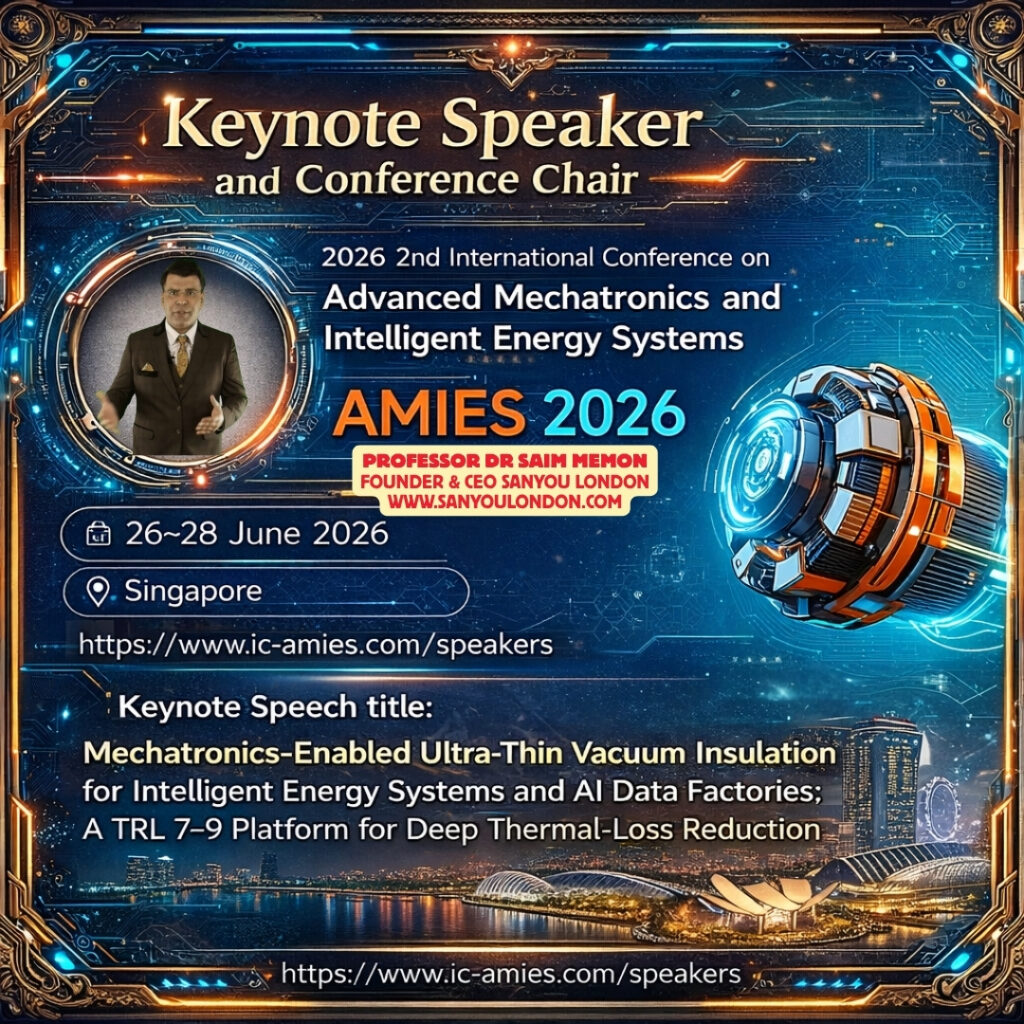
Keynote Speaker and Conference Chair, 2nd International Conference on Advanced Mechatronics and Intelligent Energy Systems, AMIES 2026
26–28 June 2026, Singapore
Conference link: AMIES 2026 Speakers
I am pleased to share this News & Events update on my participation in the 2nd International Conference on Advanced Mechatronics and Intelligent Energy Systems, AMIES 2026, taking place in Singapore from 26 to 28 June 2026. On the official conference pages, I am listed on the speakers page, and the committee page places me within the Conference Chair section, which makes this event especially meaningful to me both as a speaker and as part of the conference leadership structure. The conference presents itself as an international platform for researchers, scholars, engineers, and industry experts working across mechatronics and intelligent energy systems.
My keynote speech is titled:
Mechatronics-Enabled Ultra-Thin Vacuum Insulation for Intelligent Energy Systems and AI Data Factories: A TRL 7–9 Platform for Deep Thermal-Loss Reduction
AMIES 2026 is, in my view, a very suitable setting for this topic because the conference explicitly brings together themes such as robotics and automation, smart sensing and control, intelligent manufacturing, renewable energy systems, energy storage technologies, smart grids, power electronics, and sustainable energy solutions. That matters because intelligent energy systems do not succeed through software and control alone; they perform properly when sensing, power electronics, thermal design, materials engineering, and system integration are all aligned.
Why this keynote matters
The central argument of my keynote is straightforward. If we are serious about net-zero systems, then we have to reduce thermal loss more aggressively at the point where it actually occurs, rather than merely trying to compensate for that loss later through larger cooling systems, more electricity generation, more storage, and more infrastructure. In buildings, storage, refrigeration, transport, and increasingly in AI data factories, wasted heat transfer remains a hidden penalty that quietly drives cost, carbon, and engineering complexity.
This is why I position vacuum insulation not as a niche product discussion, but as a systems-level engineering lever. A large part of the efficiency conversation still overlooks the fact that every avoidable watt of thermal leakage creates a downstream burden on electrical supply, equipment sizing, grid reinforcement, operating cost, and carbon intensity. Once AI data centres and industrial AI facilities are added to that picture, the relevance becomes even sharper, because cooling energy quickly becomes a first-order operational issue rather than a secondary design detail.
What the keynote presents
My keynote presents a TRL 7–9 portfolio of ultra-thin Vacuum Insulation Technologies designed for practical integration into intelligent energy architectures. The technical principle is based on suppressing gas conduction and convection by evacuating engineered cores to 10 Pa or below, while also controlling radiative heat transfer through multilayer barrier structures and surface treatments. The result is high thermal resistance in millimetre-scale forms that can be embedded into real systems without forcing complete redesign.
The platform includes Vacuum Insulation Panels, VIP; Decorative Vacuum Insulation Panels, DVIP; 4 mm Vacuum Insulated Wallpaper, VIW; 7 mm Vacuum Insulated Curtains, VIC; the low-wattage Vacuum Insulated Heatable Curtain, VIHC; and Vacuum Insulated Bag-or-Box systems, VIBB. What links these technologies is not merely the use of vacuum, but a design philosophy aimed at making deep thermal-loss reduction more deployable under real constraints of space, fire safety, retrofit burden, project timing, manufacturability, and cost.
Readers who want the wider industrial context can explore my Industry Articles, Industry Videos, and Sanyou London’s Department of Products and Sales.
Why mechatronics and vacuum insulation belong together
The title of this keynote is deliberate. Mechatronics is often associated with sensors, embedded control, automation, and intelligent decision-making. Yet intelligent systems become genuinely effective only when the underlying physical system is not wasting energy excessively in the first place. In other words, data and control can optimise performance, but they cannot fully rescue a thermally poor envelope or a badly designed energy path.
That is why I frame ultra-thin vacuum insulation as mechatronics-enabled as well as mechatronics-enabling. It supports compact integration, condition monitoring, modular upgrade pathways, and digital-twin-informed optimisation, while also giving the control system a far better physical baseline to work with. This is especially relevant in AI data factories, where high cooling loads, dense equipment clusters, thermal hotspots, and space-sensitive design all intensify the need for compact and high-performance thermal control.
A related industrial discussion on this wider topic can be explored through Sanyou London’s article on VIPs for AI factories and data centres.
Technical direction and practical evidence
The keynote draws on a technology portfolio in which 15 mm fibreglass VIPs reach effective thermal conductivity of about 2.5 mW·m⁻¹·K⁻¹, while 25 mm fumed-silica VIPs reach about 4.5 mW·m⁻¹·K⁻¹. In façade form, 30 mm DVIP cassettes are presented at about 7 mW·m⁻¹·K⁻¹, alongside A1 fire classification and multi-decade durability targets within the wider technical context of the platform.
The practical case studies are equally important. The keynote highlights how VIW can reduce solid-brick wall U-values by up to 71% and lower space-heating demand in London dwellings by around 30%. It shows how VIC assemblies achieve effective whole-curtain conductivity of about 13 mW·m⁻¹·K⁻¹ and reduce cooling loads by about 23% in a single-glazed Riyadh office scenario. It also shows how VIHC supports local comfort through low-wattage operation of roughly 1 kWh per three-hour cycle, which helps reduce dependence on high whole-building setpoints. In cold-chain applications, VIBB prototypes maintain 2–8 °C for 120 hours under 40 °C ambient exposure, which points to a serious route for lowering reliance on dry ice or active cooling.
For readers interested in the product pathways behind these examples, relevant links include the VIP page, VIW page, VIC page, VIHC page, and VIBB page.
Why this matters for sustainability, industry, and future systems
The wider message I bring to AMIES 2026 is that deep thermal-loss reduction is not separate from intelligent energy systems; it is part of their foundation. Mechatronic control, predictive maintenance, digital twins, adaptive energy management, and smart-grid interaction all become more effective when the physical system itself is thermally stronger. That is why this work matters not only for sustainable buildings, but also for cold chain, transport, smart infrastructure, and AI-linked industrial systems.
The conference itself emphasises interdisciplinary exchange and practical collaboration between academia and industry, which is precisely the kind of environment where this conversation becomes valuable. AMIES 2026 positions itself as a forum for technological innovation, collaboration, and emerging engineering trends, and that wider setting aligns well with the translational nature of my own work across research, industrial R&D, and scalable deployment.
Readers who want the wider academic context may visit my Worldwide Speaking Engagements, Research Publications, Research & Development Laboratory, and Biography.
Final reflection
I value my participation in AMIES 2026 because it creates room for a more serious engineering discussion about what intelligent energy systems really require. In my view, net-zero credibility depends not only on renewable supply, advanced controls, and better analytics, but also on whether we reduce the structural thermal losses that force those systems to work harder than they should. Ultra-thin vacuum insulation offers one of the few technically mature, integration-ready routes that improves efficiency, affordability, resilience, and system intelligence at the same time.
I welcome future dialogue with universities, industrial organisations, AI infrastructure developers, architects, contractors, cold-chain stakeholders, transport operators, and research partners who are interested in collaboration, consultancy, invited talks, industrial R&D, or deployment strategies linked to vacuum insulation, intelligent energy systems, and advanced thermal management. For professional contact, please visit my Contact page.
SHARE