
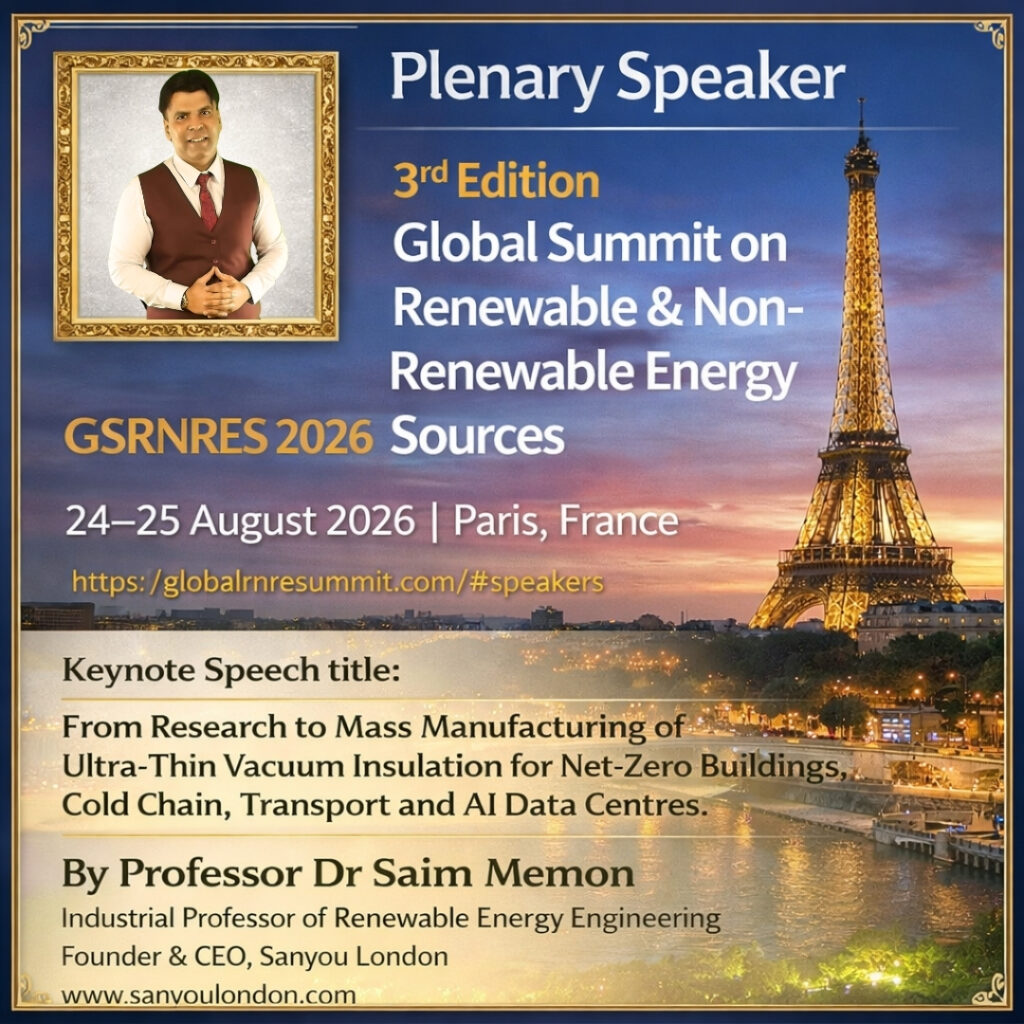
Plenary Speaker, 3rd Edition Global Summit on Renewable & Non-Renewable Energy Sources, GSRNRES 2026
24–25 August 2026, Paris, France
Conference link: GSRNRES 2026
I am pleased to share this News & Events update on my participation in the 3rd Edition Global Summit on Renewable & Non-Renewable Energy Sources, GSRNRES 2026, held in Paris, France, on 24–25 August 2026. The official summit website lists me as a Plenary speaker, and the event presents itself as an international platform for researchers, industry leaders, policymakers, and students to exchange ideas on practical energy solutions across the renewable and non-renewable spectrum.
My plenary speech is titled:
From Research to Mass Manufacturing of Ultra-Thin Vacuum Insulation for Net-Zero Buildings, Cold Chain, Transport and AI Data Centres
This is an important summit contribution for me because the discussion is not only about inventing better materials, but about whether energy-saving technologies can move beyond attractive prototypes and become reliable, factory-controlled solutions that industry can actually procure and deploy at scale. The official summit themes include thermal energy storage and heat recovery systems, energy efficiency and demand-side management, climate change and sustainability, and grid resilience with AI and digital energy management, which makes this a strong setting for a more serious conversation about demand-side loss reduction.
The central argument of my plenary talk is simple. Net-zero targets are increasingly limited not by a lack of ambition, but by the fact that avoidable thermal losses remain built into real systems: building envelopes, chilled-water systems, refrigeration, logistics packaging, transport barriers, and now the cooling-heavy environments of AI data centres and industrial AI factories. In practice, every watt of preventable heat leakage forces additional electricity generation, more cooling infrastructure, more grid pressure, and more cost. That is why I continue to treat energy efficiency as a strategic engineering issue, not a decorative one.
What makes this plenary talk distinctive is its emphasis on the route from research to mass manufacturing. The speech presents a TRL 7–9 platform of ultra-thin Vacuum Insulation Technologies designed for repeatable industrial production rather than one-off laboratory performance. The engineering principle is well established: evacuate the core to 10 Pa or below to suppress gas conduction and convection, manage radiative transfer through barrier architectures and surface treatments, and then translate that into modular formats that fit real products and real projects without forcing whole-system redesign. A broader technical explanation of this design logic appears in Sanyou London’s materials on what a Vacuum Insulation Panel is and how it works and in the company’s VIP technical overview.
The technology platform itself spans Vacuum Insulation Panels, VIP; façade-integrated Decorative Vacuum Insulation Panels, DVIP; 4 mm Vacuum Insulated Wallpaper, VIW; 7 mm Vacuum Insulated Curtains, VIC; the low-wattage Vacuum Insulated Heatable Curtain, VIHC; and Vacuum Insulated Bag-or-Box systems, VIBB. What links them is not only the use of vacuum, but a manufacturing intent: make low U-values achievable in real buildings and supply chains under practical limits of space, fire safety, programme time, maintenance, and cost. That shift from prototype promise to controlled, repeatable industrial output is, in my view, one of the most important parts of the message.
Across the wider Sanyou London technical material, 15 mm fibreglass VIPs are presented at about 2.5 mW·m⁻¹·K⁻¹, while 25 mm fumed-silica VIPs are presented at about 4.5 mW·m⁻¹·K⁻¹. The broader platform also includes applications where thin thermal control matters for AI data centres, where Sanyou London describes flexible VIP systems as a route to stabilising hot spots, protecting control zones, and reducing cooling demand in racks, pods, and related equipment spaces. That is precisely why the summit theme of digital and AI-linked energy resilience is so relevant to this talk.
For buildings, the portfolio matters because thin retrofit can remove one of the biggest barriers to real adoption. The published VIW material describes 4 mm Vacuum Insulated Wallpaper as a route to internal wall upgrade without the heavy thickness burden of conventional systems, and related articles report up to 71% reduction in solid-brick wall U-value in the cited case. For windows and glazed openings, the Vacuum Insulated Curtain platform is presented with thermal conductivity around 13.1 mW/m·K and U-value around 1.87 W/m²·K, while the Vacuum Insulated Heatable Curtain adds gentle radiant heating at roughly 1 kWh for 3 hours to improve local comfort without relying on aggressive whole-room heating.
For cold-chain and transport applications, the same core principle extends into passive temperature protection. The published VIBB and related logistics material presents vacuum-insulated bag and box systems as a route to maintaining controlled temperatures with reduced dependence on active cooling or dry ice, while related Sanyou London articles also position thin VIP systems as useful in refrigeration, HVAC piping, and vehicle thermal-management contexts where compact insulation can reduce energy burden without unacceptable bulk.
What gives this plenary extra importance is the summit’s own emphasis on practical solutions, knowledge exchange, and real-world impact. The official site states that the event aims to help participants test ideas, form partnerships, and move credible work from research into pilots, procurement, and deployment. That aligns closely with the direction of my own work, where academic research, industrial R&D, product development, and commercial readiness are not treated as separate worlds.
Readers who would like to explore the wider context behind this plenary contribution may visit my Worldwide Speaking Engagements, Research Publications, Research & Development Laboratory, and Biography. Those interested in the industrial and deployment side may also explore Sanyou London, the Department of Products and Sales, and relevant technical pathways including VIP, VIW, VIC, VIHC, and VIBB.
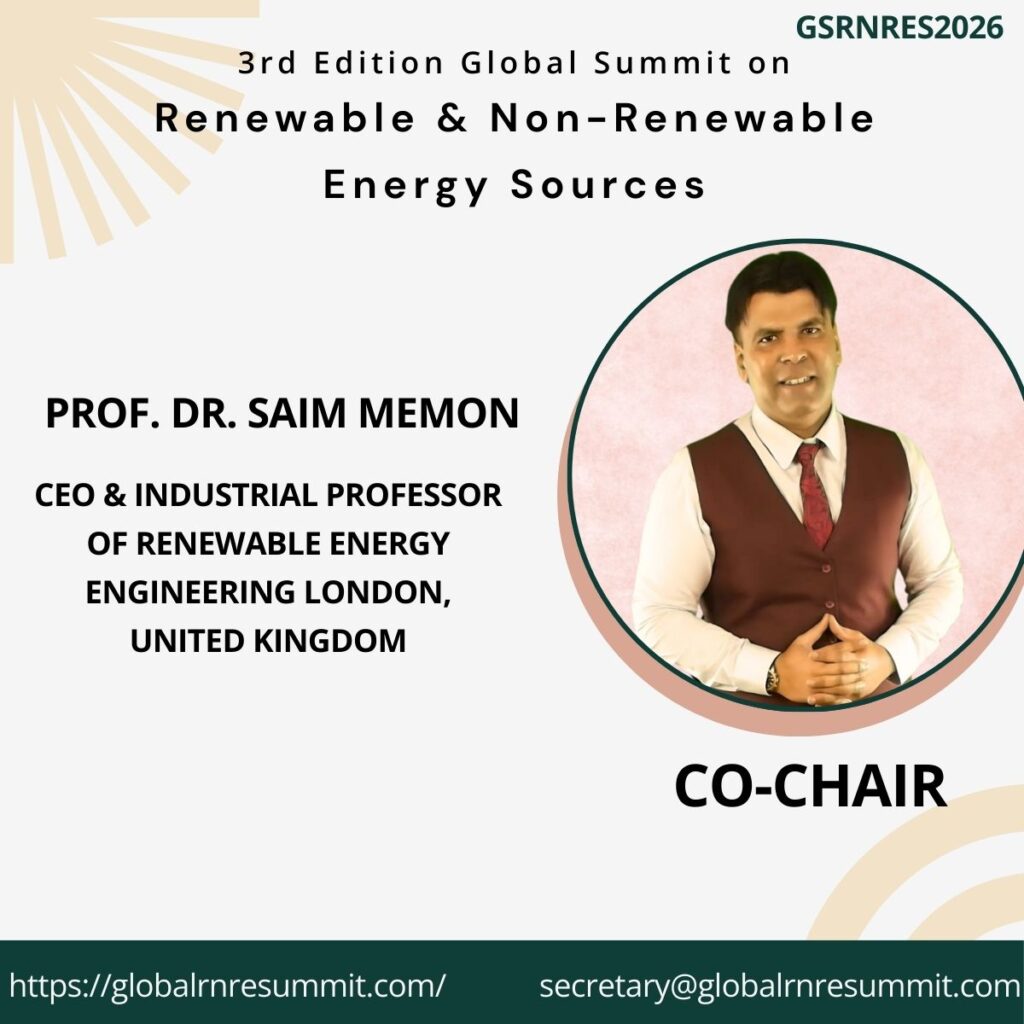
I value my participation in GSRNRES 2026 because it gives space for a message that I believe needs far more serious attention. If the world wants credible progress on climate, affordability, and grid resilience, then we cannot keep treating end-use thermal losses as a minor background issue. Manufacturable, quality-controlled, ultra-thin vacuum insulation is one of the few practical levers that can improve sustainability, affordability, and system resilience at the same time across buildings, cold chain, transport, and AI-linked thermal infrastructure.
I welcome future dialogue with universities, industrial organisations, research groups, housing and retrofit stakeholders, cold-chain operators, transport partners, AI infrastructure developers, architects, contractors, suppliers, and distributors who are interested in collaboration, consultancy, invited talks, industrial R&D, or deployment of advanced vacuum-insulation technologies. For professional contact, please visit my Contact page.
SHARE