
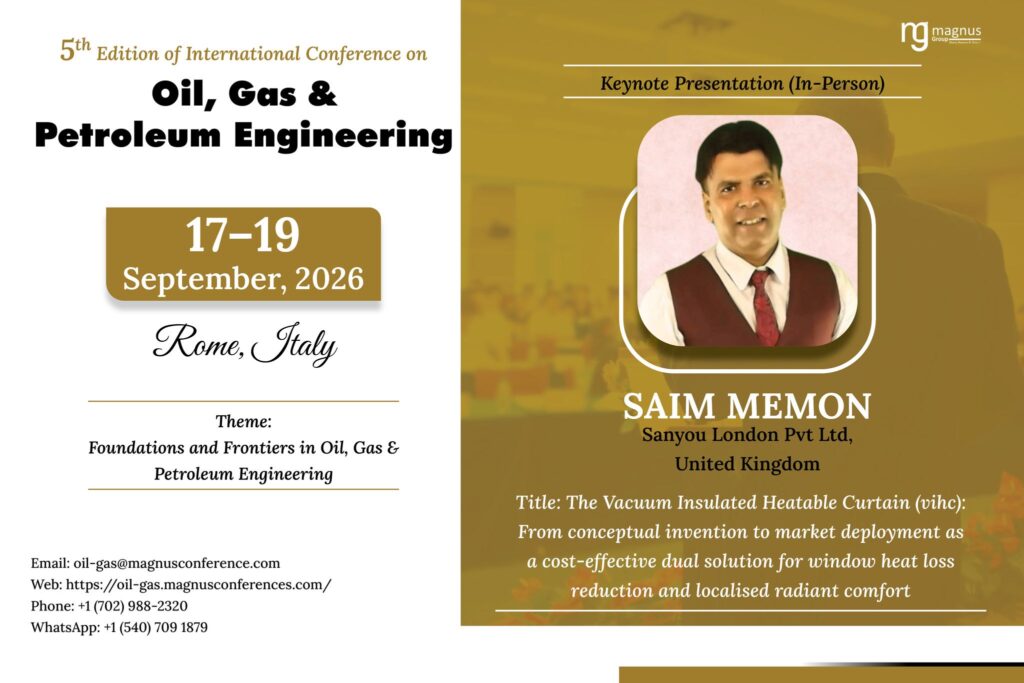
Keynote Speaker and Scientific Committee Member
5th International Conference on Oil, Gas & Petroleum Engineering, GOPE 2026
17–19 September 2026, Rome, Italy
Conference link: GOPE 2026
I am pleased to share this News & Events update on my participation in the 5th International Conference on Oil, Gas & Petroleum Engineering, GOPE 2026, held in Rome, Italy, on 17–19 September 2026, where the official conference pages list me both as a keynote speaker and as part of the Scientific Committee. The organisers present GOPE 2026 as a hybrid international forum under the theme “Foundations and Frontiers in Oil, Gas & Petroleum Engineering”, with a strong focus on knowledge exchange, technical innovation, and strategic partnership across the energy sector.
My keynote speech is titled:
The Vacuum Insulated Heatable Curtain (VIHC): From Conceptual Invention to Market Deployment as a Cost-Effective Dual Solution for Window Heat Loss Reduction and Localised Radiant Comfort.
This is an important conference contribution for me because it demonstrates something I continue to value strongly in my work: the movement of an idea from scientific conception to industrial reality. The official speaker page presents this keynote title directly, and that matters because the Vacuum Insulated Heatable Curtain, VIHC, is not merely another thermal product concept; it is part of a wider research-to-industry pathway in which academic invention, engineering validation, manufacturing progression, and market deployment begin to align in a practical and commercially relevant way.
At first glance, some readers may ask why a heat-loss and comfort solution belongs at an oil, gas, and petroleum engineering conference. In my view, the answer is straightforward. The official GOPE programme and conference overview make clear that the event is not limited to traditional upstream or downstream topics alone; it also addresses energy transition, the role of oil and gas in net-zero goals, and, in the official welcome material, the growing role of AI and big data in the sector. In other words, GOPE 2026 already sits within the wider conversation about how energy systems become more efficient, more resilient, and more realistic in a changing world.
That broader context is exactly where the VIHC becomes relevant. In many buildings, especially those with poor glazing performance, heritage constraints, rented occupancy, or limited retrofit budgets, a large share of heating demand is driven not by luxury but by avoidable heat loss at the window line. The usual response is to run central heating harder, for longer, and often more widely than the occupied zone actually requires. The Vacuum Insulated Heatable Curtain addresses that problem in a more intelligent way by combining vacuum insulation with low-power radiant heating in a single portable curtain system. This allows local comfort improvement and window-side heat-loss reduction to work together rather than separately.
Sanyou London’s published VIHC material describes the product as a 7 mm composite assembly that combines a vacuum-insulating layer with an ultra-thin heating mesh, delivering gentle warmth at around 1 kWh for 3 hours. The same material presents the system as a DIY-style solution that installs like a curtain, without glazing replacement, scaffolding, or invasive building work, which makes it especially relevant to homes, hotels, lounges, rented properties, and heritage settings where structural intervention is difficult, unwanted, or not permitted.
What makes the VIHC particularly significant is that it is not simply a heater, and it is not simply an insulating curtain. It is a dual solution. It reduces heat loss through the glazed zone while also improving local mean radiant conditions near the occupied space. That distinction matters, because conventional portable heaters often add heat without addressing the underlying loss path, while ordinary thermal curtains reduce some loss but do not actively support comfort when cold downdraughts and radiant asymmetry remain problematic. The VIHC combines both functions in one lightweight system.
The official GOPE speaker biography also supports the significance of this work by presenting my role at Sanyou London in taking inventions from TRL 1 to TRL 9, including the world’s first Vacuum Insulated Wallpaper, Vacuum Insulated Curtain, and Vacuum Insulated Heatable Curtain. That alignment between keynote theme and official speaker profile strengthens the wider message of the conference contribution: innovation becomes most meaningful when it moves beyond conceptual novelty and reaches real-world implementation.
This keynote also sits within a broader family of Vacuum Insulation Technologies, including VIP, DVIP, VIW, VIC, and VIBB, all of which aim to reduce thermal loss in compact, practical, and deployable formats. The wider published Sanyou London material positions these technologies across buildings, transport, storage, and industry, which means the VIHC keynote is best understood not as a standalone curiosity, but as one part of a wider engineering platform focused on realistic demand-side energy reduction. Readers interested in that wider context can explore Sanyou London, the Department of Products and Sales, the VIHC page, and the article Vacuum-Insulated Heatable Curtain (VIHC): DIY Warmth and Insulation for 1 kWh.
A further aspect that makes GOPE 2026 especially meaningful to me is the conference’s collaborative culture. On the official welcome-message page, my own published note describes the event as one I have participated in and observed over the past three years, and I characterise it there as a place where industry and academia meet with candour, rigour, and practicality. I also encourage participants to ask searching questions, share what genuinely works and what does not, and focus on evidence-led discussion with real-world impact. I value that spirit, because it reflects the kind of engineering exchange that is actually useful.
Readers who wish to explore the wider academic and professional context behind this keynote may visit my Worldwide Speaking Engagements, Research Publications, Research & Development Laboratory, Industry Articles, and Biography. These pages reflect the broader direction of my work across renewable energy engineering, vacuum insulation technologies, translational innovation, and industrial deployment.
I value my role at GOPE 2026 not only because of the conference itself, but because it offers a serious international setting in which to demonstrate how a practical built-environment innovation can speak directly to wider energy-system efficiency. In a net-zero world, it is not enough to discuss generation alone; we also have to reduce avoidable losses where they begin, and we have to do so with solutions that are realistic, scalable, affordable, and user-friendly. The Vacuum Insulated Heatable Curtain is, in my view, one such solution.
I welcome future dialogue with universities, industrial organisations, architects, retrofit specialists, hospitality stakeholders, housing providers, distributors, and collaboration partners who are interested in vacuum insulation, localised radiant comfort, low-energy retrofit, and practical pathways from invention to market deployment. For professional contact, please visit my Contact page
SHARE