
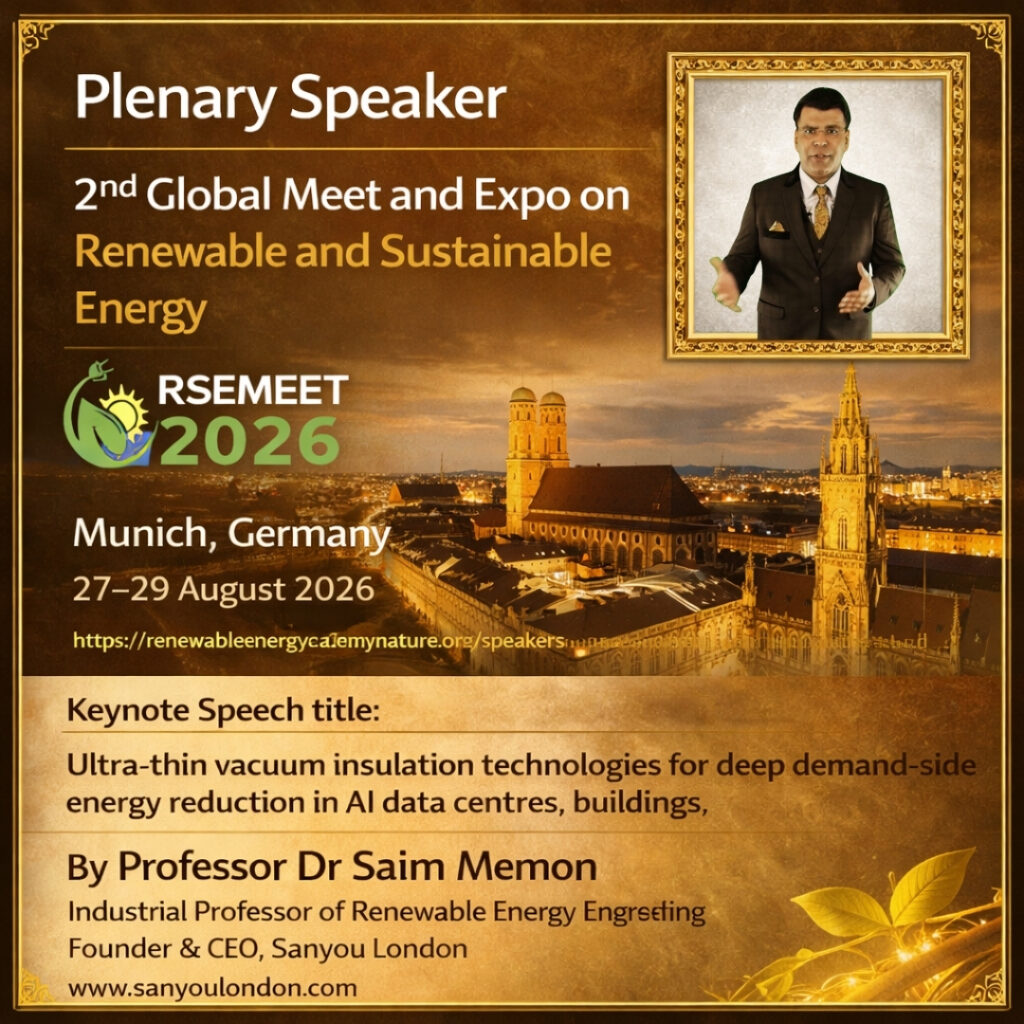
Plenary Speaker, 2nd Global Meet and Expo on Renewable and Sustainable Energy, RSEMEET 2026
27–29 August 2026, Munich, Germany
Conference link: https://renewableenergy2026.academynature.org/#speakers
I am pleased to share this News & Events update on my plenary speaker participation at the 2nd Global Meet and Expo on Renewable and Sustainable Energy, RSEMEET 2026, held in Munich, Germany, from 27 to 29 August 2026. The official summit site presents the event in Munich on those dates, and its speaker listings surface my profile for the conference.
My plenary speech is titled:
Ultra-thin vacuum insulation technologies for deep demand-side energy reduction in AI data centres, buildings, cold-chain storage and transport
This is an important plenary contribution because it addresses a reality that the energy sector still does not confront seriously enough. We often discuss net-zero pathways as a matter of better generation, cleaner grids, and smarter controls, yet in practice a very large share of wasted energy still disappears through unwanted heat transfer in buildings, refrigerated systems, cold-chain storage, transport envelopes, and increasingly in the cooling-intensive environments of AI data centres. In my view, this makes demand-side loss reduction one of the most immediate and commercially relevant levers available for sustainability, resilience, and affordability.
Why this plenary matters now
The problem is simple, but its consequences are large. When thermal losses remain high, every downstream system has to work harder. Buildings need more heating or cooling. Refrigeration systems run longer. Chilled-water networks carry a heavier burden. Logistics chains require more active temperature control. AI data centres demand more cooling capacity and more electrical input simply to counter losses that should never have been allowed to dominate the system in the first place.
That is why I frame this plenary not as a narrow materials talk, but as a wider engineering discussion about deep demand-side energy reduction. If we do not reduce losses at source, we merely keep building more infrastructure to compensate for avoidable waste.
What the plenary presents
My plenary speech presents a harmonised TRL 7–9 portfolio of ultra-thin Vacuum Insulation Technologies, developed for real deployment rather than laboratory display. The engineering principle is based on evacuating designed cores to 10 Pa or below, which suppresses gas conduction and convection, while layered barrier structures and surface treatments help control radiative transfer. This allows high thermal resistance in millimetre-scale forms that can be integrated into real buildings, storage systems, transport solutions, and modular equipment without forcing whole-system redesign.
The platform includes:
- Vacuum Insulation Panels, VIP
- Decorative Vacuum Insulation Panels, DVIP
- 4 mm Vacuum Insulated Wallpaper, VIW
- 7 mm Vacuum Insulated Curtains, VIC
- Vacuum Insulated Heatable Curtains, VIHC
- Vacuum Insulated Bag-or-Box systems, VIBB
What links these technologies is a consistent design purpose: reduce heat loss under real constraints of space, retrofit practicality, fire safety, cost, and operational pressure.
Readers who wish to explore the wider industrial context can visit my Industry Articles, Industry Videos, and Sanyou London’s Department of Products and Sales.
Why AI data centres belong in this discussion
One of the most important parts of this plenary is the inclusion of AI data centres. This is not a fashionable add-on. It is an engineering necessity. AI facilities and industrial AI factories are pushing electricity demand, cooling intensity, and thermal-management pressure faster than many energy roadmaps expected. When such facilities operate with dense equipment layouts, high thermal concentration, and strict reliability requirements, every avoidable watt of heat flow matters.
This is why ultra-thin vacuum insulation becomes strategically relevant. It offers compact thermal resistance in places where traditional thick insulation becomes awkward, spatially expensive, or operationally limiting. In that sense, the material is not only an insulation layer; it becomes part of the system architecture that helps reduce cooling burden and improve thermal control in compact, high-value environments.
A relevant industrial discussion appears in Sanyou London’s article on VIPs for AI factories and data centres.
Technical direction and practical evidence
The wider published technical material behind this platform describes 15 mm fibreglass VIPs with effective thermal conductivity around 2.5 mW·m⁻¹·K⁻¹, and 25 mm fumed-silica VIPs around 4.5 mW·m⁻¹·K⁻¹. In façade form, 30 mm DVIP systems are presented around 7 mW·m⁻¹·K⁻¹, with fire-classification and durability targets that support longer-term practical use.
For internal building retrofit, the VIW route is important because it targets major heat-loss improvement with a very slim 4 mm product format. In the cited application evidence, VIW reduces solid-brick wall U-values by up to 71% and lowers space-heating demand by around 30% in London dwellings. For glazed openings, VIC assemblies deliver effective whole-curtain conductivity around 13 mW·m⁻¹·K⁻¹ and reduce cooling loads by around 23% in the cited Riyadh office scenario. The VIHC route adds gentle local radiant warmth with low-wattage use of about 1 kWh over three hours, supporting comfort without locking buildings into wasteful heating patterns.
For cold-chain operations, VIBB prototypes maintain 2–8 °C for 120 hours under 40 °C ambient exposure, reducing dependence on dry ice or active cooling by around 80% in the cited use case. That makes the platform relevant not only to buildings, but also to medical logistics, food-chain resilience, transport packaging, and mobile storage systems.
Relevant product and technical links include the VIP page, VIW page, VIC page, VIHC page, VIBB page, and the article What Is a Vacuum Insulation Panel (VIP)? How It Works.
Why this matters beyond one conference
What matters to me is not simply standing at another conference podium. What matters is whether the engineering message is strong enough to influence real decisions. Ultra-thin vacuum insulation is important because it addresses a part of the energy problem that is physically obvious, commercially costly, and still too often ignored. It does not ask the world to wait for an entirely new energy system. It improves the one we already have by cutting losses where they occur.
That is why this plenary contribution has relevance for universities, industrial research groups, data-centre operators, building owners, retrofit specialists, logistics companies, contractors, public-sector institutions, and manufacturers. The underlying question is the same in all cases: how do we reduce waste deeply, practically, and at scale?
Wider academic and industrial context
Readers who would like to explore the broader context behind this plenary work may visit my Worldwide Speaking Engagements, Research Publications, Research & Development Laboratory, and Biography. These pages reflect the wider direction of my work across academia, industrial R&D, translational engineering, and practical deployment of advanced energy-saving technologies.
Final reflection
I value my participation at RSEMEET 2026 because it gives space for a more serious and realistic conversation about where energy is actually being lost, and what can now be done about it. The official summit site presents the event in Munich, Germany, across 27–29 August 2026, and that setting is important because the wider renewable-energy discussion must also include demand-side efficiency with equal seriousness.
I welcome future dialogue with universities, industrial institutions, AI infrastructure stakeholders, architects, retrofit professionals, cold-chain operators, distributors, suppliers, and organisations interested in collaboration, consultancy, invited talks, industrial R&D, or deployment of vacuum insulation technologies for buildings, AI data centres, storage, and transport. For professional contact, please visit my Contact page
SHARE